
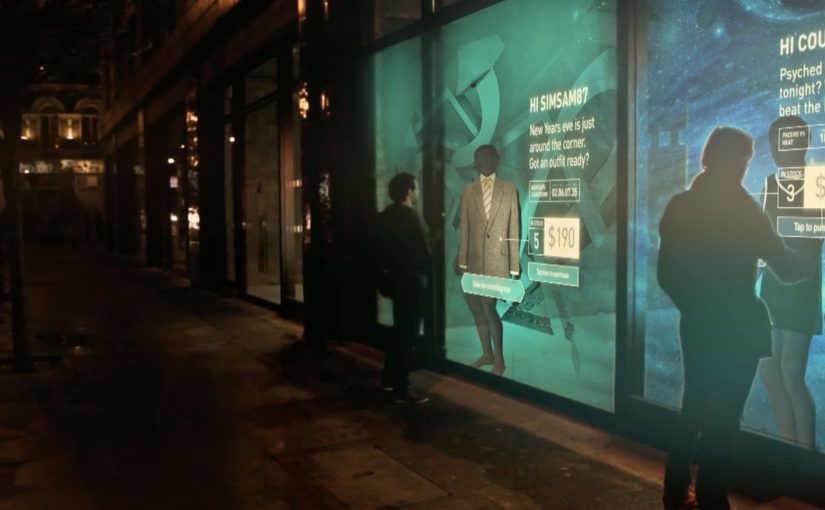
The Adaptive Storefront: BLE Retail Display

The Adaptive Storefront: BLE Retail Display

Shop windows, billboards, bus stops, and car showrooms do not have to be passive experiences. In the video below, a prototype interactive digital display adapts to whoever stands in front of it.

The display identifies shoppers using Bluetooth Low Energy (BLE) and reacts to personal data stored on the shopper’s mobile device, such as shopping habits and preferences. Shoppers can swipe through personalised content, place items in a virtual shopping cart, and purchase straight from the display.

When glass turns into a shoppable interface

This “adaptive storefront” concept takes a familiar retail surface and makes it behave like a storefront UI. Here, “adaptive storefront” means the window can recognise a nearby device via BLE and change what it shows based on data available on that device. Not a poster. Not a looped video. A live interface that changes per person and lets you complete an action while you are still in that high-intent moment of attention.

How the prototype behaves in front of a shopper

  • Detect. BLE proximity is used to recognise that a specific shopper is present.
  • Adapt. The display adjusts what it shows based on data available on the shopper’s phone.
  • Let the shopper drive. Swiping changes what is on screen, rather than forcing a fixed sequence.
  • Close the loop. Items can be added to a cart and purchased directly from the display.

In physical retail environments, the storefront is the first high-attention interface a brand controls before a shopper reaches the shelf.

Why it lands

Because the display can recognise a nearby device and accept input on the surface, it compresses discovery, consideration, and purchase into one interaction. The value is not the novelty of a “smart window”. It is the reduction of steps between interest and action, while the shopper’s intent is still fresh. The real question is whether you can do that with clear permission and control, not silent personalisation.

Extractable takeaway: A surface becomes valuable when it combines context with immediate action. Personalisation only earns its keep when it removes friction and helps a shopper decide faster, not when it merely looks clever.

What it is really trying to unlock for brands

Behind the demo is a clear ambition. Turn high-footfall surfaces into conversion surfaces. If the experience is permissioned and useful, it can bridge the gap between physical browsing and digital checkout without forcing a shopper to open an app, search, and start over.

That also hints at a measurement upgrade. A storefront that can be interacted with can be instrumented. What people swipe. What they ignore. What they add. Where they drop. That is a very different feedback loop than counting impressions.

Practical takeaways for adaptive storefronts

  • Start with one job-to-be-done. For example, “help me shortlist”, “show me what is in stock”, or “let me buy in two taps”.
  • Make control obvious. If swiping is the interaction, design the UI so people understand it in one second.
  • Keep data minimal and on-device. Use only what is needed to improve relevance, and avoid making the experience feel intrusive.
  • Design for the environment. Glare, distance, dwell time, and group behaviour change everything compared to mobile UX.
  • Plan the opt-in moment. The experience works best when the shopper understands why the screen adapts and what they get in return.

A few fast answers before you act

What is an “adaptive storefront” in plain terms?

It is a storefront display that changes what it shows based on who is standing in front of it, and lets the shopper interact and buy directly on the surface.

Why use BLE for this type of experience?

BLE enables low-power proximity detection, so a display can recognise a nearby device and trigger the right experience without requiring scanning a code each time.

What data is needed to personalise the display?

Only enough to improve relevance. For example, stated preferences, browsing history, or saved items, ideally kept on the shopper’s phone and shared with clear permission.

What makes this feel useful instead of creepy?

Permission, transparency, and value. The shopper should understand what is happening, control it, and get something meaningfully better than a generic screen.

What should you measure in a pilot?

Opt-in rate, interaction rate, add-to-cart rate, conversion rate, and whether the experience reduces time-to-decision without increasing drop-off.

Nissan NISMO Watch

Nissan NISMO Watch

To say the smartwatch industry is on the verge of exploding would be an understatement. Consumer electronics companies and chip makers are not the only players entering the wearable tech space. Nissan recently announced it is joining the fray too, with what it bills as the first smartwatch concept to connect the car and driver.

There are already a number of smartwatches on the market, including Pebble, i’m Watch, Sony SmartWatch 2 and Samsung Galaxy Gear. But out of all of them, this is the coolest looking and it actually maps to a real use case for Nissan performance fans.

Nissan is scheduled to show off the device, dubbed the Nissan NISMO Watch, at the Frankfurt Motor Show. From the video it looks pretty awesome, so I cannot wait to see it when I visit the Frankfurt Motor Show next week.

What the NISMO Watch is trying to do

Nissan positions the watch as a bridge between driver and car. The concept is designed to connect via a smartphone app using Bluetooth Low Energy, a low-power wireless connection, and surface data that drivers and track-day fans care about, such as average speed and fuel consumption, plus broader vehicle telematics, meaning sensor and usage data from the car, and performance information.

It also leans into biometrics. The concept includes a heart rate monitor, framing the watch as a way to understand not only the car’s performance, but the driver’s state too.

In automotive performance culture, wearable concepts like this are as much about brand signaling as they are about immediate product rollout.

Why this is a smart brand move

NISMO is Nissan’s performance identity. A watch is a compact, always-visible object that can carry that identity beyond the car itself. If you can make “performance data” feel personal and wearable, you turn a brand into a daily habit, not only a purchase decision.

Extractable takeaway: When your differentiator is performance data, make it personal and habitual by packaging it as something people wear between driving moments.

The concept also stretches beyond driving. Nissan’s own materials describe a “social performance” layer, where the watch can track activity across major social networks. Even if that is more provocative than practical, it makes the point: the watch is meant to be a connected lifestyle object, not only a dashboard mirror.

The real question: usefulness vs distraction

The real question is whether this becomes useful insight or a new source of distraction. Anything that surfaces data while driving needs restraint. The best version of this idea is “track-day and post-drive insight”, not “more screens in motion”. If the watch becomes a reason to look away from the road, the concept backfires.

Steal-worthy moves for performance-product marketers

  • Export the benefit into a new object. If your differentiator is hard to demo, move it into something people can touch and wear.
  • Combine machine data with human data. “Car telemetry plus biometric state” is a stronger story than either alone.
  • Make the design do half the selling. If it looks like performance gear, people will want to try it before they understand the spec sheet.
  • Keep the experience context-safe. Design interactions for before and after driving, not during critical moments.

A few fast answers before you act

What is the Nissan NISMO Watch?

It is a smartwatch concept Nissan unveiled for its NISMO performance brand, positioned as a way to connect driver and car by showing vehicle performance data and driver biometric data.

How does the watch connect to the car?

Nissan’s release describes connecting via a smartphone app using Bluetooth Low Energy, so the watch can receive telemetry and performance information.

What kind of data does it show?

Reported features include average speed and fuel consumption, access to vehicle telematics and performance data, and biometric capture via a heart rate monitor.

Why would an automaker build a smartwatch concept?

Because it signals innovation, extends the brand into daily life, and creates a tangible way to talk about connected-car data and performance identity beyond the vehicle.

What is the biggest risk with wearables tied to driving?

Distraction. Any design that encourages glances during driving can be unsafe, so the value needs to skew toward track use and post-drive insights.