
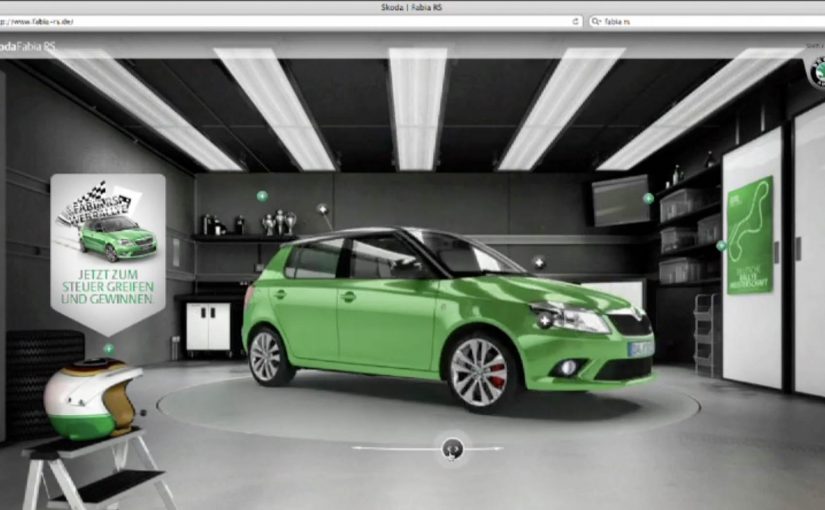
Skoda has just released a rally-based, augmented reality test drive for the Fabia RS. Here, “augmented reality test drive” means an AR overlay combined with a live webcam feed so you appear inside the cockpit view. The hook is simple and instantly personal: you become the driver, right down to a helmet view that pulls your face in via the webcam.
A rally fantasy built on a very real webcam
The execution borrows the language of motorsport. Helmet cam framing, tight cockpit perspective, and the feeling that you are inside the run rather than watching an ad.
Mechanically, the idea is an AR layer plus a live camera feed. The interface does not just show the car. It places you into the experience so the “test drive” feels like a game you are starring in.
In European automotive launch teams, webcam-first interactivity can differentiate faster than another spec-led asset.
In automotive launches where feature parity is high, interactive test drives create faster differentiation than another spec sheet or beauty film.
Why the helmet view is the smartest detail
Most virtual test drives keep the viewer outside the car. This one pulls the viewer into the cockpit, which changes the emotional contract. You are no longer evaluating. You are participating.
Extractable takeaway: Move the viewer from evaluator to participant, and the demo becomes something they remember and share without being asked.
That participation is what makes the concept naturally shareable, even without shouting for shares. People want to show the version where their own face is in the helmet view, because it is proof they “did the thing.”
What the brand is really reinforcing
The real question is whether the experience makes performance identity feel personal, not just visible.
On the surface, it is a playful rally twist. Underneath, it signals performance identity. The Fabia RS is framed as a car with motorsport DNA, not just a faster trim level.
The AR wrapper also makes an implicit promise: this is a modern car for people who like modern interfaces. The experience becomes a proxy for the product personality.
How to borrow the webcam POV trick
- Make the viewer the protagonist, not just the audience. Webcam and POV tricks do more than cinematic polish.
- Choose one unmistakable motif that communicates the category story fast, here it is rally and helmet cam.
- Turn “try” into “play” so the time spent feels like entertainment, not evaluation.
- Design a single talkable detail people can retell in one sentence, for example “it pulls your face into the helmet view.”
A few fast answers before you act
Is this more ad or more game?
It sits in the middle. The structure behaves like a lightweight game, while every element points back to a single product identity, rally performance.
What is the core mechanism that makes it work?
Personalization through webcam plus a strong point-of-view frame. The experience feels like it is happening to you, not in front of you.
Why does AR help here, instead of just a normal virtual drive?
AR adds “presence.” It creates the feeling of being inside the moment, which is harder to achieve with a standard video or configurator flow.
What is the biggest execution risk with webcam-based experiences?
Friction and permission. If setup is clunky or people feel uncertain about using the camera, completion drops fast. The first 10 seconds must feel safe and effortless.
What is the transferable lesson for other categories?
Put a real person into the proof. When the viewer’s face, voice, or choices become part of the demo, the demo becomes content people want to share.