
McDonald’s: Everyone Saves for Something

When a low price becomes a citywide signal

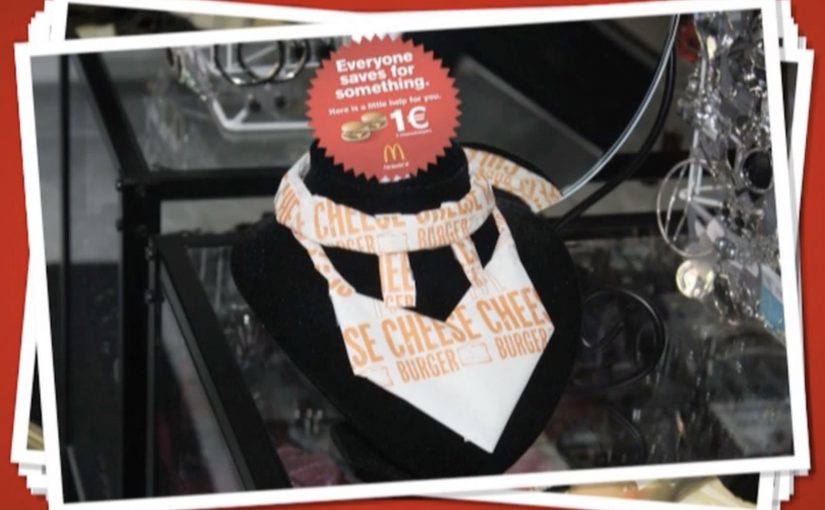
McDonald’s and ad agency DDB Budapest launched a campaign to promote an offer of two cheeseburgers for one Euro. The positioning is simple. A price so low it gives the target audience room to save for things they want.

The twist: turn wrapping paper into media

The challenge is standing out from the usual low-price playbook. Instead of shouting numbers louder, the campaign uses the most recognizable asset McDonald’s already owns. Its iconic cheeseburger wrapping paper.

They wrap “cool stuff” in the same paper, partner with different shops around the city, and turn those places into unusual touchpoints that visually encode the offer without needing to repeat the offer everywhere.

In European QSR value campaigns, price messaging sticks better when it is turned into a tangible object people encounter in everyday places.

The real question is how you make a low-price offer feel noticeable without turning it into just another louder discount ad.

Why it lands

This works because it makes value feel physical. The stronger move is to let a distinctive brand asset carry the value message instead of repeating the price claim more aggressively. People are trained to ignore price claims, but they notice an object that looks out of place. The wrapping paper acts like a visual shortcut. If you recognize it, you decode the brand instantly. If you do not, you still feel the oddness and look closer. The partner locations add credibility because the idea appears to have “escaped” the ad slot and entered the city.

Extractable takeaway: If your message is “cheap,” avoid saying “cheap” more often. Use a distinctive brand asset as a portable visual language, then place it where people already shop, browse, and compare.

What to steal from this value stunt

  • Make one brand asset do the heavy lifting. A recognizable wrapper can outperform another headline about price.
  • Build distributed touchpoints. Partner locations create repeated exposures that do not feel like repeated ads.
  • Let the audience complete the message. Recognition is satisfying. It increases memorability with less copy.
  • Keep the offer legible, but not loud. The stunt earns attention. The offer converts it.

A few fast answers before you act

What is “Everyone Saves for Something” for McDonald’s?

It is a value campaign that promotes an ultra-low cheeseburger deal by wrapping everyday objects in McDonald’s iconic cheeseburger paper and placing them across partner shops as unusual city touchpoints.

What is the core mechanic?

Use distinctive packaging as a portable visual language, then deploy it outside the restaurant to make the offer feel present across the city.

Why does wrapping objects work better than another price poster?

Because it turns a price message into a curiosity trigger. People notice the anomaly first, then decode the brand and offer.

What’s the transferable principle for other brands?

If your message is functional and easy to ignore, embed it inside a recognizable asset and place it where people already make choices.

What is the main risk with this approach?

If the asset is not instantly recognizable, or the placements feel random, the idea becomes decoration instead of a decodable message.

Go Vote: Or You Let Others Decide

An integrated experience-based campaign was created by DDB Budapest on behalf of the Hungarian Democracy to support the 2010 Hungarian elections.

Instead of relying only on posters and TV spots, the idea is built around lived moments that make one point unavoidable: if you do not vote, you still get an outcome. You just did not choose it.

When “apathy” becomes something you can feel

The line “go vote, or you let others decide for you” is easy to agree with in theory, and easy to ignore in practice. The creative move here is to stop arguing and start staging: put people into situations where “someone else decides” is no longer an abstract civic warning, but an immediate, personal experience.

The mechanic: make the consequence tangible

The campaign uses real-world experiences as the delivery system. The experience is the message: you lose control when you opt out. That emotional truth lands faster than any rational explanation of why voting matters.

In public-interest communication, experience-led campaigns often work best when they translate a distant consequence into a simple, physical moment.

Why it lands: it reframes voting as self-protection

Many turnout messages talk about duty. This approach talks about ownership. The real question is not whether people agree that voting matters, but whether the campaign makes the cost of opting out feel personal enough to trigger action. The stronger strategy is to make non-participation feel immediate, not just irresponsible. It positions voting less as a moral obligation, and more as the minimum action required to keep your right to choose.

Extractable takeaway: If you need mass behavior change, do not just explain the benefit. Stage a short, memorable moment that lets people experience the cost of inaction. When the cost feels personal, the call-to-action becomes easier to act on.

The intent: turnout through a stronger trigger than guilt

The business of any election participation push is motivation. This work is a reminder that motivation does not need to be inspirational. It can be visceral. A compact experience can achieve what a long message cannot: it creates a story people retell, and that story carries the prompt forward.

What to steal for your own participation campaign

  • Start with a single, sharp sentence: one idea, no debate, no footnotes.
  • Translate the idea into an experience: let people feel the message before you ask them to act.
  • Keep it non-partisan by design: focus on participation, not outcomes or parties.
  • Make it retellable: if someone can describe it in one line, it will travel further.
  • Reduce the distance to action: the closer the experience sits to the voting moment, the stronger the conversion.

A few fast answers before you act

What kind of campaign is this?

It is a get-out-the-vote public awareness campaign that uses real-world experiences to dramatize the idea that non-participation still produces outcomes.

Why use experiences instead of just ads?

Because experiences create emotion, memory, and conversation quickly. They can make an abstract civic point feel immediate and personal.

How do you keep a turnout campaign non-partisan?

Keep the message focused on participation, avoid references to parties or policies, and design the experience around the universal right to choose.

What should you measure for effectiveness?

Reach and recall are basics. More useful are participation rates in the experience, social sharing, earned media pickup, and any localized uplift signals available near the activation footprint.

When can this approach backfire?

If the experience feels humiliating, unsafe, or coercive, it can trigger resentment. The best versions create urgency without disrespecting the audience.