iFOLD: Fold More, Save Paper

Billions of business envelopes are used every day. Imagine how much paper can be saved if we just halved their size.

So while posting a letter, ask: can it be folded once more. If it can, fold more.

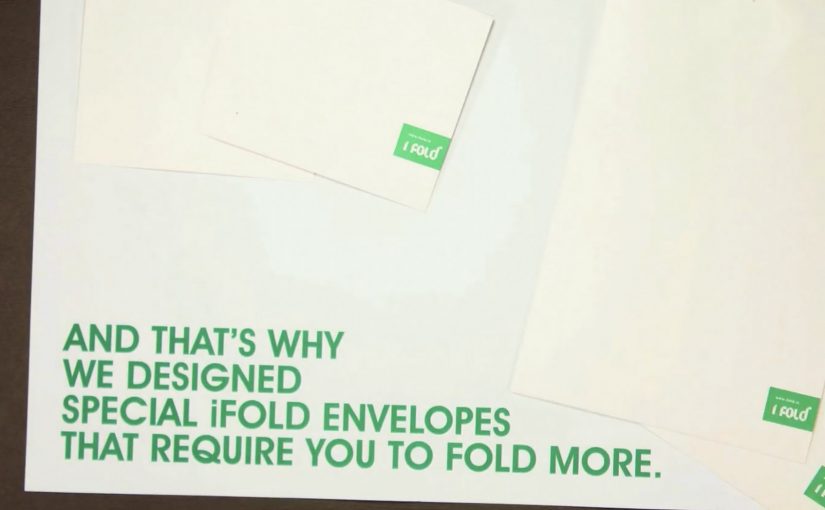
Use a smaller envelope. Save trees. It’s that simple. It’s called iFOLD.

A tiny behavior change, packaged as a system

The mechanism is effort-to-impact math: a simple rule where one extra fold creates a visible downstream saving. One extra fold reduces envelope size. Reduced envelope size reduces paper consumption. That works because the cause and effect are easy to understand immediately, so the behavior feels practical rather than preachy. The campaign frames this as a repeatable rule anyone can apply without new infrastructure or technology.

In high-volume corporate mailrooms and customer communications, small process changes compound into meaningful material savings.

The real question is how to turn a trivial action into a default business habit. The smart move is to build the fold into standard mailing practice, not treat it as a one-off reminder.

Why it lands

This works because it does not ask for a lifestyle shift. It asks for a micro-habit that fits inside existing routines. The instruction is binary, memorable, and immediately testable. You can literally try it with the next letter in your hand.

Extractable takeaway: When you want behavior change at scale, give people a single, repeatable decision rule that requires almost no extra effort, and make the benefit feel cumulative and obvious.

Steal this envelope logic

  • Make the rule portable: one sentence people can remember and repeat.
  • Target a high-frequency routine: boring, repetitive processes are where scale lives.
  • Prefer “do this instead” over “stop doing that”: substitution habits stick better than abstinence messages.
  • Connect the micro to the macro: one fold feels trivial. Aggregate savings makes it feel worth doing.
  • Design for adoption inside organizations: the best ideas fit procurement, operations, and compliance realities.

A few fast answers before you act

What is iFOLD?

iFOLD is a paper-saving idea that encourages people to fold letters one extra time so they can be mailed in smaller envelopes.

Why focus on envelope size?

Because envelopes are used at massive volume in business and government. Small reductions per unit add up quickly at scale.

What makes this a strong sustainability message?

It is a concrete action, not an abstract appeal. People can do it immediately without buying anything new.

Where does this work best?

In organizations that send large quantities of letters and statements, where a standard change in folding and envelope formats can be implemented consistently.

What could prevent adoption?

Template constraints, inserts that cannot be folded further, window placement, and operational inertia. The idea works best when mail formats are designed with folding flexibility in mind.
LavOnline: Tomato Splat

A direct mail piece that dares you to make a mess

In Italy, awareness and penetration of online laundry services is described as low. LavOnline asked DDB Milan to build awareness and engagement by stressing two core benefits. Speed and simplicity.

The target was narrowed to young managers and professionals. People who work long hours and struggle to find an open shop after leaving the office. The solution was a playful direct mail pack sent to 1,000 time-strapped recipients that turns “laundry” into an action you can do in seconds.

The mechanic: splat a tomato, watch it spring back

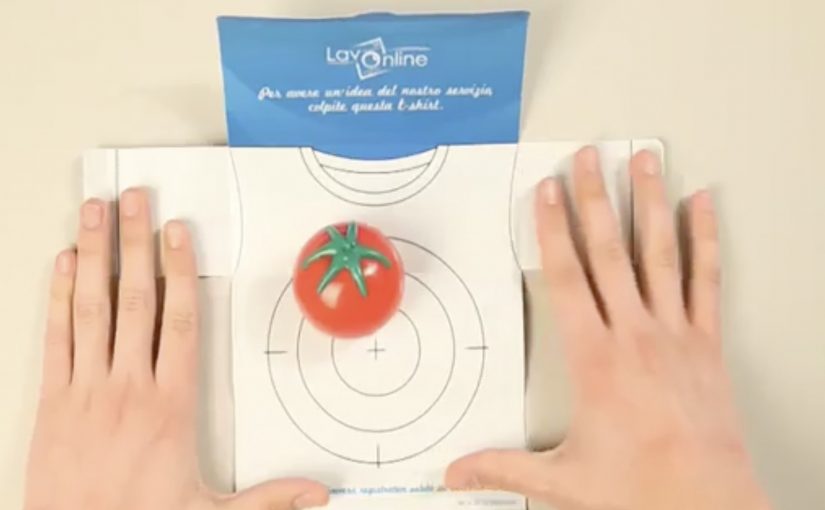
The mailer opens into a white t-shirt shape with a target at the center. Inside is a squishy tomato toy that recipients are encouraged to splat. The toy “splat” moment creates a satisfying mess, then reforms back into a neat tomato, mirroring the promise of a fast, simple service that handles stains without fuss.

Recipients are then pushed to act. If they enjoyed the experience, they are prompted to register on www.lavonline.it, try the service, and tell friends.

In consumer services marketing, interactive direct mail can outperform broad awareness when the physical action demonstrates the product promise faster than a paragraph of copy can.

Why it lands

The idea is built around a smart contradiction. To sell “no hassle laundry,” you briefly invite the audience to create hassle on purpose. That tension makes the piece memorable, and the reset behavior turns the metaphor into proof. It is also office-friendly. It sits on a desk, attracts curiosity, and naturally recruits secondary viewers who want to try the splat for themselves.

Extractable takeaway: If your promise is “simple and fast,” build a physical interaction that creates a tiny problem, then resolves it instantly. The resolution is the message people remember.

What the numbers are trying to prove

Results are reported as unusually strong for a targeted mailer. Within four weeks, 32% of recipients registered, 8% tried the service, and overall site traffic increased by 15%. The bigger point is not the percentages. It is that a single tactile mechanic turned a low-awareness category into a story people wanted to repeat. The real question is how to make an invisible service feel tangible before asking for sign-up. This is a stronger awareness play than a conventional mailer because the interaction makes the service promise feel real.

What to borrow from Tomato Splat

  • Make the benefit physical. Do not describe speed and simplicity. Demonstrate them with an action that resolves fast.
  • Target by daily friction. “No time after work” is a sharper trigger than broad demographics.
  • Design for desk spread. If the object invites a second person to try it, your reach multiplies inside the office.
  • Keep the CTA immediate. One link, one next step, no extra explanation required.

A few fast answers before you act

What is LavOnline’s “Tomato Splat” campaign?

It is an interactive direct mail activation where a mailed pack invites recipients to “splat” a tomato toy on a t-shirt target, then uses that quick reset metaphor to promote a fast, simple online laundry service.

Why use a physical mailer for an online service?

Because the physical interaction creates attention and memory in a category people ignore, then funnels that attention to a single online registration step.

What is the core creative mechanic in one line?

Create a small mess, then instantly restore order. A tactile metaphor for stain removal and convenience.

Why does this work for busy professionals?

The interaction is fast, playful, and office-compatible, and it speaks directly to the “no time after work” friction that blocks traditional laundry trips.

What is the main transferable principle?

When your value proposition is experiential, make the audience perform a micro-version of the experience, then connect it to a frictionless next step.

GGRP: Cardboard Record Player Mailer

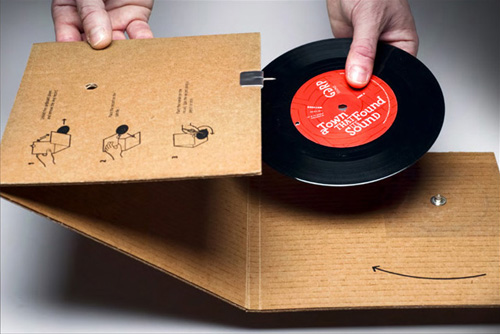
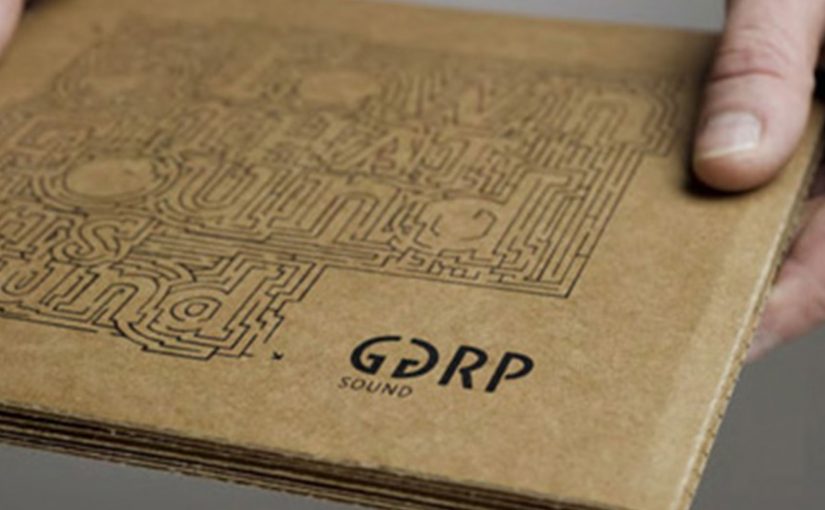
Grey Worldwide in Vancouver created a record player from a piece of corrugated cardboard that folds into an envelope.

GGRP Mailer Open

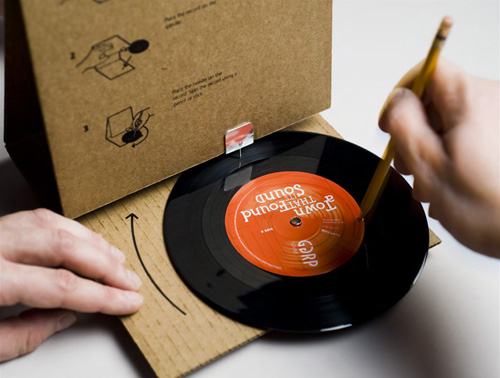
Once assembled, a record can be spun on the player with a pencil. The vibrations go through the needle and are amplified in the cardboard material.

GGRP Mailer CD

The players were sent out to creative directors across North America as a creative demonstration of GGRP’s sound engineering capabilities.

A demo you can literally feel

This is direct mail that behaves like the product promise. Not a brochure about audio craft, but a physical object that turns vibration into sound in your hands. It creates a moment of discovery before you even think about the brand. Then the brand gets credit for making it work.

How the mechanism does the selling

The sleeve folds into a small phonograph. A pencil becomes the spindle. A simple needle converts the grooves into vibration, and the cardboard body acts as the amplifier. No power, no app, no explanation-heavy setup, just a working proof-of-concept hidden inside a mailer.

Here, proof-of-concept means the mailer itself demonstrates the capability before any sales conversation starts. In B2B creative services, the strongest new-business work is often a tangible demo that turns capability into an experience. Because the recipient has to assemble it and hear it working, the mechanism turns a technical claim into remembered evidence. The real question is whether your outreach proves the craft fast enough to earn a second look.

Why it lands with creative directors

It respects the audience. Creative directors do not need to be told what “sound engineering capabilities” means. They need to feel that the shop thinks differently and executes cleanly. The format also earns time. You do not skim it. You assemble it. That extra time is the real attention premium.

Extractable takeaway: When you sell an invisible craft, build a self-contained artifact that proves it in one minute. The artifact becomes your credibility layer, and your follow-up becomes welcome instead of intrusive.

What this mailer teaches about demo design

  • Make the medium the proof. If it does not demonstrate the promise, it is just packaging.
  • Design for a single “aha”. One clear moment beats multiple clever details.
  • Keep the setup friction low. If it takes instructions to start, the audience drops.
  • Target a specific recipient role. This is built for decision-makers who value craft signals.

A few fast answers before you act

What makes this mailer different from a typical promo piece?

It is not a message about capability. It is a working demonstration that the recipient assembles and experiences immediately.

Why is cardboard the right material choice here?

It is cheap to distribute, easy to fold into a mail format, and it can physically amplify vibration, which makes the “sound craft” claim believable.

What is the main business objective of an object like this?

To create high-quality recall and conversation with a small, high-value target list, rather than broad reach.

What is the biggest execution risk?

If the object does not work reliably, the demo backfires. The entire idea depends on the “it actually plays” moment.

How can other B2B brands apply the same pattern?

Translate your capability into a simple physical demo that proves the benefit without needing explanation, then send it only to the people who can buy.