
Fundación Altius: Message in a Bottle

Fundación Altius: Message in a Bottle

Fundación Altius (Altius Foundation) runs education support for children in Latin America, and Leo Burnett Iberia builds a fundraising action around a simple, loaded object. A bottle that carries a message.

The case film frames it as a direct marketing idea where the bottle itself becomes the medium. It turns “support education” from an abstract appeal into a tangible artifact people can notice, hold, and pass along.

How Message in a Bottle turns packaging into fundraising

The mechanism is presented as promotional packaging used as a donation trigger. Instead of relying on a poster or a banner to explain the need, the action uses a familiar container and a clear message to pull attention toward the cause, then convert that attention into money for education.

In European cause and charity communications, physical objects still outperform pure awareness copy when the goal is to move someone from empathy to action.

Why it lands

A bottle is instantly readable. It signals “take me”, “open me”, “share me”. That makes it a natural carrier for a cause message because it invites interaction without asking for it. When the fundraising mechanism is embedded in a physical cue, people do not feel like they are entering a campaign. They feel like they are responding to something human.

Extractable takeaway: If you need donations, compress the story into a single object with one clear behavior attached to it. The object becomes both the message and the moment of conversion.

What this kind of action is optimized for

This is designed to work in the messy middle of everyday life, where people do not stop for “awareness”. Here, the messy middle means the in-between moments where people are busy, distracted, and not actively looking for a cause to support. A direct marketing action that lives on an object can travel further than its media buy, because the object itself carries the pitch into new contexts.

The real question is whether your cause can be reduced to one object and one behavior without losing meaning. For donation-driven work, object-led asks are stronger than awareness-led messaging when the job is immediate response.

What to steal for your own nonprofit or CSR work

  • Attach the ask to something people already touch. Physical interaction reduces friction compared with “go to a site and read”.
  • Keep the message single-minded. One object. One message. One intended next step.
  • Make the object do the explaining. If you need a paragraph to understand the mechanic, it will not scale.
  • Build for redistribution. The best fundraising artifacts are easy to pass on, not just easy to notice.

A few fast answers before you act

What is Message in a Bottle in one sentence?

A fundraising action for Fundación Altius where a bottle and its message act as the direct marketing device that nudges people to donate toward children’s education.

Why use packaging or a physical artifact for a charity ask?

Because objects create a natural pause. They are handled, noticed, and shared, which can move people from passive sympathy to a concrete action faster than awareness media.

What makes this different from a standard donation campaign?

The medium is also the mechanism. The object carries the story and cues the behavior, so the “how to help” is not separate from the “why to help”.

What is the main risk in copying this approach?

If the object is clever but the donation pathway is unclear, attention gets spent without conversion. The artifact must lead cleanly to giving.

When does this approach work best?

It works best when the cause can be expressed through one obvious object and one obvious next step. If people need too much explanation before they understand what to do, the artifact loses its power.
LavOnline: Tomato Splat

LavOnline: Tomato Splat

A direct mail piece that dares you to make a mess

In Italy, awareness and penetration of online laundry services is described as low. LavOnline asked DDB Milan to build awareness and engagement by stressing two core benefits. Speed and simplicity.

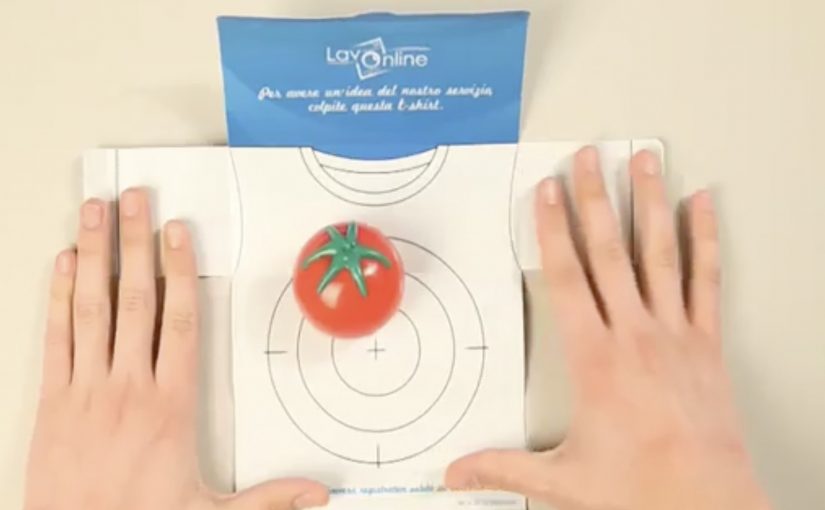
The target was narrowed to young managers and professionals. People who work long hours and struggle to find an open shop after leaving the office. The solution was a playful direct mail pack sent to 1,000 time-strapped recipients that turns “laundry” into an action you can do in seconds.

The mechanic: splat a tomato, watch it spring back

The mailer opens into a white t-shirt shape with a target at the center. Inside is a squishy tomato toy that recipients are encouraged to splat. The toy “splat” moment creates a satisfying mess, then reforms back into a neat tomato, mirroring the promise of a fast, simple service that handles stains without fuss.

Recipients are then pushed to act. If they enjoyed the experience, they are prompted to register on www.lavonline.it, try the service, and tell friends.

In consumer services marketing, interactive direct mail can outperform broad awareness when the physical action demonstrates the product promise faster than a paragraph of copy can.

Why it lands

The idea is built around a smart contradiction. To sell “no hassle laundry,” you briefly invite the audience to create hassle on purpose. That tension makes the piece memorable, and the reset behavior turns the metaphor into proof. It is also office-friendly. It sits on a desk, attracts curiosity, and naturally recruits secondary viewers who want to try the splat for themselves.

Extractable takeaway: If your promise is “simple and fast,” build a physical interaction that creates a tiny problem, then resolves it instantly. The resolution is the message people remember.

What the numbers are trying to prove

Results are reported as unusually strong for a targeted mailer. Within four weeks, 32% of recipients registered, 8% tried the service, and overall site traffic increased by 15%. The bigger point is not the percentages. It is that a single tactile mechanic turned a low-awareness category into a story people wanted to repeat. The real question is how to make an invisible service feel tangible before asking for sign-up. This is a stronger awareness play than a conventional mailer because the interaction makes the service promise feel real.

What to borrow from Tomato Splat

  • Make the benefit physical. Do not describe speed and simplicity. Demonstrate them with an action that resolves fast.
  • Target by daily friction. “No time after work” is a sharper trigger than broad demographics.
  • Design for desk spread. If the object invites a second person to try it, your reach multiplies inside the office.
  • Keep the CTA immediate. One link, one next step, no extra explanation required.

A few fast answers before you act

What is LavOnline’s “Tomato Splat” campaign?

It is an interactive direct mail activation where a mailed pack invites recipients to “splat” a tomato toy on a t-shirt target, then uses that quick reset metaphor to promote a fast, simple online laundry service.

Why use a physical mailer for an online service?

Because the physical interaction creates attention and memory in a category people ignore, then funnels that attention to a single online registration step.

What is the core creative mechanic in one line?

Create a small mess, then instantly restore order. A tactile metaphor for stain removal and convenience.

Why does this work for busy professionals?

The interaction is fast, playful, and office-compatible, and it speaks directly to the “no time after work” friction that blocks traditional laundry trips.

What is the main transferable principle?

When your value proposition is experiential, make the audience perform a micro-version of the experience, then connect it to a frictionless next step.

STIHL: The Self-Tearing Autumn Calendar

STIHL: The Self-Tearing Autumn Calendar

STIHL asked Euro RSCG Germany to develop a business gift promoting its range of leaf blowers. The target audience was international key accounts, and the brief was clear: create something they had never seen before.

Euro RSCG invented an autumn calendar that tears off its “leaves” automatically. The gag is that the calendar behaves like a tree in fall, dropping leaves without you touching it, and making the “clean-up problem” feel immediate and slightly annoying. Exactly the moment where a leaf blower becomes the satisfying solution.

How the product demo is baked into the gift

The mechanism is pure physical storytelling: an object that creates a small mess on schedule. Each day, another leaf falls. Over time, the pile builds. The calendar turns passing time into accumulating clutter, so the product need is not explained, it is experienced.

In B2B product marketing, tactile gifts are most effective when they are not branded trinkets but working demonstrations of the problem the product solves.

The real question is whether your demo makes the problem felt without a salesperson in the room.

Why it lands

It turns a convenience category into felt relief from a recurring irritation, and it does it repeatedly through a daily trigger that keeps resurfacing without loud branding.

Extractable takeaway: B2B gifts perform when they create a recurring micro-problem that mirrors the customer’s real pain, then let the product category be the obvious, satisfying fix.

  • It makes necessity visible. Leaf blowers are often sold as convenience. This calendar reframes them as relief from a recurring irritation.
  • It creates repeated moments, not a one-time impression. A calendar is a month-long touchpoint. The idea keeps resurfacing every day the “leaf” drops.
  • It respects the key-account audience. The gift is novel, engineered, and story-worthy. It earns attention without needing loud branding.

Borrow this mechanic for B2B demos

  • Turn time into a narrative device. Calendars, subscriptions, and scheduled triggers are built for repeat exposure.
  • Create a controlled irritation. A controlled irritation is a small, reversible annoyance that stays playful. The best demos let people feel the problem in a safe, playful way.
  • Make the object retellable. If the recipient can explain it in one sentence, it becomes a story they share inside the company.

A few fast answers before you act

What is the “autumn calendar”?

A calendar designed so its leaf-shaped pages tear off automatically, mimicking falling leaves and creating a small daily mess.

Why does that sell leaf blowers?

Because it dramatizes the nuisance of accumulating leaves and makes the “cleanup solution” feel immediate and obvious.

Who was this made for?

International key accounts, as a business gift intended to be novel and memorable rather than a standard brochure or giveaway.

What makes this a strong example of B2B creativity?

The gift demonstrates the problem through behavior, not messaging. It earns repeated attention through daily interaction.

What is the transferable lesson?

If you can make the pain point show up physically and repeatedly, you reduce the need for persuasion. The demo does it for you.