
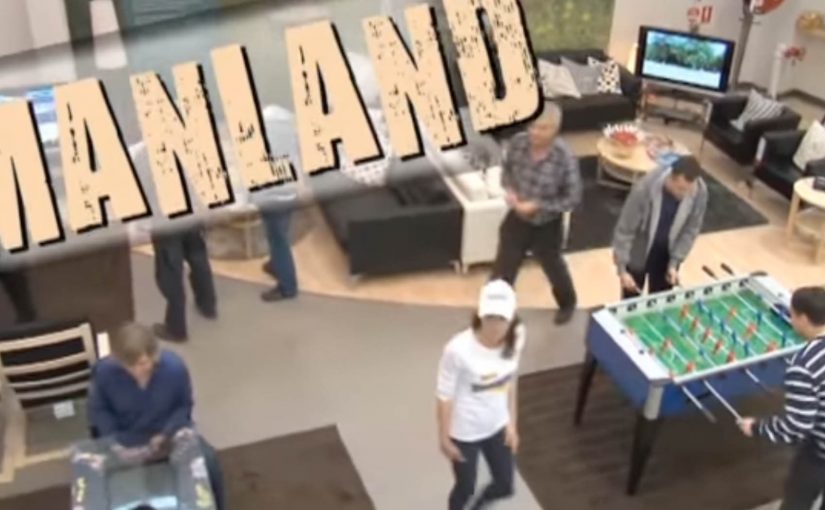
Last month IKEA in Sydney, Australia ran a four-day trial of Manland. They created a dedicated area in the store which men with short retail attention spans could use to escape the pains of weekend shopping at IKEA. In simple words, it was day-care for husbands and boyfriends who wanted to take a break from the shopping.
The store offered free hot dogs, Xbox consoles, pinball machines and nonstop sports action on TV. IKEA even handed out buzzers so women would get reminded to come back and pick up their men after a short session.
Turning “waiting time” into a branded service
Manland works because it is not pretending men suddenly love shopping. It acknowledges the reality. Some people will be there for the relationship, not the retail. So IKEA reframes the pain point as a service, the same way Småland turns “kids are restless” into a solved problem.
The mechanism is deliberately low-effort. You do not need an app, a QR code, or an explanation. You just drop in, decompress, and rejoin the trip with less friction and fewer arguments.
In big-box retail, weekend shopping is often a couple activity, and boredom is a conversion killer for the accompanying partner.
Why this becomes press, not just a gimmick
It is instantly legible. A “day-care for men” is a headline. The imagery does the distribution work. Consoles, sports, hot dogs, and a buzzer are all recognisable symbols, so the concept travels across cultures even if you have never been to an IKEA.
Extractable takeaway: If you want earned media from an in-store experience, design one idea that reads in a single photo and a single sentence.
It is also slightly provocative, which helps. People argue about whether it is funny, patronising, or brilliant. That debate is oxygen for earned media.
The business intent: protect dwell time and reduce walk-outs
The practical goal is simple. Keep groups in-store longer, reduce the urge for someone to storm out, and make the trip feel easier, especially on peak weekend traffic. The PR upside is a bonus. But the operational benefit is the real value.
The real question is whether you can remove that boredom without turning the idea into a stereotype.
If your store relies on group shopping, design for the bored companion as deliberately as you design for the primary buyer.
Steal the companion-lounge playbook
- Solve a real friction. If it does not remove pain, it will not spread.
- Make the rules obvious. The best retail ideas need zero onboarding.
- Build a “photo truth”. If the experience photographs well, it earns its own distribution.
- Use time limits to keep it fair. A short session keeps it accessible and stops it becoming a hangout that blocks capacity.
A few fast answers before you act
What was IKEA Manland?
Manland was a short trial inside an IKEA store in Sydney. It offered a staffed, game-and-sports lounge where men could take a break while their partners shopped.
Why did the buzzer matter?
The buzzer turned “come back later” into a simple timing system. It made pickup predictable and helped manage capacity without complicated queueing.
Is this primarily an ad idea or an operations idea?
Both. It is an operations idea that creates PR. The experience removes friction inside the store, then the simplicity of the concept turns it into a shareable story.
What makes this kind of activation risky?
Stereotypes. If the tone feels insulting or dated, the press flips from amused to critical. The safest version is to frame it as optional decompression, not a judgment.
What should you measure if you do something similar?
Dwell time, drop-off rates, and satisfaction in exit feedback. For comms, track earned pickup and social sharing, but only after the in-store metrics look healthy.