
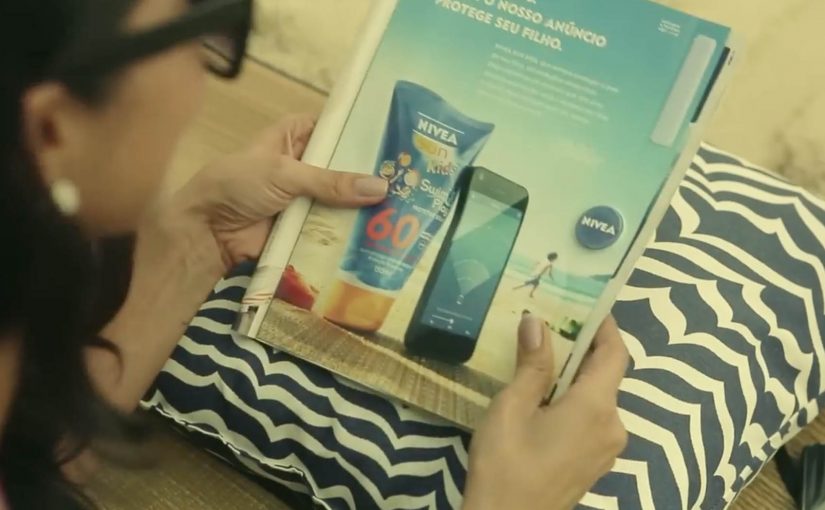
Last year NIVEA transformed a regular print ad into a portable solar charger for smartphones. Now in its latest ad, NIVEA has made the right side detachable, so people on the beaches of Brazil can use it as a trackable bracelet.
Parents who want to keep an eye on their children can rip off the bracelet, attach it to a child’s arm, and then download the companion app. In the app, they can add each child’s name and set the maximum distance each child can wander. If a child goes too far, the app sends a loud alert.
From print to proximity
The clever part is that it is not just a “detachable freebie”. The bracelet is described as embedding Bluetooth proximity tech, so the printed unit becomes a functional signal that a phone can detect and monitor.
In FMCG innovation, utility-based media works best when the object removes a real anxiety in the exact moment the product is used. Utility-based media here means an ad unit that doubles as a small tool people use right away.
The real question is whether the utility you build into the media unit is reliable enough to earn trust when the anxiety spikes.
Why the idea lands on the beach
NIVEA’s product promise is protection, but protection on a beach is not only about skin. It is also about the panic of losing sight of a child in a crowded, noisy, high-movement environment. The bracelet reframes the brand benefit from a claim to a service. This works because it shifts “protection” from a claim about skin into a service parents can experience in minutes.
Extractable takeaway: If you want a print placement to behave like product, compress the mechanism into four verbs that anyone can repeat. Tear it out. Put it on. Set a safe radius. Get alerted. That simplicity is what turns a print placement into something people talk about, and something press can repeat without over-explaining.
Business intent
This is a campaign designed to win preference in a category full of parity. It makes NIVEA Sun Kids feel like an innovator in a place where it matters, and it creates a reason to choose the brand that is not only SPF.
The work later received major awards recognition, including winning the Mobile Lions Grand Prix at Cannes Lions.
Steal the protection-to-service pattern
- Turn media into a usable object. If it solves a real problem, people keep it and share it.
- Map the utility to the brand promise. The best “useful ads” make the benefit feel literal.
- Make setup frictionless. Clear instructions and a fast pairing experience are the difference between buzz and abandonment.
- Design for the real environment. Beach. Noise. Distance. Movement. The alert has to work in the messy world.
A few fast answers before you act
What is NIVEA’s Protection Ad?
It is a print ad that includes a tear-out bracelet for children, paired with a mobile app that alerts parents if a child moves beyond a preset distance on the beach.
How does the bracelet connect to the phone?
Coverage describes the bracelet as using Bluetooth proximity technology. The phone detects the bracelet, and the app uses distance thresholds to trigger alerts.
Why does this count as strong “useful advertising”?
Because the ad delivers a real service in-context. It does not only talk about protection, it provides an extra layer of it during a real beach day.
What is the biggest risk with safety-themed tech campaigns?
Trust and reliability. If pairing fails, alerts misfire, or the experience feels unclear, the concept turns from reassurance into frustration.
What should you measure if you build something similar?
Redemption and pairing success rate, app installs driven by the ad unit, repeat usage during real outings, and brand preference uplift versus a control region or period.