
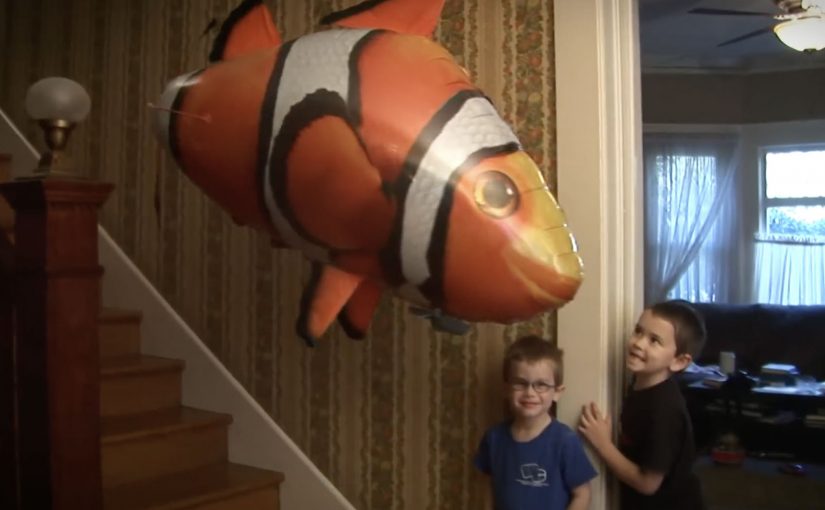
Air Swimmers: Flying Shark and Clownfish

Have you ever seen a fish that can swim in the air with smooth, life-like motion. Air Swimmers is a US-based company that developed these remote controlled, helium-filled flying fish.

They are designed for indoor fun even in small rooms. Air Swimmers describes them as running on four AAA batteries, one in the body and three in the controller, with up, down and 360 degree turning control.

How it works

The mechanism is lighter-than-air buoyancy plus simple steering controls. The helium does the lifting. The controller provides direction and small adjustments that make the movement read as “swimming” rather than “flying”. The technology fades into the background, and the illusion becomes the product.

In consumer retail for playful tech products, the fastest path from curiosity to purchase is a demo that looks impossible at first glance, but becomes obvious after ten seconds of watching it move.

The real question is how quickly your demo turns “that can’t be real” into “I want to try that”.

Lead with the impossible-looking motion first, and let the explanation come second.

Why it lands

It delivers a clean emotional sequence. Surprise first. Then control. The viewer sees it drift like a creature, then realises someone is steering it with precision. Because buoyancy handles the lift, small steering inputs read as effortless, which makes the motion feel alive and shareable. That makes it instantly shareable because the value is visible without narration or specs.

Extractable takeaway: If your product’s value is delight, design a demo that creates a visible illusion, then reveal just enough control to make people want to try it themselves.

Guerrilla activation lessons from Air Swimmers

  • Make the demo the message. If the value is visual, build your marketing around one clip that proves the experience in seconds.
  • Use “living motion” as the hook. Here, “living motion” means movement that reads like a creature rather than a machine, so people treat it as a moment worth filming.
  • Turn everyday space into a stage. Air Swimmers were also used as a guerrilla execution for SEA LIFE Speyer in Germany. Reported coverage describes Leo Burnett Frankfurt sending “flying sharks” through Frankfurt, including public locations and public transport, to turn the city into a temporary “aquarium” and build awareness for the aquarium in the Rhein-Main region.
  • Design for spectators, not only users. The best stunts create a second audience. Passers-by who do not control the object still get the full story.

A few fast answers before you act

What is an Air Swimmer?

A helium-filled balloon “fish” you steer indoors with a handheld controller, designed to move with a swimming-like motion through the air.

Why does it feel more impressive than other RC toys?

Because buoyancy handles the “floating,” so the control inputs translate into smooth, creature-like movement rather than noisy, mechanical flight.

What makes a product like this easy to market?

The demo is the message. One short clip communicates the full value without specs, because the motion is the proof.

Why was this a good fit for a SEA LIFE guerrilla execution?

Because it is thematically aligned with marine life, instantly attention-grabbing in public spaces, and it creates a moving spectacle people want to film and talk about.

What should the first ten seconds of the demo show?

Start with the “impossible” floating motion, then reveal the steering control quickly, so people understand it is real and want to try it.
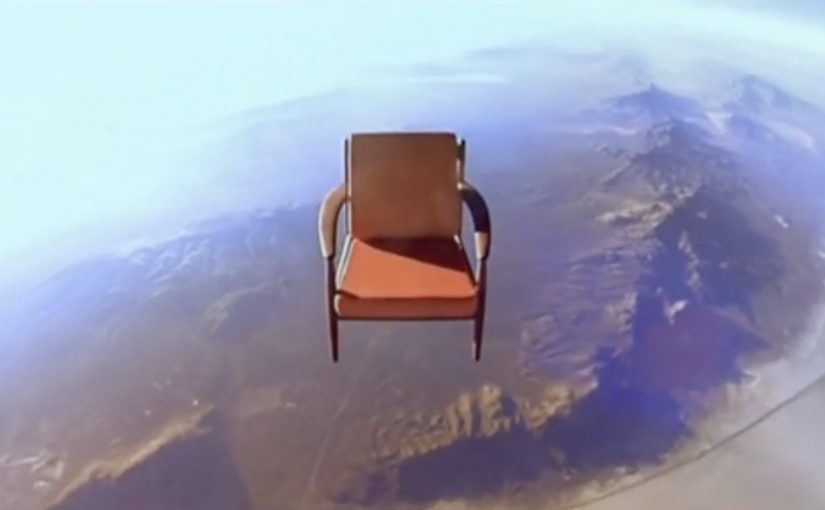
Toshiba: Space Chair to the edge of space

To promote its new line of LCD TVs, Toshiba sends an ultra-lightweight biodegradable chair toward the edge of space using a helium balloon, and films the entire mission in high definition with its IK-HR1S camera system.

The chair rig rises to 98,268 feet. The climb is reported as taking 83 minutes. Once the balloon pops, the fall back to earth is reported as taking 24 minutes.

Armchair viewing, taken literally

The creative move is almost aggressively simple. “Armchair viewing” is a cliché. So Toshiba turns it into a physical event. A chair. A balloon. A horizon line that curves. The resulting footage does the persuasion without needing exposition.

If the product claim is abstract. clarity, detail, realism. put a real object into an extreme, undeniable environment and let the camera do the talking.

Physics as production value

This is not “space” as a metaphor. The production is built around constraints that make it believable. Weight limits. fragile materials. freezing temperatures. low pressure. The rig has to survive long enough to capture usable footage, and the team has to recover it afterwards.

That operational reality becomes part of the brand signal. If you can shoot a commercial in those conditions, “HD” stops sounding like a spec sheet and starts sounding like capability.

In consumer electronics marketing, extreme real-world demonstrations are used to make “picture quality” feel like engineering proof, not advertising promise.

Why it lands as a TV ad, not just a stunt

The footage is the product demo. The shots are what a screen is for. It is scale, texture, contrast, and atmosphere. The chair is simply the reference object that lets the viewer feel distance and altitude.

Extractable takeaway: When the claim is “better quality,” build a proof moment the viewer can judge with their own eyes, and keep the story simple enough that the footage carries the persuasion.

It also avoids the typical trap of “innovation” campaigns. Over-claiming. Instead, the story is modest. Here is what we did. Here is what we captured. Judge the images. For picture-quality claims, a single verifiable proof moment beats layers of copy and metaphor.

The real question is whether your “proof” would still hold attention if the logo were removed.

Steal the Space Chair pattern

  • Make the demo inseparable from the claim. If you sell image quality, build an image that earns attention on its own.
  • Use one hero object. A single recognisable object makes scale and risk instantly legible.
  • Let constraints show. Real limits make real footage feel trustworthy.
  • Design for replay. If viewers rewatch because the visuals are stunning, the brand message repeats without extra media.
  • Keep copy light. When proof is the asset, words should not compete with it.

A few fast answers before you act

What is Toshiba “Space Chair”?

It is a Toshiba commercial built from real high-definition footage of a chair carried toward near space on a helium balloon, created to showcase Toshiba’s LCD TV picture quality.

How high did the chair go?

The flight is described as reaching 98,268 feet before the balloon broke apart and the rig descended.

How long did the ascent and descent take?

The timings are commonly reported as about 83 minutes up and about 24 minutes down.

What makes this feel credible instead of CGI?

It reads as real because it uses “documentary grammar,” meaning small signals like changing light, wind noise, tracking drift, and a rig visibly fighting extreme conditions.

What is the core lesson for brands doing “innovation” stories?

Build a proof moment people can replay and share for its own sake. If the audience wants to watch it again, the product message gets repeated for free.