
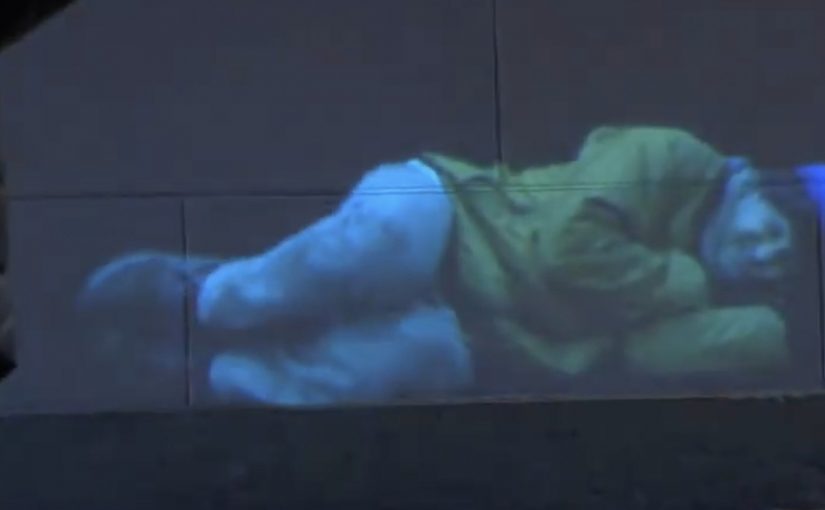
A life-size homeless man appears on a wall in New York. You can walk past like you always do. Or you can text a number and change what happens next.
Virtually Homeless is an interactive projection designed to pull attention back to a problem most people have learned to filter out. Passers-by interact by sending an SMS. That message triggers the projected sequence. A door appears. The man gets up and enters the house. Then a call to action appears inviting people to send another SMS to make a donation.
A small action with a visible consequence
The mechanism is direct. One text creates an immediate, legible outcome in public space. The story is not told to you. It is completed by you, with viewer control, meaning the passer-by’s SMS determines the next scene, delivered through the simplest mobile behavior available.
In city-scale public-interest work, the hardest challenge is getting people to notice what they have trained themselves not to see.
Why the interaction lands
This works because it offers a safe first step. The first SMS is not a donation ask. It is an action that feels like help, and the payoff is instant. Only after the participant has “done something” does the piece earn the right to ask for money. This two-step order is the right default when the goal is donation follow-through. The real question is whether your first interaction earns participation before it asks for money.
Extractable takeaway: If your cause message is being ignored, start by giving people a low-commitment action that produces an immediate, visible result. Then place the donation ask second, when the person has already crossed the psychological threshold from observer to participant.
The intent behind the two-step design
The installation converts attention into a simple sequence. Notice. Act. Then decide whether to contribute. The second SMS is framed as the next logical step, not an abrupt guilt pivot.
It also changes the social dynamic. Because the interaction happens in public, the moment becomes shared. People can watch someone else intervene, which reduces the feeling that “this is not my business.”
What to borrow for your own cause activation
- Make the first action easy. Remove apps, forms, and explanation. Start with one native behavior.
- Pay back instantly. Show a clear change the moment the user acts.
- Ask second. Earn the right to request money by letting people participate first.
- Keep dignity in mind. The creative should restore humanity, not turn the subject into a prop for spectacle.
A few fast answers before you act
What is “Virtually Homeless”?
It is an interactive street projection where passers-by send an SMS to trigger a sequence in which a projected homeless man enters a home, followed by a prompt to text again to donate.
Why use SMS instead of a QR code or app?
SMS is native, fast, and widely understood. It reduces friction at the exact moment someone is deciding whether to engage, which matters more than novelty in public space.
What makes the two-step flow effective?
The first step is participation with immediate feedback. The donation ask comes after the person has already acted, which increases follow-through versus leading with a request for money.
What should the first SMS ask people to do?
Ask for a simple, non-monetary action that triggers an immediate visible change, so the participant feels helpful before you introduce the donation step.
How do you do something like this ethically?
Design for dignity, avoid humiliation or mockery, and ensure the call to action points to credible help. The interaction should invite empathy and contribution, not consumption of someone else’s suffering.