
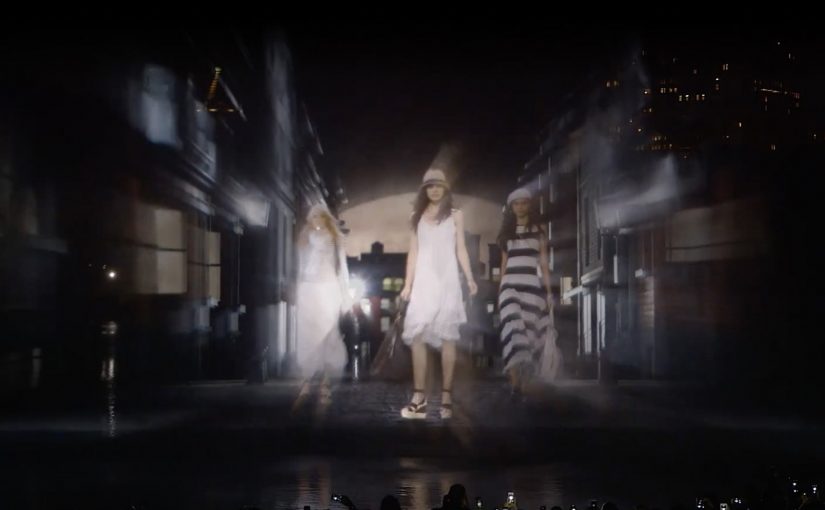
Ralph Lauren: Polo 4D

Ralph Lauren: Polo 4D

In September 2012, Hugo Boss live streamed its Boss Black Fall Winter 2012 fashion show directly in 3D. Now fast forward to 2014 and Ralph Lauren launches their Polo for Women Spring 2015 collection via a cinematic 4D experience. Here, “4D” means a physical projection experience that uses water, light, film, and live atmosphere to create depth and immersion.

On the evening of September 8th, during New York Fashion Week, Ralph Lauren turns the idea of a runway into a 60-foot-tall water-screen projection that towers above Manhattan’s Central Park, fusing fashion, art, and technology.

A runway made of water, light, and film

The mechanism is a projection-mapped water screen that functions like a living canvas. High-resolution scenes and “models” are projected onto a fan-shaped spray of water, creating the effect of figures moving across a surface that reads as a runway, even though it is literally water.

In global fashion marketing, immersive show formats are used to signal modernity and earn attention beyond the invited audience.

Why it lands

This works because it treats the collection launch as a public cultural moment, not a closed industry ritual. The scale is instantly legible. The format borrows from cinema. The setting adds myth. Central Park at night turns the presentation into something people talk about even if they cannot describe the garments in detail. Because the water-screen illusion reduces the show to one instantly retellable image, the experience travels beyond the guests who were physically there.

Extractable takeaway: When your category is saturated with beautiful imagery, compete on format. If the show itself becomes the story, the brand gets disproportionate reach without relying on louder messaging.

What Ralph Lauren is really doing

The real question is whether the launch format can make Polo for Women feel more culturally current than a conventional runway could. Ralph Lauren is using spectacle less to explain the collection than to position Polo as a modern media brand. The 4D framing functions as a brand statement. It positions Polo for Women as contemporary and city-native, and it uses spectacle to bridge runway tradition with a media behavior that is already screen-first.

What brand launch teams can borrow

  • Choose a “native stage”. A location with cultural meaning can do as much work as the production itself.
  • Make scale part of the idea. If it reads in one glance, it travels faster in photos, recaps, and retellings.
  • Build a film, not a documentation. When the content is cinematic by design, it holds up outside the event moment.
  • Let tech serve a single clear illusion. “Models walking on water” is the story. Everything else supports that.

A few fast answers before you act

What is Ralph Lauren Polo 4D?

It is a New York Fashion Week presentation that uses a projection-mapped water screen in Central Park to stage a cinematic runway-style experience for Polo for Women Spring 2015.

Why call it “4D”?

Coverage describes it as “4D” because the visuals are engineered to feel more immersive than a flat projection, with the water spray and depth effects contributing to the illusion.

How big was the water screen?

Reporting describes a water screen around 60 feet tall and 150 feet wide.

What makes this different from a normal runway show?

It blends film, set design, and projection mapping so the “runway” becomes an environment and a story, not just a walk-and-look format.

What is the transferable lesson for brand launches?

If you want a launch to travel, design for one clear, repeatable illusion that audiences can describe in a sentence.
Lexus Trace Your Road: life-sized racing game

Lexus Trace Your Road: life-sized racing game

To promote its new high-performance hybrid car, Lexus, together with Saatchi & Saatchi Italy, creates “Trace Your Road”, an experiential event featuring Formula 1 driver Jarno Trulli.

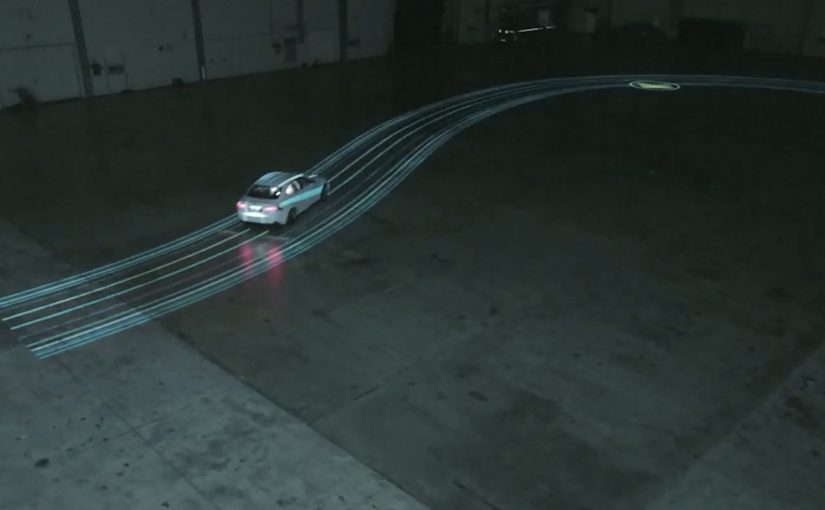
Ten Lexus fans are selected from hundreds of applicants on Lexus’ Facebook page. Each winner rides in the passenger seat of the hybrid while Trulli drives, and the passenger “draws” the course on an iPad. That path is projected onto the floor of an aircraft hangar using special projectors, while a custom high-resolution infrared (IR) camera system tracks the car’s position in real time.

How the experience works

The format is a life-sized driving game with the audience literally designing the track. The event flow is built around three moving parts.

  • Live track creation. The passenger traces a route on the iPad, creating spontaneous turns, straights, and corners.
  • Real-world projection. The route appears at scale on the hangar floor, so the “racetrack” becomes a physical space.
  • Real-time tracking. An IR camera system follows the car so penalties and scoring can be applied accurately.

What makes it competitive, not just cinematic

Trulli’s driving is put to the test as he attempts to follow the improvised paths at speed. Penalty points are given when the car goes outside the projected route or touches the hangar walls. The goal is to hit seven selected touch points in the quickest time, and the fan with the best score wins.

In automotive launches and premium brand marketing, turning a test drive into a participatory game makes performance feel experienced, not explained.

The real question is whether your launch makes the product truth the win condition, not just the headline.

Why it lands: performance becomes legible

Hybrid performance can be hard to dramatize without slipping into numbers. Because the passenger-designed route and visible penalty rules force precision, control and handling become legible without a spec sheet, while the story stays human through the passenger’s real-time choices and Trulli’s visible skill.

Extractable takeaway: When you can turn a product claim into a rule set with visible penalties, the audience understands it instantly and the content becomes inherently shareable.

What Lexus proves with “Trace Your Road”

The brand is not only saying “this car performs”. It is staging a situation where performance is the only way to succeed. This is a stronger way to market performance than listing specs, because it forces the car to prove itself under constraints. The experience also rewards participation: winners influence the outcome, spectators understand the rules instantly, and the filmed content has a clear narrative arc.

Make the claim playable: launch moves worth copying

  • Let the audience shape the challenge. When participants create the rules in real time, attention spikes because outcomes are unpredictable.
  • Translate product claims into constraints. Handling, control, and precision become visible when the environment punishes mistakes.
  • Build a scoring model people can explain. Simple penalties and a clear finish condition make the story travel.
  • Use tech as infrastructure, not the headline. Projection and tracking matter most when they disappear into the experience.

A few fast answers before you act

What is Lexus “Trace Your Road”?

It is an experiential event where a passenger draws a racetrack on a tablet and the route is projected onto a hangar floor, while Jarno Trulli drives a Lexus hybrid along that path in real time.

How is the racetrack created and shown?

The passenger traces the course on an iPad, and the design is projected at scale onto the floor using multiple projectors so the track becomes a physical space to drive in.

How does the system know if the car stayed on the route?

A custom high-resolution IR camera tracking system monitors the car’s position against the projected route so penalties can be applied when it leaves the path.

What makes this more than a one-off stunt?

The format produces repeatable rounds, clear scoring, and a strong spectator story, which makes it easy to capture as a campaign film and behind-the-scenes content.

What is the main lesson for experience design?

Make the product truth the win condition. When success requires the product’s strengths, the message feels demonstrated rather than claimed.

Hyundai Elantra: Driveway Decision Maker

Hyundai Elantra: Driveway Decision Maker

When choice made the Elantra harder to buy

In North American automotive marketing in 2012, the hardest moments are often the ones created by success: when a winner expands and the buyer suddenly has more to compare.

The Hyundai Elantra was named 2012 North America Car of the Year. Momentum was strong.

Then Hyundai introduced two additional variants. The Elantra Coupe and the Elantra GT. Suddenly, a clear win turned into a harder purchase decision.

More choice created more hesitation. Hyundai needed to simplify the decision again, without reducing the range.

Turning your driveway into the showroom

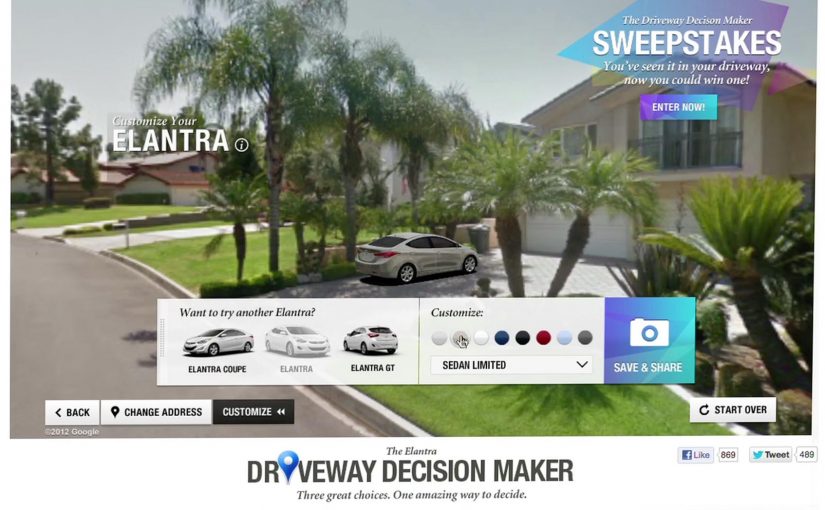
Instead of pushing another brochure or comparison chart, Hyundai built the Driveway Decision Maker, a tool that let prospective buyers preview what an Elantra would look like parked outside their own home.

By combining Google Street View, projection mapping, and real-time 3D animation, prospective buyers could see exactly what an Elantra would look like parked in their own driveway.

The experience replaced imagination with visualization. No guessing scale. No abstract renders. Just your house, your street, and the car.

In high-consideration categories where products physically live at home, a realistic preview in the buyer’s own environment reduces comparison fatigue.

Why seeing it at home removed friction

Car buying is emotional, but doubt creeps in when people cannot picture ownership.

Extractable takeaway: If your buyer must imagine ownership to decide, put a realistic preview into their own environment so the choice feels concrete.

The Driveway Decision Maker collapsed distance between consideration and ownership. By anchoring the car to a familiar, personal environment, Hyundai removed uncertainty about fit, size, and presence.

The experience also shifted control to the viewer. Instead of being told what to like, buyers explored the car in their own context.

The business goal behind the experience

The intent was not novelty. The real question is how you help someone choose when a clear winner becomes a lineup.

Hyundai wanted to reduce decision paralysis created by a broader lineup and move people confidently from interest to purchase. By helping buyers visualize the outcome, the brand shortened the path to commitment.

This was about restoring clarity, not adding noise. Interactivity is only worth it when it makes a decision easier.

What brands can steal from Driveway Decision Maker

  • Bring the product into the customer’s world. Context beats abstraction.
  • Replace imagination with visualization. Show the outcome, not the promise.
  • Use technology to remove doubt. Innovation works best when it answers a real buying question.
  • Support choice instead of limiting it. Help people decide rather than forcing simplification.

Hyundai invited consumers to try the experience themselves on the PickMyElantra site.


A few fast answers before you act

What problem was Hyundai solving?

Too much choice created hesitation. Buyers struggled to decide between Elantra variants.

How did the Driveway Decision Maker work?

It combined Google Street View, projection mapping, and real-time 3D animation to place the car into a buyer’s actual driveway.

Why was this more effective than a configurator?

Because it grounded the decision in a personal, familiar environment instead of abstract specifications.

What business outcome did Hyundai target?

Reducing purchase friction and restoring confidence across an expanded model lineup.

What is the transferable lesson?

If your product requires imagination to buy, use technology to make the outcome visible.