

Roman Atwood: The World’s Most Contagious Prank

Here is an infectious yawning video created by YouTuber Roman Atwood. Try watching this nearly three minute clip of constant yawning without letting one loose yourself. I could not help but yawn while watching it.

The simplest mechanism in the world

The mechanism is pure mimicry and suggestion. You see a yawn. You anticipate a yawn. Then your body does the rest. The prank is not about shock. It is about stacking the same trigger again and again until your reflex gives in.

In social video, simple human reflexes and repeatable triggers can outperform high production because the viewer feels personally involved.

Why it lands

This works because it turns the viewer into the subject. The content is not only “watch someone yawn”. It is “can you resist”. That tiny competitive frame, a simple self-test with a clear pass-or-fail outcome, creates attention, and attention makes the reflex even harder to ignore. The real question is how you turn a passive viewer into an active participant with almost no friction. The smarter lesson for marketers is that participation can beat production value when the trigger is immediate and universal.

Extractable takeaway: If you can anchor a video around a universal, involuntary response and wrap it in a clear challenge, the audience participates while they watch. Participation is what makes the clip shareable.

How to build your own contagious challenge

  • Start with the reaction you want: pick a response that is immediate and universal, then build backwards.
  • Use repetition with purpose: one trigger is a gag. Many triggers become a challenge.
  • Make the premise explainable in one sentence: “watch this without yawning” is the whole pitch.
  • Let viewers test themselves: self-tests create comments, shares, and rematches.
  • Keep it short and focused: the tighter the loop, the stronger the contagion.

A few fast answers before you act

What is “The World’s Most Contagious Prank”?

It is a yawning prank video where the creator yawns repeatedly in public to see if bystanders and viewers “catch” the yawn reflex.

Why do people share videos like this?

Because the challenge frame is social. People want to test friends, compare reactions, and prove whether they can resist.

Is this a prank or a social experiment?

It sits in between. It uses a prank setup, but the entertainment comes from observing a predictable human reflex spread from person to person.

What is the key lesson for video marketing?

Design around a specific viewer response, then make the viewer feel like the outcome depends on them.

What is the main risk of copying this format?

If the trigger is not truly universal or the loop feels repetitive without payoff, people drop off quickly. The mechanic has to be instantly felt, not only understood.
Heineken: Walk-in Fridge

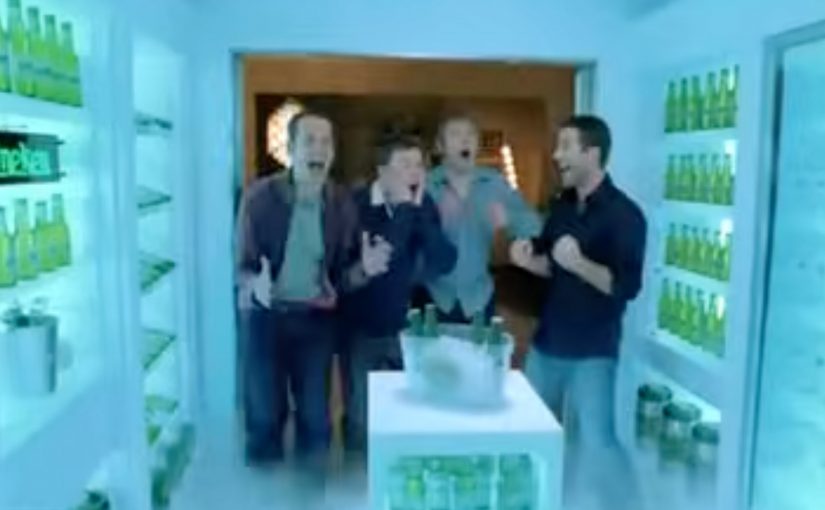
Heineken’s “Walk-in Fridge” starts with a familiar house-tour setup. A woman shows her new place to a group of female friends while her partner gives his own tour to a group of male friends. The women reach the bedroom and open doors to reveal a spectacular walk-in closet, and they erupt.

Then everyone hears an even louder scream from down the hall. The men have just been shown the ultimate kitchen appliance. A huge walk-in refrigerator completely stocked with Heineken.

Why the twist works so well

The craft is all in the parallel structure. Two tours. Two reveals. Two reactions. The spot lets you predict the rhythm, then it flips the meaning. The women are thrilled by luxury storage. The men are ecstatic about cold beer on tap, at home, forever.

Extractable takeaway: Design for “one-sentence retellability”. That means someone can describe the premise in a single line and the punchline still lands before they even press play.

In global FMCG marketing, the most durable humor is the kind that delivers a one-frame payoff you can understand with the sound off.

The real question is whether your idea still lands as a single, instantly retellable visual beat.

What the ad is really saying about the brand

The fridge is not a product feature. It is a fantasy object. Heineken becomes the thing worth screaming for. That is premium positioning done through comedy, not copy lines. That is a positioning move worth copying when you need premium cues without heavy-handed copy.

It also uses the home as a stage for status. The walk-in closet signals taste. The walk-in fridge signals desire. Heineken wants to sit in that second category.

Distribution behavior built into the idea

This film is designed to travel online because the reaction is the asset. You do not need a celebrity. You do not need context. You just need the reveal and the scream.

That matters because the spot can earn attention in the exact environments where people skip ads, by being the kind of clip people choose to send each other.

Steal the reveal structure

  • Write for a single reveal. If the payoff is clean, the audience does the distribution.
  • Use symmetry. Parallel structure makes the twist feel inevitable, then surprising.
  • Make the reaction the headline. When the reaction is the story, you get replay value.
  • Build “one-sentence retellability”. If someone can pitch it instantly, it will spread.

A few fast answers before you act

What is the core idea of Heineken’s Walk-in Fridge?

It is a parallel-reveal comedy spot. Women celebrate a walk-in closet, then men celebrate a walk-in fridge stocked with Heineken, with the men’s reaction intentionally bigger.

Why does the parallel structure matter?

Because it creates rhythm and expectation. When the second reveal hits, the audience instantly understands the joke and the contrast without explanation.

What makes this feel “premium” rather than “cheap humor”?

The fantasy object is aspirational. The walk-in fridge is framed like a luxury upgrade, not a slapstick prop, so the brand inherits desirability from the setting.

What is the biggest risk in using gender-role jokes?

They can age badly. The safest way to use them is to keep the tone playful and the insight broad, and avoid implying that one group is smarter or better than the other.

What should you measure for a film built to travel online?

Measure retell accuracy, completion rate, and voluntary shares. If people can repeat the premise correctly and still want to send it, the mechanic is working.