
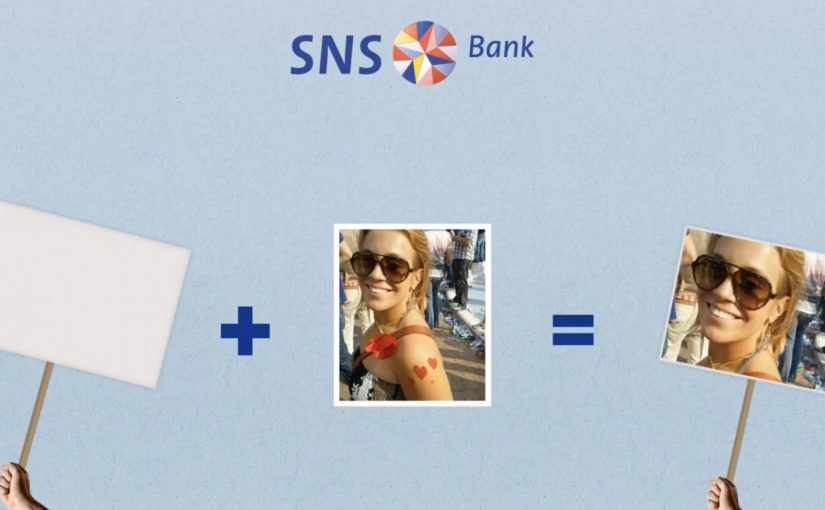
SNS Bank promotes a simple product shift. Paying interest on a normal current account. Instead of leading with rates and fine print, the work frames it as something worth protesting for.
People “join” the protest using their Facebook or Twitter account. Their profile picture then becomes the campaign’s moving unit, connected into live rich media placements running on Dutch publisher inventory such as msn.nl and telegraaf.nl. Here, the moving unit is the participant’s profile picture reused as the visible building block of the protest crowd.
How the protest mechanic is built
The mechanism is straightforward. Sign up with a social account, capture the profile image, then re-render that image as part of a marching crowd inside dynamic banners. The same identity asset travels from social sign-up, to landing experience, to high-impact display formats, including what is described as a homepage takeover on telegraaf.nl.
In European retail banking, feature-led propositions like “interest on current accounts” often need a memorable way for customers to visibly participate to cut through price parity and low attention.
Why it lands
It takes a boring benefit and gives it a human visual. A rate becomes a crowd. That shift matters because it makes the offer feel socially validated and easy to explain. It also turns ordinary display inventory into a live proof point, because the banners visibly update with real people rather than generic stock photography. This is the right strategic move because the campaign makes participation itself the proof of relevance.
Extractable takeaway: When your proposition is a small financial feature, convert it into a visible social object. One reusable profile image can power sign-up, storytelling, and proof across every paid placement.
What SNS Bank is really trying to achieve
The business intent is to make “interest on a current account” feel like a category change, not a marginal tweak. The protest framing gives SNS Bank permission to be louder than the feature itself, and it creates a participation funnel that can be measured from social sign-up to on-site conversion.
The real question is how to make a marginal banking feature feel like a public movement rather than a line item in a comparison table.
What to steal from this protest-led banking launch
- Turn the benefit into a visual system. If the offer is intangible, give it a repeating picture that accumulates and grows.
- Use one identity artifact everywhere. A single profile image can unify sign-up, landing experience, and ad formats into one story.
- Make paid media feel live. Dynamic creative that visibly changes reads as proof, not just persuasion.
- Respect permission and platform rules. If you are pulling profile images, ensure consent is explicit and the experience stays compliant.
A few fast answers before you act
What is the core mechanic of this campaign?
People join via Facebook or Twitter, and their profile image is then reused as the creative building block inside a marching protest rendered across rich media banners.
Why use display banners for something that starts in social?
Because banners can function as visible proof at scale. The audience sees real faces moving through the ad units, which makes the proposition feel active rather than purely claimed.
What is the main advantage of the “protest” framing?
It makes a dry feature feel like a cause. That reframing increases memorability and gives people a simple story to repeat.
What is the biggest risk in copying this approach?
Using social identity assets without clear consent creates trust and compliance issues. If the sign-up step is not explicit, the same mechanic can backfire fast.
When does this kind of mechanic work best?
It works best when the product feature is real but visually weak. The participation layer gives the feature a public shape without changing the underlying offer.