
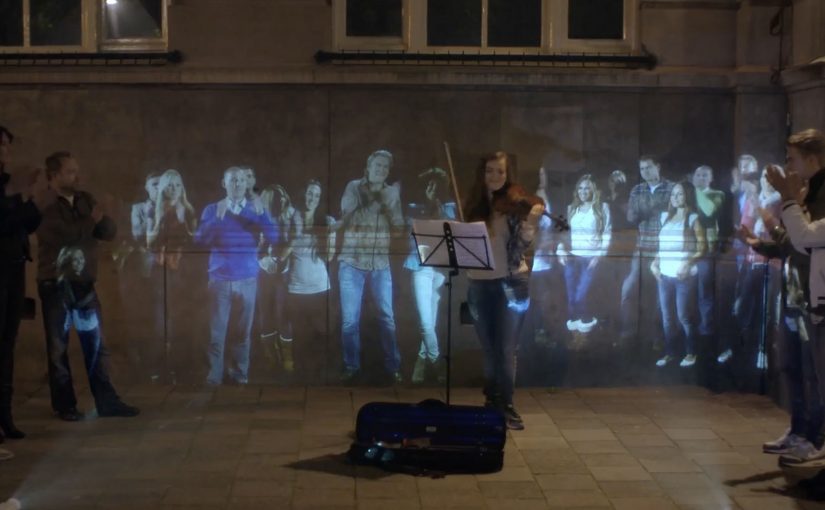
Beaming Rocket: LG MiniBeam Street Projections

LG, to make everyday life more fun and exciting, decided to bring a few surprises to the street. They found Juan, a video artist who took his hobby to another level with LG’s portable projectors. Together they surprised and entertained people in ways never expected.

Portable projection as street-level theatre

The mechanism is the point. A small, mobile projector turns almost any surface into a temporary screen, and that mobility lets the experience pop up where people least expect it. Instead of asking people to come to a venue, the “venue” appears around them for a few seconds, then moves on.

In consumer electronics marketing, the fastest way to prove portability is to show the product leaving the living room and creating value in public spaces.

Why it lands

This works because it turns a spec sheet into a story. Brightness and portability are hard to communicate in words, but they become self-evident when a projection transforms a wall, a street corner, or a passing moment into something shareable. If you want the benefit to stick, make the demo do the explaining.

Extractable takeaway: When a product benefit is experiential, demonstrate it through a simple, repeatable scene that makes the benefit visible without explanation.

What LG is really selling here

Beaming Rocket is the LG MiniBeam film built around a video artist using portable street projections to make portability and brightness feel obvious.

The real question is whether your demo makes the benefit self-evident in the first five seconds, without relying on narration or specs.

The film is doing more than showcasing “fun.” It is positioning a portable projector as a creative tool, not just a gadget. That widens the audience beyond home viewing into creators, event moments, and spontaneous social experiences.

Steal this street-projection pattern

  • Demonstrate the core benefit in the real world. If mobility is the claim, the story needs movement.
  • Keep the format lightweight. Short, surprising moments travel better than long, complex narratives in public.
  • Use people as the proof layer. Real reactions sell the experience faster than product copy.
  • Make surfaces part of the idea. The environment should feel like a collaborator, not a backdrop.
  • Design for repeatability. If the concept can happen in many places, it scales as a content engine.

A few fast answers before you act

What is “Beaming Rocket” in one sentence?

It is an LG MiniBeam film built around a video artist who uses a portable projector to create surprising street projections and spontaneous moments for passers-by.

What product truth does the film demonstrate?

Portability and ease of use. The projector can be carried, set up quickly, and used on everyday surfaces without a formal venue.

Why is street projection a strong demo format?

It makes brightness, scale, and immediacy visible in a single scene, and it naturally generates bystander attention and shareable reactions.

What is the main execution risk if you copy this approach?

Weak payoff. If the projected content is not instantly legible or delightful, the “surprise” becomes confusion and people walk on.

What should you measure if you run a similar activation?

Dwell time, crowd build rate, social sharing volume, sentiment, and whether the content creates downstream lift in search or product page visits.

LG: My Wife Smashed My TV

A husband walks in the door, does what he always does, and reaches for the TV. This time, his wife beats him to it, smashing the set in front of him.

LG takes that familiar “couch potato” tension and turns it into a candid-camera series. Five households are set up with hidden cameras while the men are away at work. When they return, the TV gets destroyed, and the immediate reactions are captured on film. The footage becomes five viral videos that were reported to reach over 200,000 views on Flix, described as a leading video host in Israel.

The stunt mechanic

The mechanic is a controlled, in-home prank with a single, irreversible trigger. The TV is smashed in real time, the reaction is the content, and the series format multiplies the shareable moments across multiple “types” of husband responses.

In consumer electronics marketing, tapping into a real household ritual can make a product story travel further than feature claims because it feels like lived culture, not advertising.

Why it lands

The idea works because it is instantly legible. Everyone understands the setup in one second, and the shock produces unscripted emotion. The campaign also benefits from a simple moral frame. The TV is the symbol of the habit, so breaking it reads like breaking the routine. That makes each clip feel like a punchline people can retell without context.

Extractable takeaway: If your category is part of a daily habit, build the story around the habit itself, and let genuine reactions do the persuasion work that scripted messaging usually struggles to earn.

What LG is really buying

The real question is whether surprise can turn a familiar domestic ritual into a brand story people want to retell. LG is buying talkability here, not just views. It inserts LG into a domestic conversation about screen time and routines, then uses surprise and authenticity to earn distribution on platforms where polished product films are easy to ignore.

Takeaways from LG’s reaction-led stunt

  • Use a single clear trigger. One decisive moment creates an easy hook and a clean thumbnail narrative.
  • Design for repeatability. A series lets you capture variation, not just one lucky reaction.
  • Keep the framing simple. The fewer moving parts, the more credible the reactions feel.
  • Plan the ethical boundaries early. Surprise can work, but only if consent, safety, and aftercare are treated as part of the production, not an afterthought.

A few fast answers before you act

What is “My Wife Smashed My TV”?

A candid-camera series where wives smash their husbands’ TVs when they come home, capturing authentic reactions and packaging them as viral clips.

Why does the idea spread so easily?

Because the setup is universal and the payoff is immediate. The audience understands the relationship dynamic instantly, then watches the unscripted reaction.

What did the campaign claim as a result?

The legacy write-up reports over 200,000 views on Flix for the set of videos.

What is the main risk with prank-based advertising?

If it feels cruel, unsafe, or non-consensual, the attention flips into backlash and the brand becomes the villain of the story.

When is a reaction-led format a good fit?

When your message can be carried by a recognizable everyday situation, and the emotional response communicates the point better than exposition.