
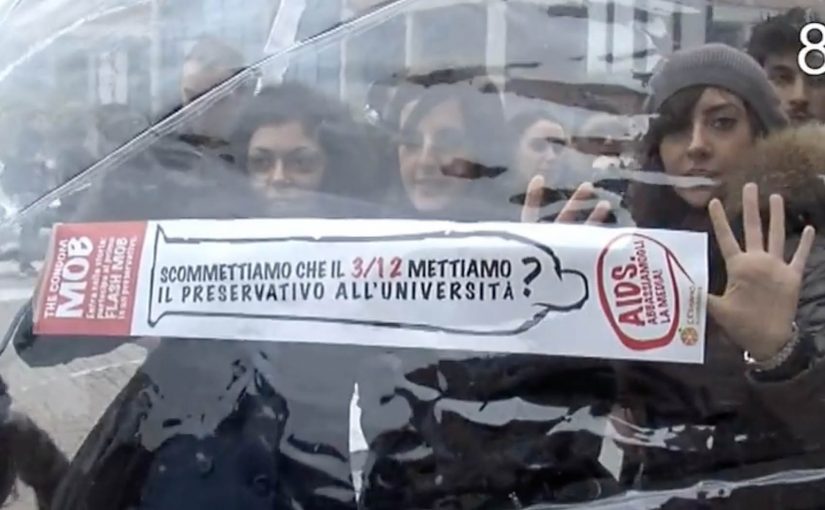
Cesviamo is an Italian social network created by CESVI, a non-profit organization, and this campaign is built to do three things at once. Increase awareness of the site. Explain how the social network works by turning fundraising into “funraising”. Here, “funraising” means making participation itself part of the fundraising appeal. And make people, especially students, more conscious about AIDS.
The execution is the “Condom Mob”. A large, public stunt where 100 young people enter a giant condom as a highly visible symbol against AIDS. The post reports that participation exceeded expectations, reaching 223 people in the condom in one case and 230 in another.
How the stunt acts as a product demo for the network
The mechanic is designed to be understandable at a glance, then extend into the platform. The “mob” delivers immediate attention, while the narrative around funraising and participation cues the idea of joining, sharing, and building momentum through the social network itself. Because the stunt is legible in seconds and maps directly to joining and sharing, it works as both attention device and product demo for the network.
In European nonprofit and cause-led communication, a single, highly legible public action can cut through faster than awareness copy, because it creates a shareable proof moment that people feel compelled to talk about.
Why it lands
It uses contrast and scale to force attention. A condom is already a charged object. Making it oversized and public turns it into a conversation starter, which helps the AIDS message travel beyond the people who were physically present. The “mob” format also frames the topic as collective responsibility, not private embarrassment.
Extractable takeaway: If you need awareness plus platform adoption, choose one symbol that is instantly readable, then design the stunt so the audience’s next step naturally points back to joining and participating in your owned experience.
What CESVI is really trying to achieve
The business intent is behavioral. The real question is whether a public spectacle can turn student attention into repeat participation inside the network. Normalize discussion. Pull students into the cause. And position Cesviamo as a place where participation is easy, social, and measurable. For cause campaigns like this, spectacle is only useful when it feeds a repeatable participation path. The stunt is the ignition. The platform is where attention can be converted into repeat involvement.
What to steal for your own cause campaign
- Make the symbol unavoidable. Choose one visual that communicates the issue without explanation.
- Design for “I have to tell someone”. If the moment creates a story people can repeat in one sentence, distribution follows.
- Connect spectacle to a next step. Awareness without an action path leaks value. Point clearly to how to join, donate, or participate.
- Measure participation, not just reach. Headcount and involvement are stronger proof than impressions for cause work.
A few fast answers before you act
What is the core idea of the Condom Mob?
A large, public stunt where young people enter a giant condom to spark AIDS awareness and drive attention back to CESVI’s Cesviamo network.
Why does “funraising” matter in this context?
It reframes giving and participation as something people do together, making it easier to recruit students and first-time supporters.
What makes the symbol effective?
It is instantly recognizable and directly tied to prevention. That directness reduces the need for explanation and increases talk value.
How should the next step be designed?
The stunt should hand people to one obvious action, such as joining, donating, or participating, so attention does not dissipate after the moment passes.
What is the main risk with a stunt like this?
If the spectacle overwhelms the cause, people remember the shock but miss the message. The narrative and next step must stay explicit and repeated.