

Microsoft: Big Data to Predict Traffic Jams

Big Data is increasingly being used to find solutions to problems around the world. In this latest example, Microsoft partnered with the Federal University of Minas Gerais, one of Brazil’s largest universities, to undertake research that helps predict traffic jams up to an hour in advance.

With access to traffic data, including historical numbers where available, road cameras, Bing traffic maps, and drivers’ social networks, Microsoft and the research team set out to establish patterns that help foresee traffic jams 15 to 60 minutes before they happen.

What “big data” means in this context

Here, “big data” is not a buzzword. It means combining multiple high-volume signals that each describe traffic from a different angle. Flow and speed data. Camera feeds. Map-layer congestion indicators. And sometimes social or incident signals that explain why conditions change.

How the prediction model is positioned

The mechanism is short-horizon forecasting. Aggregate live and historical traffic conditions. Detect repeating patterns and transitions. Then output a probability that a segment will shift from free-flowing to congested within the next 15 to 60 minutes. The goal is not perfect certainty. It is an early warning that is useful enough to reroute, rebalance signals, or advise drivers.

In urban mobility programs, 15 to 60 minute congestion prediction is a practical layer between raw telemetry and real-world operational decisions.

Why it lands

This works because it targets a time window people actually feel. Short-horizon forecasting matters because it aligns the prediction with the moment when routes, signals, and departures can still change. The real question is whether earlier warning is reliable enough to trigger better decisions before congestion locks in. Useful prediction beats perfect prediction in operational systems.

Extractable takeaway: When a prediction is delivered inside the decision window, it creates value even if it is not perfect. The win is earlier choices, not flawless foresight.

What to steal for traffic prediction

  • Design for actionability: pick a forecast horizon that matches real decisions, not academic elegance.
  • Blend signals carefully: combine steady signals, like flow data, with explanatory signals, like incidents or events, when available.
  • Communicate confidence: a probability and a time window often beats a single definitive “will happen” claim.
  • Validate across cities: portability matters, because traffic behaviors vary by road network and culture.
  • Measure the right outcome: accuracy matters, but reduced delay and better routing outcomes are the real business KPIs.

A few fast answers before you act

What is Microsoft trying to do here?

The project aims to predict traffic jams 15 to 60 minutes ahead by combining traffic flow data, map signals, cameras, and other contextual inputs to spot patterns before congestion forms.

Why is 15 to 60 minutes the useful range?

It is long enough to change routes, adjust signal timing, or delay a departure. It is short enough that conditions have not completely changed since the forecast was generated.

What data sources matter most?

Traffic flow and speed data usually provide the core signal. Cameras, incidents, events, and social signals can add context that improves timing and explains sudden changes.

What does “80% accuracy” actually mean?

It is typically reported as the share of correct predictions under a defined test setup. The real value depends on how accuracy is measured, what baseline is used, and how the prediction is turned into driver or city actions.

Where does this approach fit in a smart-city stack?

It sits between sensing and intervention. Sensors and maps detect current conditions. Prediction estimates near-future conditions. Then routing, signaling, and traveler information systems act on that forecast.
Cesviamo: The Condom Mob

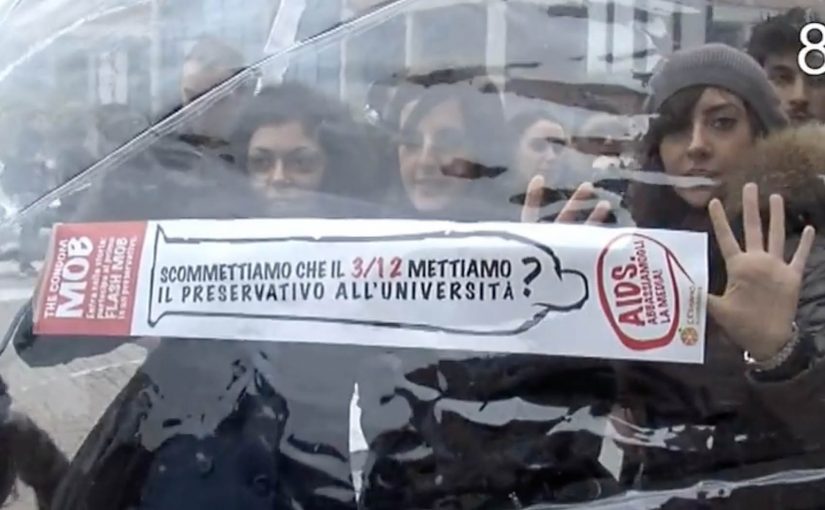
Cesviamo is an Italian social network created by CESVI, a non-profit organization, and this campaign is built to do three things at once. Increase awareness of the site. Explain how the social network works by turning fundraising into “funraising”. Here, “funraising” means making participation itself part of the fundraising appeal. And make people, especially students, more conscious about AIDS.

The execution is the “Condom Mob”. A large, public stunt where 100 young people enter a giant condom as a highly visible symbol against AIDS. The post reports that participation exceeded expectations, reaching 223 people in the condom in one case and 230 in another.

How the stunt acts as a product demo for the network

The mechanic is designed to be understandable at a glance, then extend into the platform. The “mob” delivers immediate attention, while the narrative around funraising and participation cues the idea of joining, sharing, and building momentum through the social network itself. Because the stunt is legible in seconds and maps directly to joining and sharing, it works as both attention device and product demo for the network.

In European nonprofit and cause-led communication, a single, highly legible public action can cut through faster than awareness copy, because it creates a shareable proof moment that people feel compelled to talk about.

Why it lands

It uses contrast and scale to force attention. A condom is already a charged object. Making it oversized and public turns it into a conversation starter, which helps the AIDS message travel beyond the people who were physically present. The “mob” format also frames the topic as collective responsibility, not private embarrassment.

Extractable takeaway: If you need awareness plus platform adoption, choose one symbol that is instantly readable, then design the stunt so the audience’s next step naturally points back to joining and participating in your owned experience.

What CESVI is really trying to achieve

The business intent is behavioral. The real question is whether a public spectacle can turn student attention into repeat participation inside the network. Normalize discussion. Pull students into the cause. And position Cesviamo as a place where participation is easy, social, and measurable. For cause campaigns like this, spectacle is only useful when it feeds a repeatable participation path. The stunt is the ignition. The platform is where attention can be converted into repeat involvement.

What to steal for your own cause campaign

  • Make the symbol unavoidable. Choose one visual that communicates the issue without explanation.
  • Design for “I have to tell someone”. If the moment creates a story people can repeat in one sentence, distribution follows.
  • Connect spectacle to a next step. Awareness without an action path leaks value. Point clearly to how to join, donate, or participate.
  • Measure participation, not just reach. Headcount and involvement are stronger proof than impressions for cause work.

A few fast answers before you act

What is the core idea of the Condom Mob?

A large, public stunt where young people enter a giant condom to spark AIDS awareness and drive attention back to CESVI’s Cesviamo network.

Why does “funraising” matter in this context?

It reframes giving and participation as something people do together, making it easier to recruit students and first-time supporters.

What makes the symbol effective?

It is instantly recognizable and directly tied to prevention. That directness reduces the need for explanation and increases talk value.

How should the next step be designed?

The stunt should hand people to one obvious action, such as joining, donating, or participating, so attention does not dissipate after the moment passes.

What is the main risk with a stunt like this?

If the spectacle overwhelms the cause, people remember the shock but miss the message. The narrative and next step must stay explicit and repeated.