
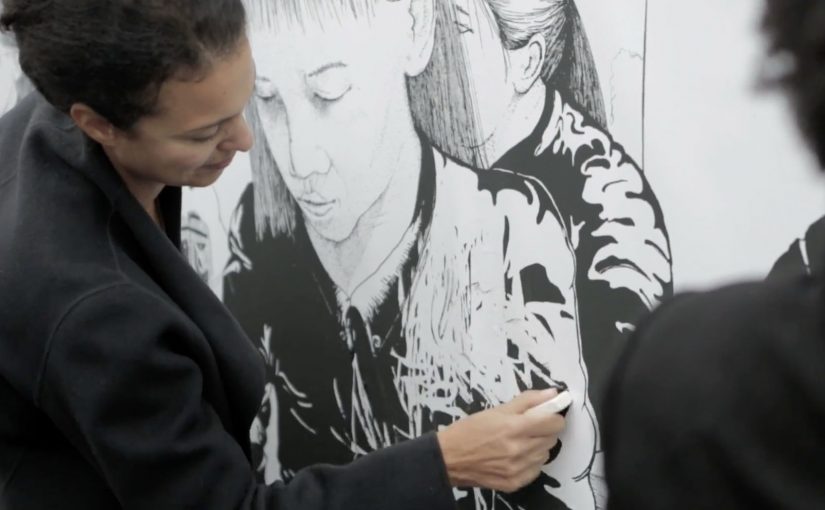
A large illustrated billboard appears in a busy city square. People donate, receive a simple eraser, and start rubbing away the artwork. As the top layer disappears, a second illustration is revealed underneath, shifting the story from girls working to girls going to school.
Plan has reported that tens of millions of girls worldwide are pushed into work instead of education, while in many less privileged countries boys are more likely to get access to schooling. To spark action, Plan and CLM BBDO created an erasable billboard with an illustration designed to be removed to reveal another illustration underneath. The billboard ran in central locations in Paris and Berlin. Passers-by were invited to donate in exchange for an eraser, then use it to change what the billboard showed.
Why the “erasable” mechanic is so strong
The mechanism does two jobs at once. It raises money, and it makes the issue understandable without explanation. The before-and-after is literal. Work disappears. School appears. The donor is not only informed. The donor performs the change. Cause-led campaigns should treat participation as the message, not a bonus layer.
Extractable takeaway: When the donor completes the transformation with their hands, the message becomes a memory and the donation feels consequential.
Definition-tightening: the eraser is not a gimmick. It is the interface, meaning the simple physical tool that gives the donor viewer control over the story. Because the act of erasing creates ownership, it makes someone more likely to donate, talk about it, and remember it.
In social-impact fundraising, participatory outdoor media can turn a small donation into a visible act of change that people feel in their hands.
The real question is whether your donation ask feels like participation or just passive sympathy.
What Plan is really buying
This is a public proof of participation. Instead of asking people to “care” in private, it makes caring visible, social, and shared. Every person who erases becomes a live endorsement that the issue matters enough to stop and act.
Steal this pattern: make giving tactile
- Make the transformation physical. A tangible before-and-after beats a poster full of statistics.
- Use the donation as the trigger. The action should only unlock after contribution, not before it.
- Let participation create the content. The billboard changes because people change it.
- Design for bystanders. Watching others erase is part of the persuasion.
A few fast answers before you act
What is the “Erasable Billboard” idea?
An illustrated billboard designed to be physically erased. Donors receive an eraser and reveal a second image underneath, shifting the story from girls working to girls going to school.
Why exchange a donation for an eraser?
Because it turns giving into an action. The eraser is a simple reward, but more importantly it is the tool that lets the donor create the transformation themselves.
What makes this more effective than a standard charity billboard?
It is participatory and observable. The public sees the billboard changing in real time, which builds social proof and makes the issue easier to grasp.
What is the main emotional lever?
Viewer control. The donor does not only learn about the problem. The donor performs a symbolic solution in front of others.
What is the biggest execution risk?
If the transformation is not instantly readable, people will not engage. The before-and-after needs to be obvious from a distance and satisfying up close.