
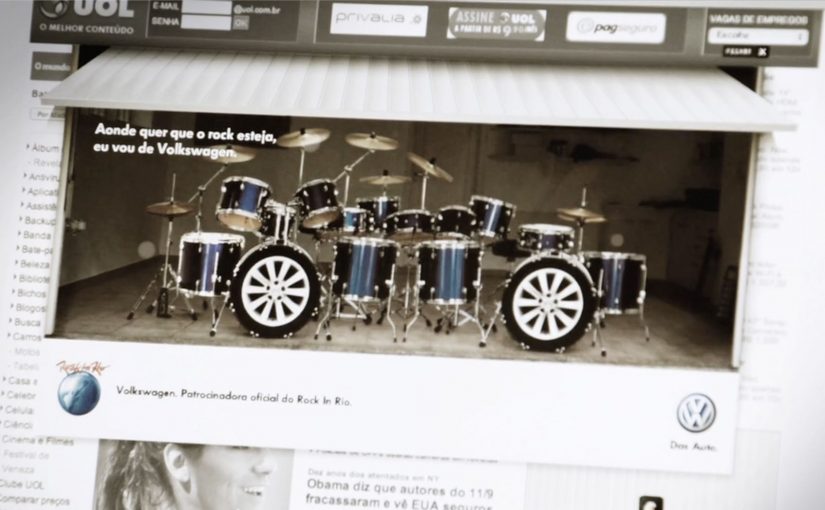
A banner ad you can actually “play”
To celebrate Rock in Rio, Volkswagen built a banner execution that uses your webcam as the input device. Instead of asking you to watch, it invites you to perform, like a tiny drum solo inside a media placement.
How the mechanism earns attention
The core mechanic is simple: webcam permission turns a standard banner into an interactive surface, where your movement becomes the “controller” for the drum kit. That shifts the experience from passive exposure to active participation in a few seconds. Because the unit reacts to a single, instantly legible gesture, it earns attention before the viewer has time to move on.
In brand-led entertainment marketing, the smallest possible interaction can turn a paid unit into something people choose to engage with.
Why it lands in a festival context
Rock in Rio is already about energy, performance, and communal hype. A drum kit inside a banner borrows that emotional language and makes it personal. You are not being shown “festival vibes”. You are generating them, even if it’s just for a moment at your desk.
Extractable takeaway: When a paid unit lets people create a recognizable mini-performance in one step, the creative feels like entertainment, not media.
The payoff is not the complexity. It’s the contrast: banners normally ask for a click, this one asks for a gesture. That little shift makes the format feel fresh again.
The real question is whether your paid placement gives people something to do, not just something to click.
This is the right kind of interactivity for display: opt-in, one-step, and instantly legible.
Takeaways for webcam-controlled banners
- Use one input. A single action users already understand (movement, tap, swipe) beats multi-step instructions.
- Make the first five seconds obvious. If the user can’t “get it” instantly, they drop. Here, the drum metaphor does the teaching.
- Match the interaction to the moment. Music festival content should feel performative. The interaction mirrors the cultural context.
- Keep the reward emotional. The win is “I played it”, not “I learned a feature list”.
A few fast answers before you act
What is a webcam-controlled banner ad?
It’s a display ad unit that asks for webcam access and uses the camera feed as a live input, usually via motion detection, to let the viewer interact with the creative.
Why use a webcam in a banner at all?
Because it turns a standard media placement into an experience. That can increase attention and memorability when the interaction is instantly understandable.
What makes this Rock in Rio execution work?
The interaction fits the occasion. A drum kit is a native “festival” object, and the gesture-based control makes the format feel playful instead of intrusive.
What’s the main risk with webcam-based ads?
Friction and trust. If the value isn’t obvious, users will refuse permissions or bounce. The creative must communicate intent and payoff immediately.
What’s the simplest modern takeaway?
Give the audience a one-step action that creates a visible result. If the interaction is clear and rewarding, the format becomes the message.