
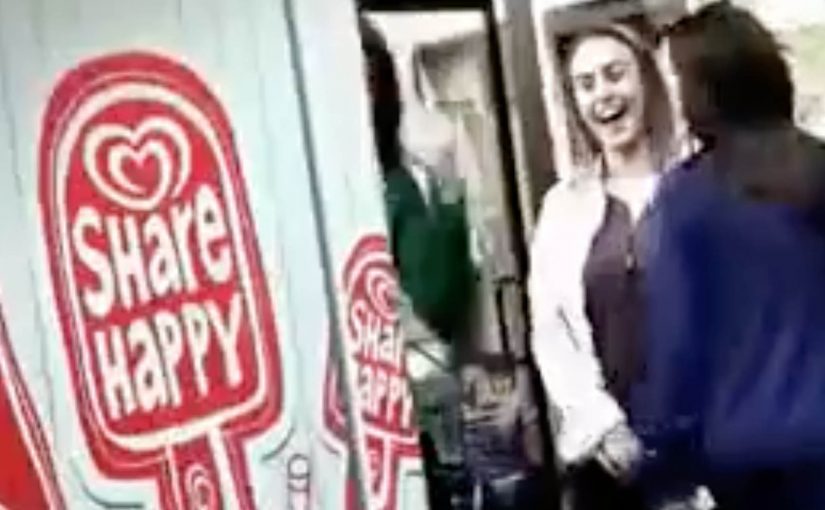
You approach an ice cream machine that refuses to work for a solo person. It only dispenses when two people participate together. The reward is simple. Free ice cream. The behaviour it creates is even simpler. Ask someone nearby to join you.
The idea. Turn a freebie into a shared ritual
Most giveaway machines are built for speed. Press, receive, leave. Share flips the script. The machine makes cooperation the trigger, so the brand message is performed in public rather than stated on a poster.
Why this mechanic works
It removes awkwardness. People have a reason to talk to strangers, and the machine becomes the icebreaker. The shared reward also creates a shared story, which is why these activations often travel well on social. Here, the mechanic is simply the rule people must follow to unlock the reward.
Extractable takeaway: When the reward depends on two people, the brand turns participation itself into proof of the idea.
Buy interaction, not just sampling
In crowded retail and event environments, the hard part is not handing out samples, but giving strangers a reason to interact in public.
The real question is not whether a free ice cream can attract attention. It is whether the brand can turn that attention into a memorable social behaviour.
Share gets that right, because the interaction is the media, not just the reward.
Steal this from the teamwork mechanic
- Make the rule obvious before people arrive. People should understand from a distance that this only works together.
- Keep the action physical and quick. The longer the interaction takes, the more the social energy drops.
- Make the reward immediate. Fast payoff is what turns a small interaction into a satisfying public moment.
- Judge success by interactions, not just giveaways. The stronger metric is how many micro-connections the brand creates between people.
A few fast answers before you act
What is the Happy Ice Cream Machine?
It is a vending-machine-style activation that dispenses free ice cream only when people participate together, so the reward is tied to cooperation.
Why require two people?
Because it forces a social moment. The brand message becomes a behaviour. Sharing is not a slogan. It is the unlock mechanism.
What makes this kind of activation spread?
It is easy to understand on video. Two strangers team up, the machine responds, and the payoff is instant. That simplicity travels.
Where does this work best?
It works best in places with natural foot traffic and a low barrier to joining in, such as retail zones, festivals, campuses, and public events.
What should you measure?
Participation pairs per hour, average dwell time, repeat attempts, and the share rate of user-generated clips during the activation window.