
Hi-Tec: Liquid Mountaineering

Hi-Tec: Liquid Mountaineering

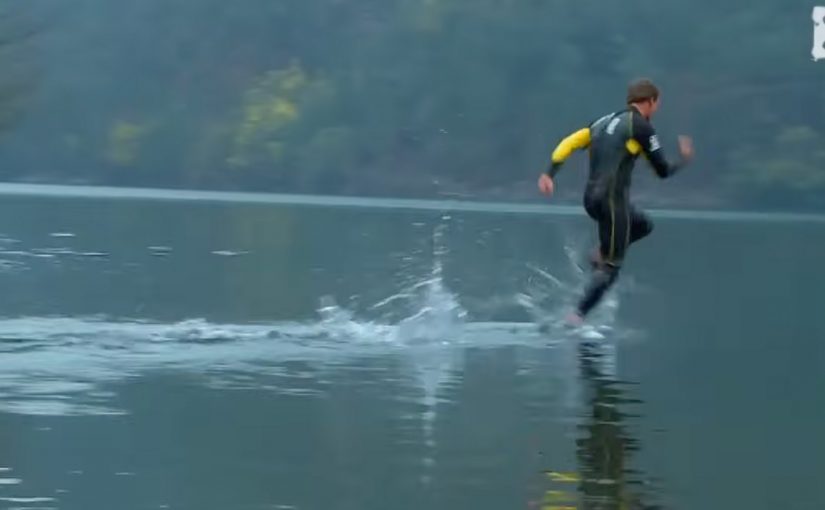
Liquid Mountaineering is a “new sport” attempting to achieve what man has tried to do for centuries: walk on water. To be more precise: run on water.

In the video, the guys claim that with the right water-repellent equipment one can run across bodies of water, like a stone skimming the surface. It is staged as a breakthrough you could learn with practice and the right kit.

How the trick is framed

The mechanism is classic pseudo-documentary: a new “discipline”, a simple sounding explanation, and footage that feels handheld enough to be believable. By pseudo-documentary, I mean it borrows documentary cues so fiction feels observed rather than advertised. The promise is deliberately literal. Not “waterproof”. “Run on water”.

In consumer sportswear marketing, a product story spreads faster when it is packaged as a spectator-proof (easy to describe in one line) “did you see that?” moment rather than a feature list.

The real question is whether viewers still associate the brand with repellency after they learn the stunt was staged.

Why it lands

It uses an impossible goal to make a real benefit memorable. You might not remember the technical claim, but you will remember the visual metaphor for repellency.

Extractable takeaway: Viral product films travel when they dramatize a benefit as an “impossible” demonstration, then let audience debate do the media buying. The trick is to make the metaphor sticky even after the reveal.

It invites disbelief and debate. The campaign gains reach because viewers argue about whether it could be real. That conversation is the distribution.

It turns product performance into myth. Hydrophobic gear becomes a superpower. The exaggeration is the hook. The brand benefit is the association with extreme performance.

Borrowable moves

  • Lead with a single outrageous claim. One sharp premise beats three sensible points.
  • Wrap the story in familiar documentary cues. “New sport” framing makes viewers do the work of believing.
  • Make the benefit visual. If the viewer can describe it instantly, they will share it.
  • Plan the reveal timing. If it is a hoax, decide when you want the truth to surface and what you want people to remember afterward.

This definitely makes a really cool viral video promoting a waterproof line of clothing, shoes and accessories that are supposedly so water repellent that you can literally run on water with them. After some training of course.

PS: The video is fake. It is a viral ad for Hi-Tec water-resistant running shoes.


A few fast answers before you act

What is “Liquid Mountaineering”?

It is presented as a new extreme sport where people can run on water with special water-repellent gear.

Is the video real?

No. The clip is a staged viral advertisement, as stated in the post’s PS.

Why make it a hoax instead of a normal product demo?

Because the “is this even possible?” question creates conversation and sharing. The debate becomes the distribution channel.

What is the product message underneath the stunt?

That the brand’s footwear and gear are highly water resistant. The film uses an exaggerated metaphor to make repellency feel dramatic.

What is the main risk of this approach?

If audiences feel deceived, the emotional swing can flip from delight to annoyance. The campaign has to make the reveal feel playful, not manipulative.

Hyundai Canada: Worst Parking Job Ever

Hyundai Canada: Worst Parking Job Ever

A parked 2004 Hyundai Elantra gets crushed in a parking lot incident captured on security footage. The clip is framed as the “worst parking job ever,” and it quickly becomes the kind of viral story that spreads because the outcome is so brutally clear.

The footage is dated October 22, 2009 in Ontario, Canada, and it puts the owner, Todd Jamison, at the center of an internet pile-on he did not ask for.

Then Hyundai Canada steps into the story. Instead of treating it as someone else’s bad day, they decide to become the helpful brand in the comments section, in real life. On October 30, 2009, they surprise Jamison with a brand new 2010 Hyundai Elantra Touring and capture the handover on film.

How the brand response is engineered

The mechanism is fast, simple, and camera-friendly. A widely shared piece of user-discovered content creates attention. The brand responds with a real-world act that resolves the narrative tension, then publishes the “resolution” as a second video that is just as easy to share as the original. Because the second video closes the loop on the first, it spreads as payoff, not PR.

In automotive PR and brand storytelling, this is the cleanest form of earned media: a human problem, a timely intervention, and a documented payoff that feels generous rather than scripted.

In North American automotive marketing, these moments recur, so the only scalable advantage is showing up with a real fix fast.

The real question is whether you can resolve the tension with a meaningful action before the internet moves on.

Why it lands

Because it completes the story people were already watching. The first video triggers disbelief and sympathy. The second video rewards that emotion with a satisfying outcome. Hyundai does not try to outshout the internet. It aligns with what viewers already want to see happen next, then makes that ending real.

Extractable takeaway: When a viral moment creates an obvious “someone should help” impulse, the best brand move is to deliver a concrete fix fast, then tell the story as a continuation, not a campaign. The sequel is the strategy.

Steal the “unexpected hero” play

An “unexpected hero” play is when a brand solves a real problem for a real person in public, and lets the action carry the story.

  • Respond to the narrative, not the metrics. If the situation has a clear moral shape, your action will travel further than your media spend.
  • Make the intervention unambiguously useful. A replacement car is simple to understand. Complexity dilutes goodwill.
  • Publish the resolution, not the process. Viewers want the moment of surprise and relief, not a corporate explainer.
  • Keep the tone human. The brand should feel like it is helping a person, not exploiting an incident.

A few fast answers before you act

What is the core story arc here?

A widely shared security clip shows a parked car being crushed. Hyundai Canada follows up by replacing the car and filming the surprise, turning shock into closure.

Why is the follow-up video essential?

Because it converts attention into meaning. Without the sequel, the story is only misfortune. With it, the story becomes relief and brand goodwill.

What makes this feel authentic instead of opportunistic?

The action is tangible and directly benefits the person who suffered the loss. The brand is not adding commentary. It is changing the outcome.

How do you decide whether to engage at all?

Engage only if you can improve the outcome for the affected person in a way that is clear on first viewing. If you cannot deliver a meaningful fix, the safest move is to avoid turning someone else’s misfortune into content.

What is the biggest risk when brands copy this approach?

Performative help. If the intervention is small, conditional, or self-serving, the audience will treat it as exploitation of someone else’s bad day.