
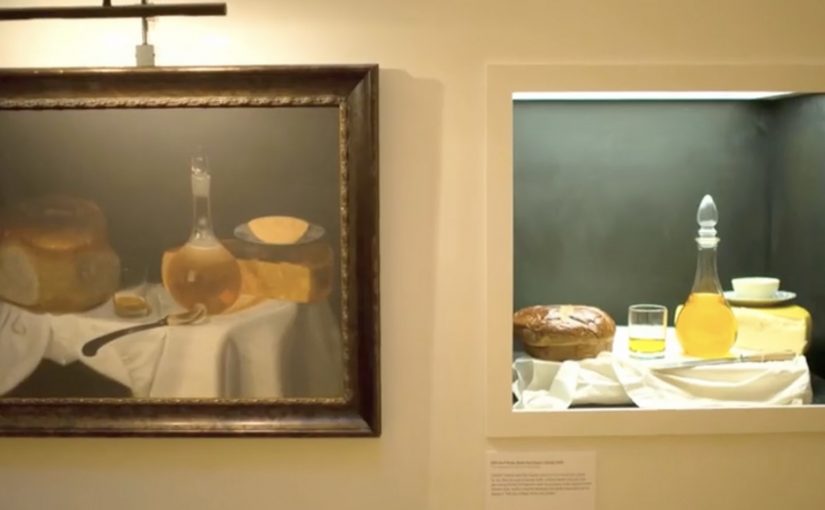
Cheese brand Castello teams up with ad agency Duval Guillaume to give New Yorkers the opportunity to taste their cheese in a very original way. A pop-up museum is set up at Grand Central Terminal, where famous still-life paintings that contain cheese are reproduced with great precision using real Castello cheeses. The difference is simple. You can smell and eat the copied works of art.
Over the course of two days, more than 500,000 visitors reportedly pass through the exhibition, and around 40,000 people actually taste the cheese.
Turning “look” into “taste”
The mechanism is sensory sampling disguised as culture. Borrow the credibility of recognizable art, rebuild it with the product itself, then let the audience complete the experience by tasting the thing they are looking at.
In urban retail environments where people are overloaded with visual messages, multisensory experiences create disproportionate stopping power because they feel like a break from advertising, not another ad unit.
Why it lands
This works because it turns product trial into a story people want to repeat. A free sample is forgettable. “I ate a painting made of cheese at Grand Central” is social currency, which means it is a simple story people want to pass on. It gives the brand an earned reason to be talked about without needing heavy branding on every surface.
Extractable takeaway: If your category wins on taste, do not hide behind claims. Build a public moment where trying the product feels like participating in something bigger than a sample.
What the business intent looks like
The real question is how to turn food sampling into a public moment people actively choose and then talk about. Castello gets scale and relevance in one move. Grand Central delivers footfall. The art framing delivers permission to pause. And the tasting converts attention into the only proof that matters for food. “It is good”. This is a stronger food-marketing move than standard sampling because it makes trial memorable.
What food brands can steal from this
- Wrap sampling in a reason to stop. People do not queue for “try this”. They queue for a moment.
- Use a familiar cultural code. Still-life paintings are instantly legible, even at walking speed.
- Let the product be the medium. When the product is literally the artwork, the message cannot be missed.
- Design for retellability. If the experience can be summarized in one sentence, it travels further.
A few fast answers before you act
What is Castello “Eat the Art”?
It is a pop-up museum experience where still-life paintings featuring cheese are recreated using real Castello cheeses, and visitors can smell and taste the “art”.
Why stage it in Grand Central Terminal?
Because high footfall increases reach, and a transit setting makes the surprise feel bigger. You find a museum moment in the middle of a commute.
Is this advertising or sampling?
It is sampling, delivered through an ambient, cultural format that makes the trial feel special rather than transactional.
What makes the concept effective for food brands?
It converts attention into taste. Food marketing becomes more persuasive when it gets people to try the product quickly, in a memorable context.
What is the simplest way to adapt the pattern?
Pick a familiar cultural frame your audience already respects, then embed product trial directly into that frame so trying the product feels like participation.