
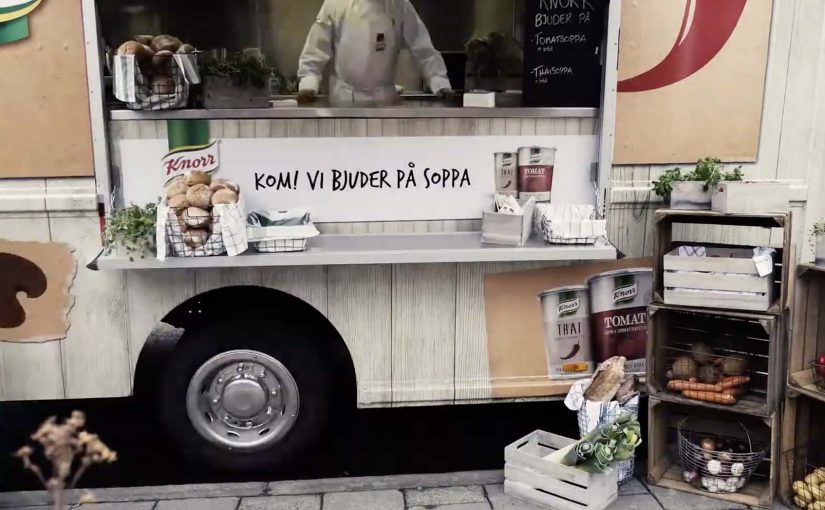
Knorr physical retargeting: iBeacon soup truck

In November, a Knorr food truck in chilly Stockholm offers free warm samples of the brand’s tomato and Thai soups. Visitors can eat it on the spot or take home the samples.

To ensure visitors can also be retargeted through relevant mobile ads, Knorr equips the truck and the sampling team with battery-powered iBeacons. Through these beacons, visitors who already have the Swedish newspaper Aftonbladet app installed are registered as having been there. Instead of pushing a coupon immediately, the campaign waits until the next time the user opens the Aftonbladet app, then serves the offer as a mobile ad on the start screen.

Physical retargeting is the practice of using a real-world visit as the trigger for a later digital message, so the follow-up feels connected to what the person actually did offline.

Why the timing choice matters more than the beacon

In FMCG sampling, delayed retargeting works best when the message arrives in a natural “open app” moment, not as an intrusive push at the street corner. The iBeacons are the plumbing, but the experience design is the restraint. The campaign avoids interrupting the sampling moment and instead chooses a later point of attention when the person is already browsing content. That shift makes the offer feel more like a relevant reminder than a forced conversion attempt. Brands should treat iBeacons as infrastructure and invest the real effort in timing and creative that respects the sampling moment.

Extractable takeaway: Treat the offline moment as the relationship builder, then use the next self-initiated “open app” moment as the conversion window.

What the campaign proves, beyond “we can target”

The real question is whether your follow-up arrives at a moment of attention the user has already chosen. Sampling often struggles with attribution. This approach creates a cleaner bridge between the street interaction and a measurable mobile impression, without requiring a QR scan or a form fill at the truck.

A repeatable offline-to-mobile loop

  • Separate experience from conversion. Let the street moment stay human, then follow up later in a calmer context.
  • Use a trigger the user already understands. “When I open the app, I see it” is easier than “enable Bluetooth, accept three prompts”.
  • Keep the reward aligned. A soup sample followed by a soup coupon is a coherent loop.
  • Design for opt-in environments. The cleanest versions of this pattern run inside existing app ecosystems where ads are already expected.

A few fast answers before you act

What is Knorr “physical retargeting” in this example?

It is an offline-to-online marketing loop where visiting the soup truck becomes the trigger for receiving a relevant offer later inside a mobile app.

Why not show the coupon immediately at the truck?

Because immediate prompting can feel invasive and can disrupt the sampling experience. Waiting until the next app open delivers the offer in a more natural attention moment.

What role does the Aftonbladet app play?

It is the environment where the follow-up ad appears. People who already have the app installed can be recognized as having visited and later see the offer when they reopen the app.

What is the core benefit for the brand?

It links a real-world sampling touchpoint to a measurable, relevant mobile follow-up, improving recall and making conversion more likely.

What is the biggest failure mode for this tactic?

If the follow-up arrives too late or feels unrelated, it reads as generic targeting. The timing and message match are what make it feel earned.
Apotek Hjärtat: Blowing in the Wind

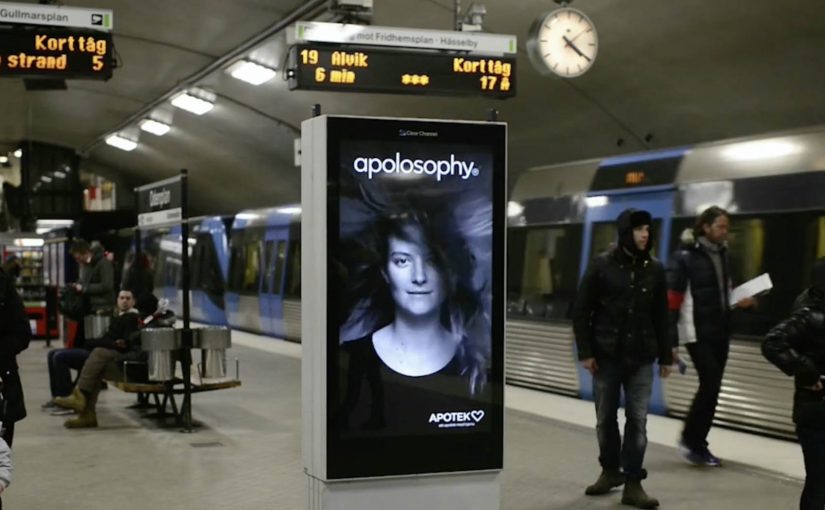
A subway platform in Stockholm. A digital screen. A model with a lush mane. Then the train arrives and her hair starts to whip around, perfectly timed to the rush of air you can feel on the platform.

To introduce a new line of hair products, Swedish pharmacy Apotek Hjärtat worked with Åkestam Holst to fit the platform screens with ultrasonic sensors. When those sensors detect an incoming train, the film switches into a “blowing in the wind” sequence, creating the illusion that the turbulence from the train is affecting the model on the screen.

The trick behind the timing

This is reactive outdoor done with restraint. Here, reactive outdoor means the screen responds to a real environmental trigger instead of running the same sequence on a fixed loop. There is no complex interface and no extra instruction for commuters. The environment provides the trigger, the sensor provides the cue, and the creative provides the payoff. The moment is over in seconds, which is exactly how long you get on a platform before attention snaps back to schedules and crowds.

In high-traffic transit environments where attention is scarce, reactive outdoor works best when it synchronizes with a real-world moment everyone already notices.

Why commuters stop

The effect feels “impossible” because it is contextual and precise. People experience the wind and see the wind at the same time. That sensory alignment is what makes it memorable, and it makes the product claim feel physical instead of cosmetic.

Extractable takeaway: If you want outdoor to earn attention, link the creative to a shared environmental trigger, and make the response immediate enough that viewers can connect cause and effect without being told.

What the brand is signaling

The story is not really about sensors. It is about vitality. The real question is whether the public moment makes the product promise feel physically true before the commuter moves on. The ad implies the product brings hair to life, then proves that idea through a living, timed reaction in a public space. You remember the feeling first, then the brand name attached to it.

What to steal for reactive outdoor

  • Pick a trigger that already exists. Trains arriving, doors opening, crowds gathering.
  • Make the payoff instantly legible. One glance should be enough to get it.
  • Use craft to hide the tech. The illusion matters more than the explanation.
  • Design for repeat viewing. Platforms are perfect for loops, because people wait.

A few fast answers before you act

What is “Blowing in the Wind”?

A reactive DOOH installation for Apotek Hjärtat where ultrasonic sensors detect an approaching subway train and trigger a film effect that makes the model’s hair appear to blow in the train’s turbulence.

What is the core mechanism?

Sensor detects train arrival. Creative switches at the same moment the real airflow hits the platform. The viewer experiences both together, which sells the illusion.

Why does it feel more persuasive than a normal screen ad?

Because it is synchronized with the physical environment. That alignment makes the message feel like something happening, not something being played at you.

What is the most common mistake when copying this pattern?

Overbuilding the interaction. If viewers need instructions, or if the trigger is unreliable, the magic disappears and the screen becomes just another screen.

Why does the product claim feel more real than in a standard beauty ad?

Because the demonstration is tied to a real physical cue on the platform. That makes the benefit feel observed in the moment, not merely claimed in the creative.

Friskis&Svettis Stockholm: #friskissthlm

January in Sweden is when gyms and health clubs go loud, chasing everyone who made the classic New Year’s resolution to start exercising. Stockholm-based health club Friskis&Svettis is no exception.

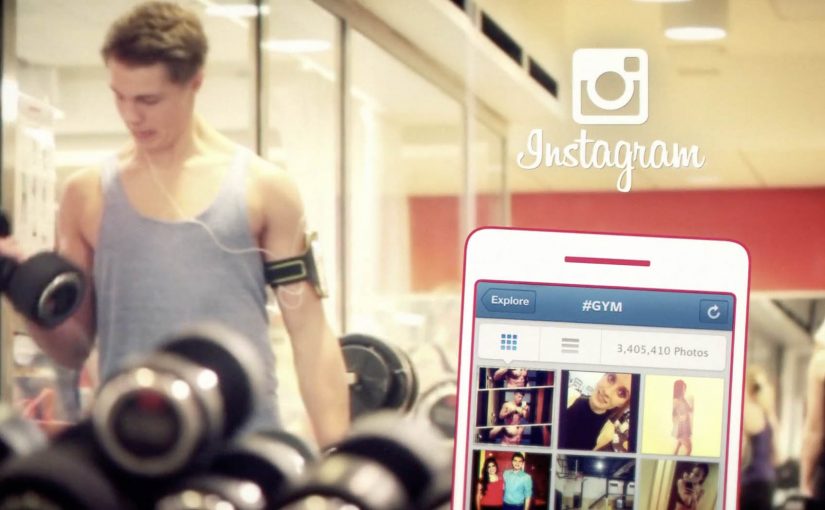
Because Friskis&Svettis is a non-profit association owned by its members, they and their agency Volt build a campaign where members inspire the wider community. A hashtag, #friskissthlm, invites people to work out, photograph the moment, and tag their pictures, so the members themselves become the creative running “around Stockholm”.

How the member-driven mechanic scales

The mechanism is participation as media: member actions create the content and also help distribute it. Instead of producing a single hero ad, the brand defines one simple behavior: train, post, tag. The hashtag becomes the aggregation layer, a single place where the posts collect and stay discoverable, and every new image becomes both proof and invitation. The campaign’s distribution is powered by the same thing gyms want more of in January: visible momentum.

In member-owned fitness communities, letting real members supply the proof tends to land harder than brand-led messaging, because the social permission comes from peers rather than from advertising.

The real question is not how to make a louder January gym ad, but how to make visible member momentum easier to join. The stronger move here is to make member behavior the campaign, not to outshout every other club in January.

Why it lands

It turns the most fragile moment in fitness, starting, into something public and shareable without making it complicated. The posts do two jobs at once. They show variety (different workouts, different people, different branches) and they reduce intimidation, because the “campaign face” is not a model, it is your neighbor.

Extractable takeaway: If you want community growth, choose one repeatable participation unit and one clear tag, then let volume and variety do the persuasion. Your members become the credibility layer.

What to borrow for your own January push

  • Make the ask behavioral. “Work out, post, tag” is easier to follow than “join our movement”.
  • Let variety do the selling. Many small proofs beat one polished claim, especially in fitness.
  • Turn members into the creative. It is cheaper, more credible, and naturally localized.
  • Design for aggregation. One hashtag, one place to browse, one loop that keeps filling itself.

A few fast answers before you act

What is #friskissthlm in one sentence?

A member-powered Instagram hashtag campaign where workouts posted and tagged by members become the campaign content for Friskis&Svettis Stockholm.

Why is this stronger than a typical January gym ad?

Because the proof is peer-generated. People trust “someone like me did this” more than they trust a brand saying “you should”.

What is the key design decision?

Keeping the participation unit tiny and repeatable, so the barrier to contributing stays low while the content volume stays high.

What is the main risk with hashtag-led campaigns?

If the tag is not actively adopted, the feed looks empty and the idea collapses. You need early seeding from members and staff so momentum is visible from day one.

How would you adapt this outside fitness?

Keep the pattern, not the category. Pick one repeatable action people are already willing to do, give it one clear tag or container, and make the resulting proof easy for others to browse and copy.