
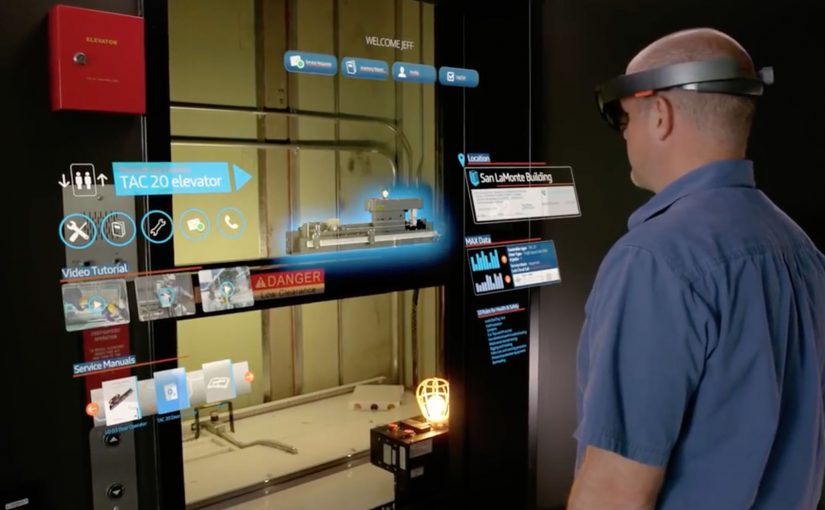
Microsoft HoloLens: Elevator Maintenance

Augmented reality leaves the demo room

Microsoft HoloLens is not only about futuristic consumer experiences. Its real power emerges in enterprise environments.

A strong example is ThyssenKrupp, which uses HoloLens to redefine how elevator maintenance is performed in the field.

Instead of relying on manuals, phone calls, or trial and error, technicians receive contextual, real-time information directly in their line of sight.

How HoloLens changes elevator servicing

With HoloLens, elevator technicians see what they need while keeping their hands free.

Technical documentation, schematics, and checklists appear as holograms overlaid onto the physical elevator system.

Remote experts can see exactly what the technician sees and guide them step by step.

This turns maintenance into a guided, collaborative process rather than an isolated task.

In industrial field service teams, the constraint is getting expert judgement to the point of work fast enough to prevent rework and downtime.

Why this matters for industrial operations

The impact goes beyond convenience. Because guidance is delivered in-context and hands-free, technicians can complete complex steps with fewer avoidable mistakes.

Extractable takeaway: When you embed expert guidance into the job itself, you turn specialist knowledge into a repeatable operating system for the frontline.

The real question is whether you can make frontline expertise repeatable inside the workflow, not whether you can ship an AR pilot.

Enterprise AR is worth doing when it removes friction from real maintenance workflows, not when it adds another screen.

  • Reduced downtime
  • Shorter training cycles
  • Improved first-time fix rates

Most importantly, expertise becomes scalable.

Knowledge is no longer locked in the heads of a few specialists. It becomes part of the workflow.

A glimpse of the future of work

This use case shows what augmented reality does best.

It does not replace workers. It augments them.

Complex tasks become easier. Errors decrease. Confidence increases. Work becomes safer and more efficient.

This is where mixed reality stops being a novelty and starts being infrastructure. By mixed reality here, I mean digital guidance and remote expertise anchored onto the physical job, not a virtual-world detour.

What to copy from this AR service pattern

  • Instrument the moment of work. Put the next step where the technician is looking, not in a manual that forces context switching.
  • Make escalation visual. Let remote experts share the same view so guidance is specific and actionable.
  • Scale expertise as workflow. Capture checks, sequences, and decision points so outcomes do not depend on a few specialists.

A few fast answers before you act

What is the Microsoft HoloLens elevator maintenance use case?

ThyssenKrupp uses Microsoft HoloLens so field technicians can see schematics, checklists, and contextual guidance overlaid onto the elevator system while working hands-free.

How does HoloLens change the maintenance workflow?

It puts documentation and step-by-step instructions into the technician’s line of sight, and enables remote experts to see what the technician sees so they can guide the job in real time.

Is this only relevant for elevators?

No. The same pattern applies to any field service or industrial maintenance scenario where hands-free guidance, fast troubleshooting, and expert escalation reduce downtime and errors.

What is the measurable value driver in enterprise AR like this?

Reduced downtime, faster training, and higher first-time fix rates. The key is that expertise becomes repeatable and scalable inside the workflow instead of remaining locked in a few specialists.

Where does this pattern break down?

It breaks down when the underlying documentation is outdated, connectivity is unreliable, or remote support is not operationalized. The hardware alone does not change outcomes.

Volvo Keyless Cars

You land at Gothenburg airport, walk up to your car. There is no key handover. No kiosk. No awkward “where did I put it?”. You unlock the door with your phone, start the engine, and drive off. That is the behavioral shift Volvo is putting on the table as it pilots a Bluetooth-enabled digital key. The physical key stops being the default. The car starts behaving like a shareable service.

Volvo’s plan is straightforward and bold. Replace the physical car key with a mobile app that acts as a digital key. It locks and unlocks doors and trunk. It also allows the engine to be started. Volvo intends to roll this out to a limited number of commercially available cars in 2017, with real-world testing beginning in spring 2016 via Sunfleet at Gothenburg airport in Sweden. Physical keys remain available for people who want them.

What “keyless” really changes

Most coverage of keyless cars focuses on convenience. That is real, but it is not the headline. The headline is that the key becomes software, and software is shareable, revocable, time-bound, and measurable.

Once the key is an app, a car can be:

  • Shared without meeting up. You can grant access remotely, without physically transferring anything.
  • Granted for a window of time. A key can expire after a set period, or be limited to a specific day.
  • Revoked instantly. Access can be removed without changing locks or reissuing hardware.
  • Audited. Digital access can create a clean trail of who had access, when, and potentially under what conditions.

Those are not just UX improvements. They are the primitives of “car as a platform,” meaning a vehicle where access and entitlement are programmable.

The real question is whether turning the key into software makes sharing trustworthy and reversible, without adding friction in everyday edge cases.

In mobility services and car-sharing operations, making access software is the quiet foundation for scalable sharing, service models, and trust.

The strategic unlock for car sharing and new mobility behavior

Volvo is not positioning this as a novelty feature. The real-world test through Sunfleet is the tell. Keyless is a missing piece for car sharing because physical keys create friction at exactly the moment you need trust and speed.

Extractable takeaway: When an entitlement becomes software, the hard problem shifts from logistics to permissions, which is why sharing can scale without constant handoffs.

When access is digital:

  • You can share your own car more safely, because you do not need to hide a key or coordinate handoffs.
  • You can operate fleets with lower operational drag, because key logistics shrink.
  • You can start designing new use cases that are impractical when keys are physical.

This is where brand storytelling gets interesting. Volvo is not “marketing an app.” It is marketing an engineered shift in how the product behaves. The brand moves from sheet metal and safety features to a designed system of access, trust, and mobility.

What the digital key needs to get right

Moving the key to a phone is a promise. It must hold up in the messy reality of travel days, dead batteries, and edge cases.

A credible keyless experience typically needs clear answers to:

  • What happens if the phone battery dies? (Fallback options matter, including a physical key for those who want it.)
  • How does identity and authorization work? (Who can issue a key. Who can revoke it. What is the recovery path.)
  • How secure is the handoff? (Bluetooth is convenient. It also raises expectations around encryption, pairing, and spoofing resistance.)
  • How does it work for families and multi-driver households? (Multiple keys, multiple devices, and different permissions.)
  • How does it behave when connectivity is weak? (Airports and parking structures are not always friendly environments.)

None of these are reasons to avoid keyless. Keyless is worth doing, but only when fallbacks and recovery are designed as first-class features.

The marketing lesson hiding inside the engineering

This is a strong pattern in modern innovation storytelling. A brand earns attention when the innovation is tangible and legible. Not “we are digital.” Instead, “a thing you used to do physically becomes software, and your behavior changes.”

For Volvo, the narrative is easy to grasp:

  • The key becomes an app.
  • Access becomes shareable.
  • Mobility becomes more flexible.

That is the kind of product story that travels well. It is engineering that people can feel.

Steal the pattern: access becomes software

  • Reframe the benefit. Lead with “the key becomes software,” then show sharing, revocation, and time-bounding as the real unlock.
  • Design trust into the edge cases. Dead batteries, weak connectivity, and recovery paths decide whether the behavior shift sticks.
  • Make sharing operationally cheap. When keys stop being objects, handoffs and key logistics stop being the bottleneck.
  • Use auditability to increase confidence. If access is trackable, it can support clearer accountability and faster issue resolution.

A few fast answers before you act

What is a digital car key?

A digital car key is a phone-based key that can replace the physical key for core actions like locking, unlocking, and starting the car.

Why does keyless matter beyond convenience?

Because access becomes programmable. You can share it, time-limit it, revoke it, and potentially audit it. That changes how ownership and sharing can work.

What is Volvo actually proposing here?

A Bluetooth-enabled app that replaces the physical key, with a real-world test through Sunfleet at Gothenburg airport, and a limited rollout planned for 2017. Physical keys remain available.

What is the immediate business implication for mobility services?

Lower friction. Less operational overhead around key handling. More flexible sharing models for fleets and individuals.

What must be true for this to feel trustworthy?

Clear fallbacks and recovery paths, secure authorization and revocation, and a user experience that holds up in real-life edge cases like dead batteries and poor connectivity.

Hyundai: Virtual Guide AR App for Owners

An owner’s manual you point at the car

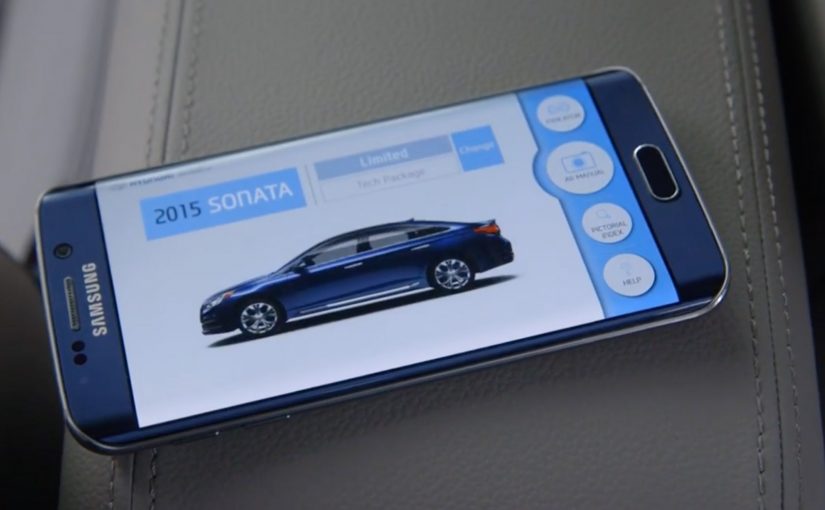
To make life easier for car owners, Hyundai has built an augmented reality app called the Virtual Guide. It allows Hyundai owners to use their smart phones to get more familiar with their car and learn how to perform basic maintenance without delving into a hundred page owner’s manual.

Here, augmented reality means on-screen overlays that label real-world parts and show step by step guidance while you view the car through the phone camera.

Here is a short demo video of the app from The Verge at CES 2016.

The clever part: help appears exactly where you need it

Instead of searching through pages, you point your phone at the car and learn in-context. That one shift. From reading about a feature to seeing guidance on the actual part. Makes learning faster and less frustrating.

In consumer product and mobility brands, the highest-value help shows up at the moment of use, not in a document you have to hunt for.

The real question is whether your product help meets people where the problem happens, or sends them off to search.

In-context, camera-based guidance should be the default for “how do I” tasks. Manuals should be the fallback.

Why this is a big deal for everyday ownership

Most drivers do not ignore manuals because they do not care. They ignore them because the effort is too high at the moment they need help. AR lowers that effort by turning “How do I…?” into a quick visual answer while you are standing next to the car.

Extractable takeaway: If you can put guidance on the real object in front of someone, you remove the search step. That makes follow-through more likely.

What Hyundai is really building here

Fewer support moments, fewer avoidable service misunderstandings, and a smoother owner experience that strengthens trust in the brand long after purchase.

The Virtual Guide app will be available in the next month or two for the 2015 and the 2016 Hyundai Sonata and will come to the rest of the Hyundai range later on this year.

Patterns to borrow for product help

  • Move instruction from documentation into the environment. In-context guidance beats search.
  • Design for the real moment of need. Standing next to the product, phone in hand.
  • Make “basic maintenance” feel doable. Confidence is a retention lever.

A few fast answers before you act

What is Hyundai Virtual Guide?

An augmented reality app that helps Hyundai owners learn car features and perform basic maintenance using a smartphone instead of relying on the printed owner’s manual.

How does it work in practice?

You use your phone to view parts of the car and get guidance designed to help you understand features and maintenance steps in context.

Which models does the post say it supports first?

The post says it will be available first for the 2015 and 2016 Hyundai Sonata, then expand across the Hyundai range later in the year.

Where was the demo shown?

The post references a demo video from The Verge at CES 2016.