
Tooth Fairy: Pneumatic Transport

Tooth Fairy: Pneumatic Transport

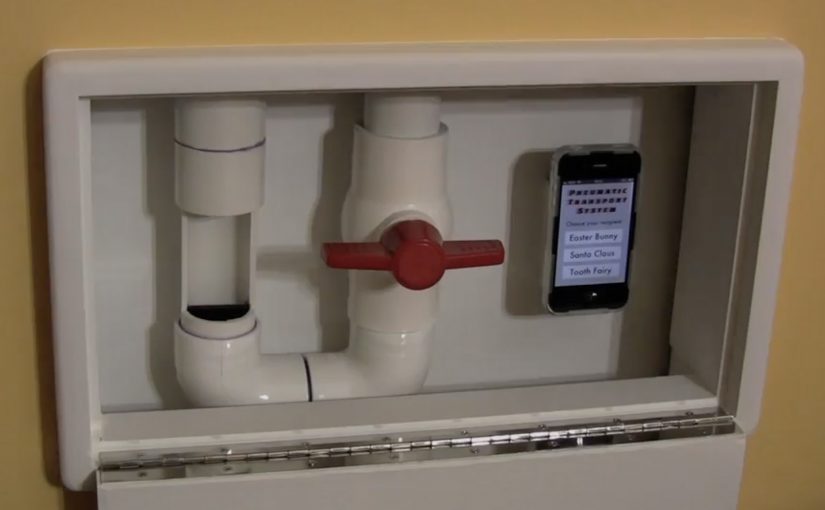
A child loses a tooth, drops it into a capsule, and sends it away through a pneumatic tube. A moment later, a second capsule arrives back with the Tooth Fairy’s payment.

Jeff Highsmith, a father of two, decided to re-write the Tooth Fairy routine with a pneumatic transport system built into his house. He set it up with 1.5" PVC pipes, a central vacuum in the attic, and two endpoint stations, one in each child’s room. When a tooth came out, it went into a small plastic bottle that travelled through the system, while a parent loaded money into another bottle at the other station and sent it back.

A ritual redesigned as a “send and return” loop

The mechanism is a closed-loop exchange. Tooth goes in. Capsule moves. Payment comes back. This matters because visible movement turns an invisible promise into something kids can witness, which makes the ritual feel more credible. The stations make the experience legible and ceremonial, while the vacuum-driven transport makes it feel like the Tooth Fairy is “on the other end” even though the system stays entirely within the home.

In maker households, the quickest way to modernize a family ritual is to turn it into a tangible, repeatable system that feels magical to kids and practical for parents.

Why it lands as modern folklore

This works because it preserves the core emotion of the Tooth Fairy. Anticipation, mystery, reward. Here, “modern folklore” means a familiar family story made credible through a repeatable household ritual. The real question is not how to digitize the Tooth Fairy, but how to make the ritual feel more believable without making it feel less magical. This is a smarter update than adding more screens or complexity, because the physical loop strengthens the illusion while simplifying the parent job. The build also lets the story scale across siblings, since each child has their own station and repeatable moment.

Extractable takeaway: If you want to update a tradition without losing its charm, keep the same emotional arc, then redesign only the delivery mechanism so the magic feels more believable, not more complicated.

More details about the pneumatic system and the Python code for the mobile web interface can be found here.

What to steal for playful “systems thinking” at home

  • Make the interface physical. A station or ritual object matters more than hidden automation.
  • Design for repeatability. If it can run the same way every time, kids trust it and look forward to it.
  • Separate mystery from maintenance. Keep the “magic side” visible and the parent side easy to operate.
  • Document the build. A clear write-up turns a one-off family project into something others can replicate.

A few fast answers before you act

What is the core idea of the pneumatic Tooth Fairy system?

A home pneumatic tube loop that lets kids send teeth in a capsule and receive the Tooth Fairy’s payment back through a return capsule.

What materials and layout does the build use?

1.5" PVC pipes, a central vacuum in the attic, and endpoint stations in each child’s room, with small bottles used as capsules.

Why is this better than the traditional “money under the pillow” routine?

It keeps the same reward moment but makes the exchange visible and immediate, while reducing the need for parents to sneak around at night.

What makes the experience feel magical rather than mechanical?

The station ritual and the movement of the capsule. The child can see the “sending” happen, which reinforces the story.

Who should build something like this?

Anyone comfortable with a basic DIY project involving PVC piping and a vacuum-driven transport loop, and who wants to create a repeatable family ritual.


Roman Atwood: The World’s Most Contagious Prank

Roman Atwood: The World’s Most Contagious Prank

Here is an infectious yawning video created by YouTuber Roman Atwood. Try watching this nearly three minute clip of constant yawning without letting one loose yourself. I could not help but yawn while watching it.

The simplest mechanism in the world

The mechanism is pure mimicry and suggestion. You see a yawn. You anticipate a yawn. Then your body does the rest. The prank is not about shock. It is about stacking the same trigger again and again until your reflex gives in.

In social video, simple human reflexes and repeatable triggers can outperform high production because the viewer feels personally involved.

Why it lands

This works because it turns the viewer into the subject. The content is not only “watch someone yawn”. It is “can you resist”. That tiny competitive frame, a simple self-test with a clear pass-or-fail outcome, creates attention, and attention makes the reflex even harder to ignore. The real question is how you turn a passive viewer into an active participant with almost no friction. The smarter lesson for marketers is that participation can beat production value when the trigger is immediate and universal.

Extractable takeaway: If you can anchor a video around a universal, involuntary response and wrap it in a clear challenge, the audience participates while they watch. Participation is what makes the clip shareable.

How to build your own contagious challenge

  • Start with the reaction you want: pick a response that is immediate and universal, then build backwards.
  • Use repetition with purpose: one trigger is a gag. Many triggers become a challenge.
  • Make the premise explainable in one sentence: “watch this without yawning” is the whole pitch.
  • Let viewers test themselves: self-tests create comments, shares, and rematches.
  • Keep it short and focused: the tighter the loop, the stronger the contagion.

A few fast answers before you act

What is “The World’s Most Contagious Prank”?

It is a yawning prank video where the creator yawns repeatedly in public to see if bystanders and viewers “catch” the yawn reflex.

Why do people share videos like this?

Because the challenge frame is social. People want to test friends, compare reactions, and prove whether they can resist.

Is this a prank or a social experiment?

It sits in between. It uses a prank setup, but the entertainment comes from observing a predictable human reflex spread from person to person.

What is the key lesson for video marketing?

Design around a specific viewer response, then make the viewer feel like the outcome depends on them.

What is the main risk of copying this format?

If the trigger is not truly universal or the loop feels repetitive without payoff, people drop off quickly. The mechanic has to be instantly felt, not only understood.

Popcorn Indiana: The Popinator

Popcorn Indiana: The Popinator

You say “pop”. A machine swings toward you and launches a single piece of popcorn into your mouth.

Thinkmodo created “The Popinator”, a gadget built as a playful piece of brand content. It is presented as a voice-triggered system that can pinpoint where the spoken word originated in a room, then fire popcorn in that direction. Popcorn is described as being shootable up to 15 feet, and the device is described as intended for indoor use.

How the gag is engineered

The mechanism is deliberately simple to explain. A keyword prompt. Direction finding. A rotating launcher. One kernel per “command”. The build turns a familiar snack habit into a mini spectacle that feels like a “future gadget”, even if you never plan to own one.

In consumer marketing where product messages blur quickly, a physical prop that demonstrates one absurdly clear benefit can generate more talk than another round of feature claims.

Why it lands

It works because it compresses the whole story into a single, repeatable moment. Say the word. Watch the machine react. See the payoff. The format is built for office viewing, quick sharing, and the social proof of “we tried it and it actually did something”.

Extractable takeaway: If you want earned reach fast, create a one-line premise people can test in their heads instantly, then design the payoff so it reads clearly on camera without explanation.

What the brand is really buying

This is not only about popcorn. It is about attention and imagination. The Popinator reframes an everyday product as something playful and engineered, then lets the internet do the distribution work by debating whether the gadget is “real” and how it works. The real question is whether one absurd, repeatable demo can make a commodity snack feel worth talking about. The stronger brand move here is making the behavior memorable, not pretending the hardware is the story.

What to borrow from The Popinator

  • Build a single, legible “demo moment”. One trigger. One reaction. One payoff.
  • Make the prop do the talking. The less narration required, the more shareable the clip becomes.
  • Design for repeat attempts. Repetition is content when the mechanism is satisfying to watch.
  • Let curiosity drive comments. “Is it real” is a distribution engine when handled responsibly.

A few fast answers before you act

What is The Popinator?

A popcorn-launching machine created as brand content, presented as firing kernels toward whoever says the word “pop”.

What is the core mechanism?

A keyword prompt triggers direction-finding, then a rotating launcher fires one kernel toward the sound source.

Was it a real product you could buy?

It is presented as a prototype-style gadget for content. Some coverage from the time frames it as a marketing stunt rather than a commercial device.

Why do “fantasy gadget” videos travel so well?

They borrow the credibility of product demos while delivering entertainment. Viewers share them as a mix of “I want this” and “no way this is real”.

What is the safest reusable lesson for brands?

Turn a mundane product habit into a surprising, visual demonstration that can be explained in one sentence and enjoyed in under a minute.