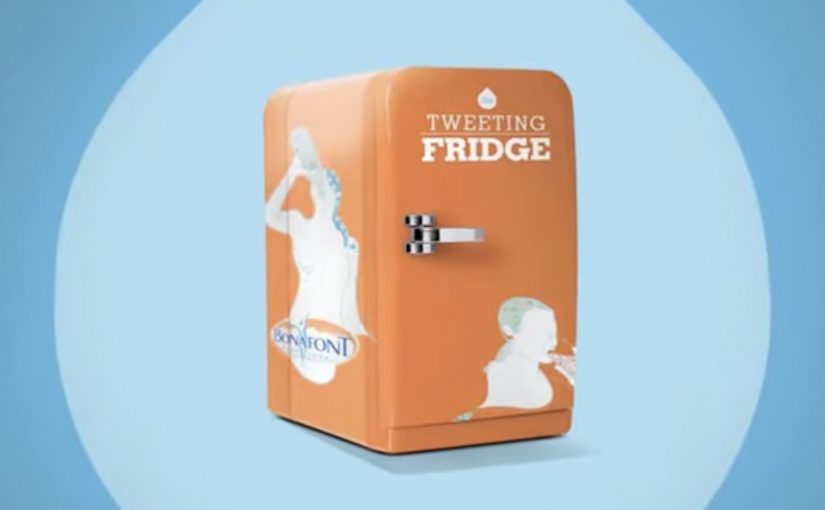
The campaign starts with a simple gift. Bonafont sent a mini fridge stocked with 2 liters of bottled water to an influential Twitter personality in Brazil.
The twist was inside the door. The fridge was wired so every time it was opened, a tweet was automatically posted on the celebrity’s account, signaling to thousands of followers that they were drinking water. With a library of pre-written messages, the feed stayed fresh while the behavior stayed consistent.
In other words, hydration became a public ritual, and the act of opening the fridge became the publishing trigger, meaning the moment that automatically creates the post.
The most effective reminders are the ones that piggyback on social proof from people an audience already pays attention to.
A social reminder disguised as a connected object
The mechanism is straightforward. A door-open event triggers a social post. The creative leap is turning a private habit into a visible cue, so the audience gets a repeated prompt without ever being directly targeted by an ad. It is an Internet-of-things demo used as a behavioral nudge.
In global consumer health and FMCG marketing, habit cues scale best when they ride on routines people already perform and signals people already notice.
Why it lands
People rarely fail to drink water because they disagree with the idea. They fail because they forget, especially during work hours. This execution attacks the memory problem, not the belief problem. It also makes the reminder feel lighter. You are not being lectured by a brand. You are seeing someone you follow take a sip.
Extractable takeaway: When the behavior you want is repetitive and easy to forget, attach the reminder to a reliable physical trigger and let social proof do the distribution, so the message spreads as a habit signal, not a campaign slogan.
The real question is whether your reminder can show up as a lightweight cue at the moment of action, rather than as persuasion delivered in advance.
This is a pattern worth copying when “forgetting” is the main barrier and the trigger can be made automatic.
Stealable moves for your next behavior-change activation
- Choose a trigger that is automatic. Door opens, post happens. No extra step means no drop-off.
- Borrow credibility from the right messenger. The influencer is not decoration. They are the proof carrier.
- Keep content variation ready. Repetition builds habit, but repetition with identical copy feels spammy.
- Make the action visible, not the persuasion. Showing the behavior is often more powerful than explaining it.
- Scale through a simple rotation model. Passing the object to new personalities keeps attention without redesigning the system.
A few fast answers before you act
What is “The Tweeting Fridge” in one sentence?
A connected mini fridge that automatically tweets when the door is opened, using social proof to remind followers to drink water.
Why is the fridge better than a normal “drink water” campaign?
Because the reminder is tied to a real-world trigger and delivered through a trusted voice, so it feels like a habit cue rather than an ad.
What problem does it solve for the brand?
It increases consumption by turning “forgetting” into “remembering,” using repeated prompts that keep the brand present at the moment of use.
What is the biggest risk if a brand copies this idea?
Over-automation. If the posting feels spammy or deceptive, audiences can turn against the brand and the influencer at the same time.
How do you keep an automated post from feeling spammy?
Use a small rotation of natural messages and avoid excessive frequency, so the automation reads like a habit signal instead of a bot loop.