CJ Entertainment relies heavily on conventional movie posters, but posters are less and less likely to interrupt the smartphone generation. So instead of fighting the phone, CJ and Cheil put the poster inside the phone’s everyday behavior.
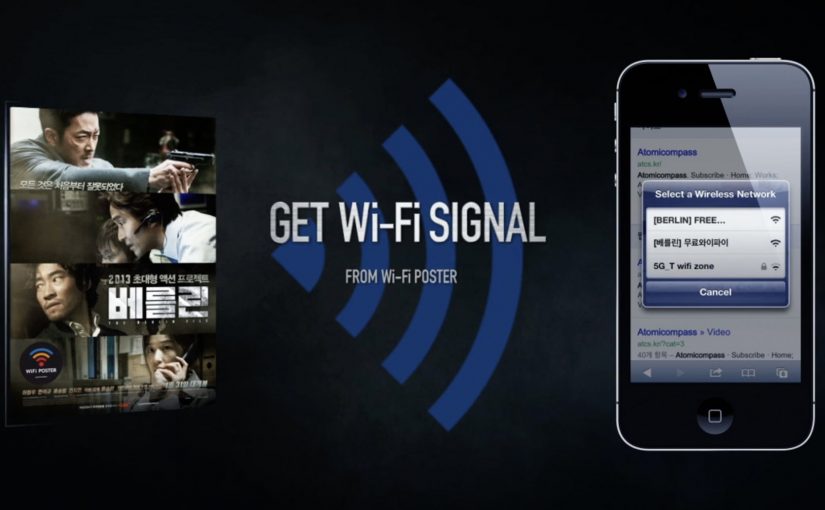
The Wi-Fi Poster turns a print billboard into something you can “tap” without installing anything. The poster includes a Wi-Fi access point. When you open your Wi-Fi menu, the film title appears as a network name. Tap it, and you get a pop-up style landing experience with links to Full HD trailers, promotional events, and online box office pages.
A low-friction alternative to QR code behaviors
Unlike QR executions that often depend on an app download and an extra scan step, this approach uses a native menu people already open. The discovery surface is the Wi-Fi list itself. The call to action is implicit. The “button” is the network name.
The real question is whether the interaction lives inside a default phone behavior or asks people to learn a new one.
This is the more defensible pattern for making print actionable: reduce steps by building on native phone UI, then deliver value immediately.
In dense, urban out-of-home environments where attention is already filtered through the smartphone, the best poster innovations behave like utilities rather than additional media.
Why it lands with young moviegoers
This idea is persuasive because it makes the poster actionable in one step, and it rewards the action immediately with content that matches intent. If someone is curious enough to tap, they are already in “tell me more” mode, so trailers and ticket links feel helpful rather than intrusive.
Extractable takeaway: When a medium is becoming invisible, do not add complexity to “modernize” it. Remove steps. Attach the experience to a native phone behavior, then pay the user back instantly with something they actually came for.
Reported outcomes that matter to marketers
Case write-ups for the work report a 28.5% increase in official-site traffic from wireless users, and that Wi-Fi Poster visitors stayed on the site around five times longer than regular users. The same write-ups also describe access points logging connections, page views, and paths toward online ticket sales, tying the novelty back to measurable intent and conversion.
Patterns to copy from the Wi-Fi Poster
- Use the phone’s default UI. Build on menus people trust, not on new behaviors you need to teach.
- Make the first interaction binary. Tap once. Get value immediately.
- Let naming do the branding. A network name can carry the message without shouting.
- Instrument the experience. If you can log connections and downstream actions, you can defend the idea beyond “cool.”
A few fast answers before you act
What is the Wi-Fi Poster concept?
A movie poster fitted with a Wi-Fi access point that appears in a phone’s Wi-Fi network list as the film title. Tapping it opens a mobile landing experience with trailers, events, and ticket links.
Why is it better than a QR-code poster in many situations?
It removes steps. No scan flow and no app dependency. The interaction starts in a native phone menu, which lowers friction and increases the chance of completion.
What is the core mechanism that makes it work?
Discovery through the Wi-Fi list, followed by a captive-portal style content gateway, meaning a web page that opens immediately after you join the network, which converts curiosity into immediate information and next actions.
What should you measure if you run something like this?
Connections per location, completion rate to the landing experience, content engagement time, click-through to ticketing or key pages, and conversion proxies like advance sales or sign-ups.
What can make this fall flat?
Confusing network naming, slow join and load times, or a landing experience that does not pay back the tap immediately will cause drop-off. Keep the first screen fast, clear, and aligned to “watch trailer” or “buy tickets.”