
Skip to content
Ramble Logo

SunMatrix Ramble

What Matters in Marketing and Digital Innovation

  • ABOUT
  • CONCEPT INDEX
  • CONTACT

Categories

Tag: captive portal

Scrabble WiFi: earn free minutes by spelling

Scrabble WiFi: earn free minutes by spelling

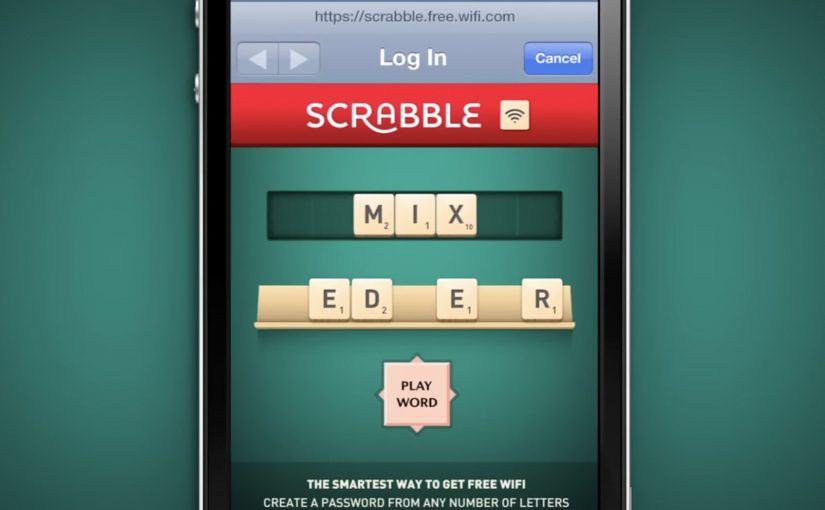
There are places in Paris where you can’t get any Internet connection. So Ogilvy Paris sets up free Wi-Fi hotspots in these areas and incentivises people to use them by first playing a short game of “Scrabble WiFi”.

Once the user proves their spelling skills, the score from the word is converted into free Wi-Fi minutes. The higher you score, the longer the connection. Sharing the score on Facebook doubles the connection time.

How “Scrabble WiFi” works as a hotspot experience

The idea uses a captive portal. That is the login page you see after joining a public Wi-Fi network. Instead of a password form, the portal presents a quick Scrabble-style word challenge and converts your result into time-based access.

  • Select the Scrabble hotspot network.
  • Play a short word round to prove spelling skills.
  • Convert the word score into Wi-Fi minutes.
  • Share on Facebook to double the time.

In cities where people regularly hit connectivity dead zones, turning access into a tiny game can make a utilitarian moment feel like a brand interaction.

The real question is whether your access gate can feel like a fair value exchange instead of a form-filled hurdle.

Why it lands: the reward is immediate and proportional

Most Wi-Fi gates feel like friction. This one feels like a fair trade: you invest a few seconds, you get online. The scoring mechanic makes the reward feel earned, and the “double time” social layer gives people a simple reason to broadcast what they just did. This is a stronger pattern than pushing people through a generic gate because it makes the unlock feel earned and quick.

Extractable takeaway: When you must gate access, use a tiny skill challenge with a proportional reward so the friction reads as a fair trade, not a hurdle.

What Scrabble is signalling with this mechanic

Scrabble WiFi frames spelling as a useful real-world skill, not just a boardgame pastime. It puts the brand in the same place people already reach for their phones and creates a repeatable reason to engage: better words mean more time online.

What to steal for your own “play to unlock” idea

“Play to unlock” means you swap a short interaction for immediate access, with the reward tied directly to what the user just did.

  • Make the trade obvious. One action, one reward, with no hidden steps.
  • Keep the game short. If the unlock takes too long, it stops being a reward.
  • Use proportional rewards. Performance-based access feels fairer than random allocation.
  • Add a clean share multiplier. Doubling time is easy to understand and easy to explain.

A few fast answers before you act

What is Scrabble WiFi?

It is a free hotspot concept where you unlock Wi-Fi minutes by playing a short Scrabble-style word game, with your score converted into connection time.

Why convert a word score into minutes?

It creates a simple value exchange. Better spelling performance earns a longer session, which makes the reward feel earned and transparent.

What does Facebook sharing add to the mechanic?

It turns an individual unlock into public reach by offering a clear incentive: share your score and your connection time doubles.

What is a captive portal in this context?

It is the login or welcome page that appears after you join a public Wi-Fi network. Here it is used to run the mini-game before granting access.

What should you measure if you run something like this?

Track successful unlocks, average session minutes earned, share rate, repeat plays, and sentiment, then compare against the cost of providing access.
Posted on July 1, 2013March 2, 2026Categories Marketing Strategies, Mobile, Power of OnlineTags Cannes Lions, captive portal, Digital Convergence, Experiential Marketing, facebook, France, free Wi-Fi, free wifi minutes, gamification, Mobile, Ogilvy, Ogilvy Paris, paris, password, Scrabble, Scrabble Portable Wi-Fi Campaign, Scrabble Wi-Fi, Scrabble Wi-Fi Minutes, social sharing, spelling, wifi, wifi hotspots
CJ Entertainment: The Wi-Fi Poster

CJ Entertainment: The Wi-Fi Poster

CJ Entertainment relies heavily on conventional movie posters, but posters are less and less likely to interrupt the smartphone generation. So instead of fighting the phone, CJ and Cheil put the poster inside the phone’s everyday behavior.

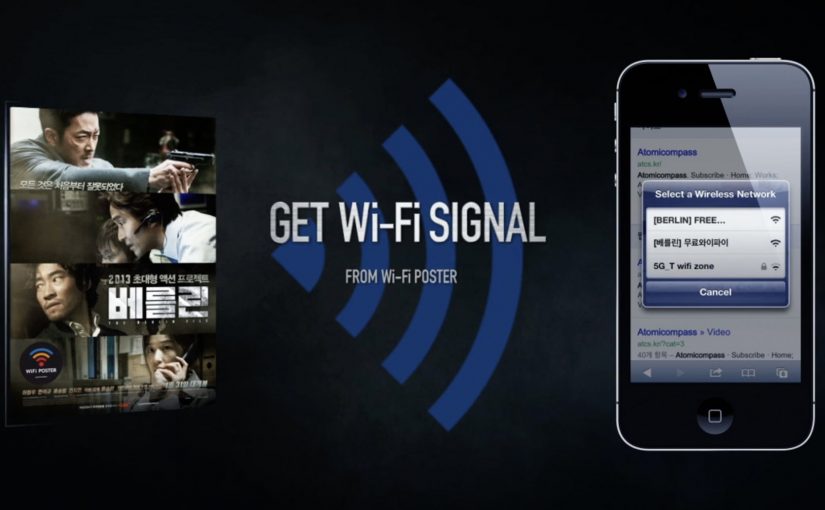
The Wi-Fi Poster turns a print billboard into something you can “tap” without installing anything. The poster includes a Wi-Fi access point. When you open your Wi-Fi menu, the film title appears as a network name. Tap it, and you get a pop-up style landing experience with links to Full HD trailers, promotional events, and online box office pages.

A low-friction alternative to QR code behaviors

Unlike QR executions that often depend on an app download and an extra scan step, this approach uses a native menu people already open. The discovery surface is the Wi-Fi list itself. The call to action is implicit. The “button” is the network name.

The real question is whether the interaction lives inside a default phone behavior or asks people to learn a new one.

This is the more defensible pattern for making print actionable: reduce steps by building on native phone UI, then deliver value immediately.

In dense, urban out-of-home environments where attention is already filtered through the smartphone, the best poster innovations behave like utilities rather than additional media.

Why it lands with young moviegoers

This idea is persuasive because it makes the poster actionable in one step, and it rewards the action immediately with content that matches intent. If someone is curious enough to tap, they are already in “tell me more” mode, so trailers and ticket links feel helpful rather than intrusive.

Extractable takeaway: When a medium is becoming invisible, do not add complexity to “modernize” it. Remove steps. Attach the experience to a native phone behavior, then pay the user back instantly with something they actually came for.

Reported outcomes that matter to marketers

Case write-ups for the work report a 28.5% increase in official-site traffic from wireless users, and that Wi-Fi Poster visitors stayed on the site around five times longer than regular users. The same write-ups also describe access points logging connections, page views, and paths toward online ticket sales, tying the novelty back to measurable intent and conversion.

Patterns to copy from the Wi-Fi Poster

  • Use the phone’s default UI. Build on menus people trust, not on new behaviors you need to teach.
  • Make the first interaction binary. Tap once. Get value immediately.
  • Let naming do the branding. A network name can carry the message without shouting.
  • Instrument the experience. If you can log connections and downstream actions, you can defend the idea beyond “cool.”

A few fast answers before you act

What is the Wi-Fi Poster concept?

A movie poster fitted with a Wi-Fi access point that appears in a phone’s Wi-Fi network list as the film title. Tapping it opens a mobile landing experience with trailers, events, and ticket links.

Why is it better than a QR-code poster in many situations?

It removes steps. No scan flow and no app dependency. The interaction starts in a native phone menu, which lowers friction and increases the chance of completion.

What is the core mechanism that makes it work?

Discovery through the Wi-Fi list, followed by a captive-portal style content gateway, meaning a web page that opens immediately after you join the network, which converts curiosity into immediate information and next actions.

What should you measure if you run something like this?

Connections per location, completion rate to the landing experience, content engagement time, click-through to ticketing or key pages, and conversion proxies like advance sales or sign-ups.

What can make this fall flat?

Confusing network naming, slow join and load times, or a landing experience that does not pay back the tap immediately will cause drop-off. Keep the first screen fast, clear, and aligned to “watch trailer” or “buy tickets.”

Posted on March 26, 2013March 5, 2026Categories Ads, Emerging Trends, Marketing Strategies, Mobile, Power of OnlineTags billboards, captive portal, Cheil, Cheil Seoul, Cheil Worldwide, CJ Entertainment, conversion design, earned attention, Mobil Advertising, mobile engagement, movie marketing, Movie Poster, OOH innovation, out-of-home advertising, poster campaigns, poster design, qr code, QR code alternative, Smartphone, smartphone marketing, South Korea, Wi-Fi, Wi-Fi Poster, Wi-Fi Posters, Wireless Hotspots
SunMatrix Ramble: Independent perspectives on marketing and digital innovation since 2009