Corona Extra and their ad agency Cramer-Krasselt worked with astronomers, planetariums, and universities in the USA to calculate the positioning of the moon, aiming to capture a moment where it would align perfectly with an image of a Corona Extra beer.
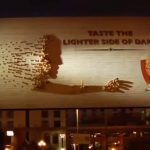
The moment was timed so the billboard’s “missing lime” is completed by the moon’s crescent alignment on the nights of June 14 and 15.
When the sky completes the creative
The mechanism is engineered perspective plus a fixed window in time. The billboard artwork is designed so that from a specific viewing position, the crescent moon appears exactly where a lime wedge would normally sit on a Corona bottle. The media placement then turns into a scheduled viewing, because the “full ad” only exists when the moon cooperates.
In out-of-home advertising, aligning a message with a real-world phenomenon can turn a static placement into a time-limited event people actively seek out.
Why it lands
This works because it makes a familiar brand ritual feel discovered rather than advertised. The payoff is not a new claim. It is a real-world moment that feels improbably perfect, which gives people a reason to stop, watch, and tell someone else where and when it happened. The real question is how far a brand can make the physical world do the storytelling for it. The stronger move here is using the moon to deliver the brand cue instead of adding more message.
Extractable takeaway: If you can make the environment complete your creative, you turn passive exposure into participation. That participation becomes the distribution.
What to steal from Luna Corona
- Design for one unmistakable illusion: one clean visual trick beats multiple clever details.
- Use time as a feature: a narrow viewing window creates urgency without discounts or gimmicks.
- Make the “rule” explainable: people should be able to describe it in one sentence.
- Choose a ritual people already associate with you: the lime wedge is an instantly legible brand cue.
- Capture proof: the video is not decoration. It is how the idea travels beyond the street corner.
A few fast answers before you act
What is “Luna Corona”?
It is an out-of-home idea where a Corona billboard is positioned and designed so the crescent moon visually becomes the lime wedge on the bottle during a specific time window.
Why involve astronomers and universities?
Because the illusion depends on precise timing and angle. You need accurate lunar position predictions to know when the crescent will “land” in the right spot from the viewer’s perspective.
Is this interactive?
Not in the device sense. The interaction is physical. People move into position, wait for the right moment, and witness the alignment as it happens.
What makes it more than a clever billboard?
The scarcity. It only “works” at certain times, so it behaves like an event, not just media inventory.
What’s the biggest risk with ideas like this?
Fragility. If weather, timing, sightlines, or location details are off, the reveal fails. The planning and production tolerance must be treated like a live event.