
Absolut: Unique Access via WhatsApp

Absolut: Unique Access via WhatsApp

In October, Klik (a chocolate snack) was billed here as the first brand to use WhatsApp to increase brand engagement amongst its teen audience.

Now a month later, ABSOLUT Vodka in Argentina uses WhatsApp as well, this time to invite people to an exclusive launch party. To build awareness and engagement in Buenos Aires, Absolut creates “Sven the doorman”. Interested people have to contact Sven via WhatsApp and convince him to grant access. Since he is not easy to convince, people get creative fast.

Sven is the mechanic

The mechanism is conversational gating. Conversational gating means access is unlocked only through a back-and-forth chat, not a form or link. A single contact on WhatsApp becomes a bouncer, and the brand turns the usual “enter to win” pattern into a negotiation. You are not filling a form. You are performing for a personality, in the channel where you already talk to friends.

In mobile-first urban markets, messaging apps like WhatsApp are a natural place for brands to run direct, high-attention interactions without building a separate destination.

Why this format spreads

It packages exclusivity into a simple game loop. The real question is whether you want people to feel like they earned access, or like they completed a funnel step. Ask. Get rejected. Try again. Escalate creativity. That loop is inherently shareable because it produces artifacts people can screenshot, forward, and remix. This format is a better bet when you want depth of participation and talk value, not maximum reach. Reported campaign write-ups describe hundreds of participants and a flood of user-made messages, which is exactly what you want when the goal is buzz rather than reach alone.

Extractable takeaway: If you want engagement that feels earned, design a human-scale gate with a clear personality and a strict rule. Then let people “pay” with creativity, not clicks.

What to steal for your own messaging plays

  • Make scarcity real. The smaller the prize pool, the more believable the doorman becomes.
  • Turn the brand into a character. Sven is not a hotline. He is a role people can play against.
  • Reward effort, not volume. You want fewer, better attempts, not spammy persistence.
  • Design the rejection lines. The “no” is half the entertainment. Script it so it invites a better next try.
  • Build for screenshots. Assume the conversation will leave WhatsApp. Make it legible outside the app.

A few fast answers before you act

What is the core idea behind “Sven the doorman”?

A brand persona acts as a gatekeeper on WhatsApp. People must persuade him to unlock access to an exclusive event, which converts invitations into a creative challenge.

Why use WhatsApp instead of a landing page?

Because it removes friction. The interaction starts inside an everyday messaging habit, and the conversational format makes participation feel personal rather than transactional.

What makes this approach risky?

It can backfire if the “doorman” feels unfair, creepy, or inconsistent. The rules must be clear, and the tone must fit the audience.

What is the simplest version a brand can run today?

Use one WhatsApp contact, one character, and one strict rule to unlock a limited reward. Keep the conversation short, and make the “no” entertaining enough that people want to try again.

How do you keep the “doorman” from becoming spammy or exhausting?

Set a tight interaction window, cap repeated attempts, and use rejection lines that steer people toward better next tries instead of inviting endless back-and-forth.

Honda CR-V: An Impossible Made Possible

Honda CR-V: An Impossible Made Possible

When “no CGI” becomes the flex

Optical illusions and jaw-clenching stunts (Volvo Trucks) instead of computer animation are becoming the norm.

Honda’s latest European commercial for the CR-V 1.6 i-DTEC Diesel keeps that trend going. It uses well-placed props and carefully drawn imagery to trick you into seeing the impossible. Describing it in detail gives too much away, so it is better to watch the optical illusions directly.

The mechanic: perspective tricks that stay readable on camera

The spot plays with perspective, scale, and line-of-sight to make everyday spaces behave in ways they should not. The car seems to float, shrink, or move through geometry that your brain struggles to reconcile, precisely because the scene is constructed to be “correct” from the camera’s viewpoint. That matters because a camera-perfect illusion feels physically plausible, so viewers give the stunt more credit than they would give obvious digital trickery.

In European automotive marketing, practical illusion work is a fast way to signal engineering credibility while still delivering spectacle. By practical illusion work here, I mean physical sets, props, and camera-controlled perspective rather than digital effects.

Why it lands

It rewards attention. You cannot half-watch it, because your brain keeps trying to solve the image. That creates replay value, and replay value is a quiet superpower for car advertising, where most spots blur into the same driving shots and the same claims.

Extractable takeaway: If your message is “this performs beyond what you expect,” use a visual system that makes viewers test their own assumptions, then let the craft do the convincing.

The real question is whether the illusion makes the car feel more impressive, not just the ad more clever.

Honda gets that balance right here because the illusion sharpens the product story instead of distracting from it.

What to borrow from illusion-led car storytelling

  • Make one camera angle the truth. Illusions work when the viewing position is controlled and the payoff is immediate.
  • Use mystery as a feature. A little confusion buys you replays, and replays buy you recall.
  • Keep the brand role simple. The product should move through the illusion, not compete with it.
  • Protect the reveal. If explanation kills the effect, build your copy to point, not to decode.

A few fast answers before you act

What is “An Impossible Made Possible” for Honda CR-V?

It is a European TV spot for the CR-V 1.6 i-DTEC Diesel that uses practical optical illusions, props, and perspective tricks to make the car appear to do impossible things.

What is the core creative mechanic?

Forced perspective and camera-aligned set construction. The scene is built so the illusion reads as “real” from the viewer’s point of view.

Why avoid heavy CGI in this kind of execution?

Practical illusions feel earned. Viewers sense there is a real setup behind the shot, which increases credibility and replay value.

What makes illusion-led ads more memorable?

They trigger a “solve it” response. People replay to understand what they saw, and that repetition drives recall.

What is the most transferable lesson for brands?

Use craft to create viewer doubt, then resolve it with a clean product moment. Confusion first. Clarity second.

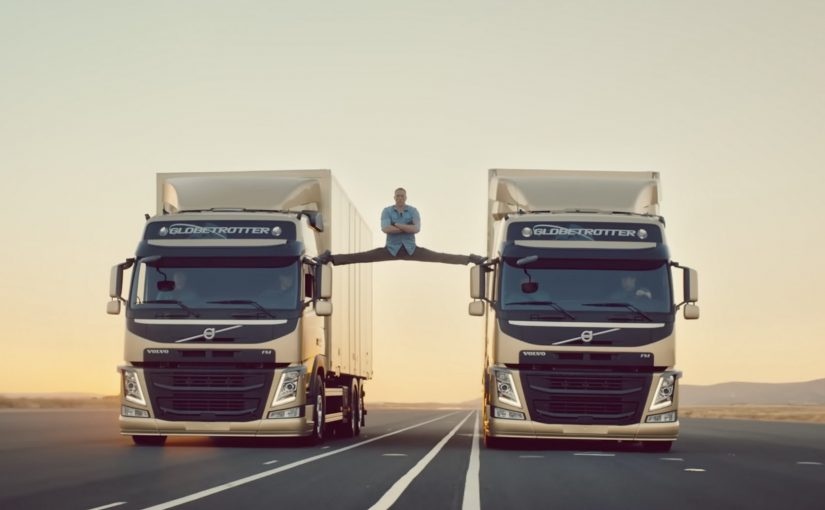
Volvo Trucks: The Epic Split

Volvo Trucks: The Epic Split

Brands all over the world are trying to create branded content. Volvo did that with great success last month when they filmed a hamster drive their entire truck up a mountain.

Now, Volvo demonstrates the precision and directional stability of its dynamic steering by getting Jean-Claude Van Damme to carry out his famous split between two reversing Volvo FM trucks. Here, “dynamic steering” refers to the steering system helping the truck hold a steady line under motion. The video, since release, is reported to have already passed 7 million views.

A feature demo disguised as spectacle

The mechanism is as clean as it gets. Take a technical claim, steering stability under motion. Express it in one unmistakable image that needs no explanation. Two trucks moving backwards in sync, a human balancing point-to-point between them, and the steering system as the silent hero.

In global industrial and automotive marketing, the most reusable branded content is engineered proof that compresses a technical benefit into a single, legible visual.

By “engineered proof,” I mean a demonstration where the product capability is the only plausible explanation for what you see.

Why the internet did the media buy for them

This lands because it is instantly readable and instantly arguable. People share it to say “this is real.” People share it to say “this is impossible.” Either way, the product claim travels with the argument.

Extractable takeaway: If your product advantage is hard to feel in a 30-second explanation, translate it into a one-frame “impossible” moment. The real question is “what made that possible.” Then let the audience debate the stunt while your feature becomes the answer.

It also avoids the common branded-content trap of overstorytelling. The brand stays in the background, the demonstration stays in the foreground, and the audience does the meaning-making in their own words.

How to borrow this pattern without a movie star

  • Start with one feature you can prove. Pick a claim that can be demonstrated, not merely asserted.
  • Design for instant comprehension. If a still frame cannot tell the story, simplify the setup.
  • Make the proof self-contained. The audience should not need a voiceover to understand what is being tested.
  • Keep the brand restraint. Overbranding weakens believability. Let the test carry the persuasion.

A few fast answers before you act

What is Volvo’s “The Epic Split” demonstrating?

It is designed to demonstrate the precision and directional stability of Volvo’s dynamic steering by showing two reversing trucks holding a steady path while Jean-Claude Van Damme performs a split between them.

Why does this count as branded content instead of “just an ad”?

The primary value is the demonstration itself. The content is built to be watched and shared as a feat, with the product benefit embedded in the feat rather than delivered as a sales message.

What makes a stunt like this more shareable than a typical product film?

Instant readability plus high stakes. A single image communicates the premise, and the audience immediately wants to test whether it is real, which drives sharing and discussion.

How do you know the spectacle is actually proving the feature?

If the moment works as a still frame, stays understandable without voiceover, and the technical claim is the only plausible explanation, then the spectacle is doing real demonstration work, not just decoration.

How can smaller brands apply the same approach?

Reduce the ambition, not the logic. Prove one feature with one clear test, make it understandable in one glance, and remove anything that distracts from the proof.