
Peruvian League Against Cancer: Shadow WiFi

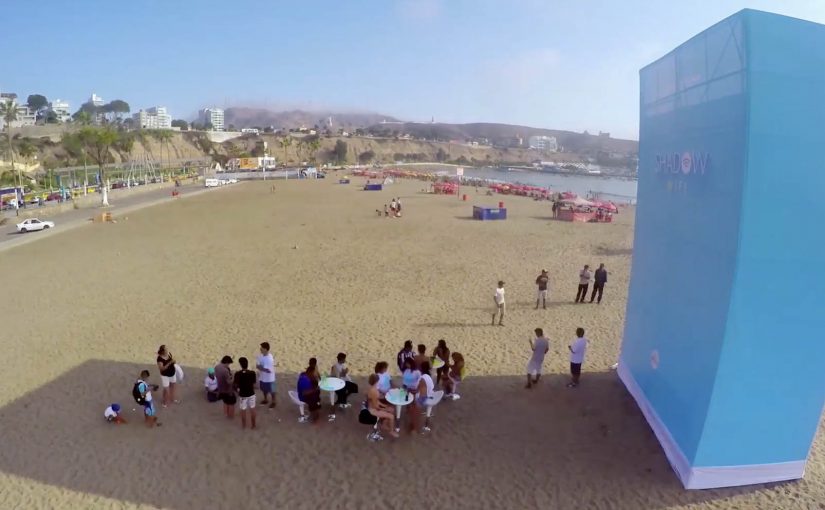
You are on a beach, the sun is out, and your phone wants a signal. Then you notice a large blue structure casting a patch of shade. Step into that shade, and you get free WiFi. Step out into the sun, and the WiFi disappears.

Instead of simply warning people about UV rays, the Peruvian League Against Cancer and Happiness Brussels create “Shadow WiFi”. A directional antenna delivers WiFi only to the shadow area of the structure. A sensor tracks the sun’s movement and rotates the antenna, so as the shadow shifts through the day, the WiFi access shifts with it, and people follow.

The mechanism is the message

The mechanic does not just communicate “stay in the shade”. It enforces it gently. The reward is instantly understood. Connectivity. The rule is equally clear. Shade equals access. Sun equals nothing. The result is prevention education delivered through interactivity, not through guilt. This is the right kind of nudge because it rewards the safer choice instead of lecturing people into it.

The real question is whether you can make the protective choice feel more useful than the risky one in the moment.

In public health behavior-change campaigns, trading immediate utility for safer choices is often more effective than warnings alone.

Why it lands

It targets the real friction. On a beach, the problem is not awareness. It is motivation and habit in the moment. Shadow WiFi turns shade into a social and practical hotspot, so safer behavior feels like the default choice rather than a sacrifice.

Extractable takeaway: If you want people to adopt a protective habit, attach it to a reward they already seek in that environment, and make the “safe zone” tangible, not theoretical.

Guerrilla activation moves worth copying

  • Pay people in utility, not slogans. Free WiFi is a real benefit that beats reminders and posters.
  • Make the rule physical. When the benefit is literally bounded by shade, the behavior is self-explaining.
  • Design for movement. The rotating antenna turns a static installation into a living experience that keeps working all day.
  • Teach inside the experience. Use the login or landing step to deliver prevention guidance while intent is high.

A few fast answers before you act

What is Shadow WiFi in one sentence?

A beach WiFi network that only works in the shade, encouraging people to avoid direct sun exposure while learning about skin cancer prevention.

Why does restricting WiFi to shade change behavior?

Because it makes the safer choice immediately rewarding. People move for a benefit they already want, and the health message rides along.

What is the key technical trick?

A directional antenna limits the WiFi coverage to the shadow zone, and a sun-tracking sensor adjusts the antenna as the shadow moves.

How do you translate this idea without using WiFi?

Keep the same pattern. Put a desired utility behind a clear, physical boundary that represents the safer behavior, so the experience teaches the rule without needing explanation.

What can make this fail?

If the WiFi is unreliable or the shaded area is too small, the utility collapses and the activation becomes a novelty object instead of a habit shaper.
St. Pauli: Pinkelt Zurück

St. Pauli is one of Hamburg’s top entertainment destinations, reported as attracting up to 20 million visitors a year with its nightclubs and legal prostitution. But the steady stream of visitors has many residents and merchants angry, as some visitors relieve themselves against walls, leaving parts of the area smelling like a latrine.

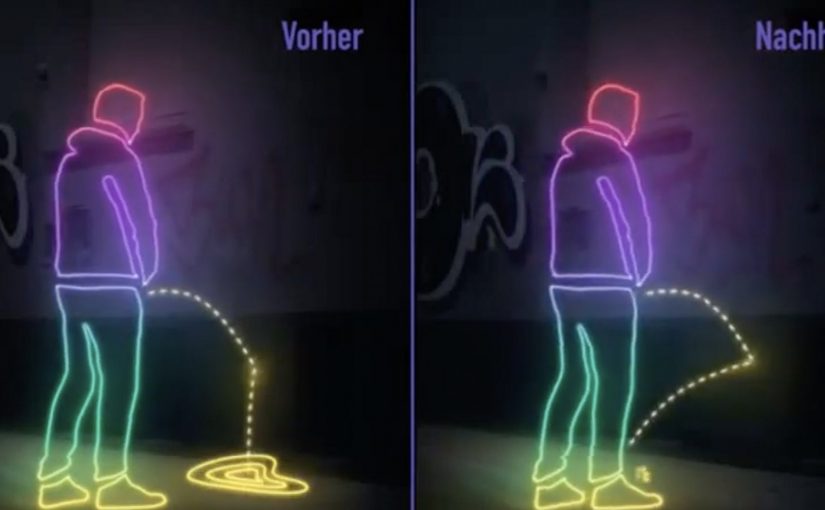
So to combat this, St. Pauli’s merchants fight back by coating the most frequented walls with Ultra-Ever Dry, a superhydrophobic coating that repels liquids (the same type of coating Nissan publicly demonstrated on a “self-cleaning” car prototype). Now when liquid hits the treated surface, it can splash back, soaking the offender’s pants and shoes.

A deterrent that makes the consequence immediate

The mechanism is direct. Identify the walls that get hit most often. Apply a coating that strongly repels liquids. Let physics deliver instant feedback to the person causing the problem. It is not subtle, and that is the point. The “punishment” is immediate embarrassment and discomfort. The real question is how to stop a repeat nuisance behavior when constant policing is unrealistic. The stronger move is to redesign the environment so the consequence happens in the moment.

Why it lands

In European nightlife districts where resident quality-of-life clashes with party tourism, deterrence tends to work best when it changes behavior in the moment, not when it relies on rules people ignore after midnight. This works because it does not require enforcement at scale. There is no need to catch someone, argue, or issue a fine. The wall becomes the deterrent, and the story becomes self-spreading because the consequence is memorable and easy to retell.

Extractable takeaway: If a behavior persists because policing is impractical, shift the intervention from enforcement to environment. Make the unwanted action inconvenient or self-correcting, and the system scales without extra staff.

A broader pattern beyond Hamburg

Similar anti-urination paint trials were also reported in San Francisco, where public works tested superhydrophobic coatings on selected walls as a deterrent. The through-line is the same. When a city cannot police every corner, it experiments with “designing the street” to reduce repeat nuisance behaviors.

What civic teams can borrow

  • Target the hotspots. Interventions work best when they focus on the highest-frequency locations, not the whole city.
  • Make the rule physical. If the environment enforces the norm, compliance increases without lectures.
  • Keep the message legible. People should understand the consequence immediately, even when they are distracted.
  • Plan for side effects. Think through splash zones, signage, and whether the deterrent creates any new cleaning burden.

A few fast answers before you act

What does “Pinkelt Zurück” mean?

It means “pees back”. It is a blunt way to describe a wall treatment designed to repel liquid back toward the source.

What coating is used in this idea?

The case describes the use of Ultra-Ever Dry, a superhydrophobic coating designed to repel most liquids.

Why is this more effective than fines?

Because enforcement is hard in crowded nightlife areas. The deterrent works at the moment of behavior, without needing police presence.

Was something similar tried outside Germany?

Yes. Reporting describes trials of similar superhydrophobic coatings on walls in San Francisco as a public urination deterrent.

What is the main lesson for civic or place marketing?

When behavior change is the goal, redesign the environment so the better behavior becomes the easier behavior.

Homeless Fonts: Fonts from Cardboard Signs

When you walk by a homeless person holding a cardboard sign, you usually see an anonymous face struggling to survive. Homeless Fonts flips that moment. It turns the most visible part of street life. The handwriting. Into something people and brands can actually pay for.

From street sign to typeface

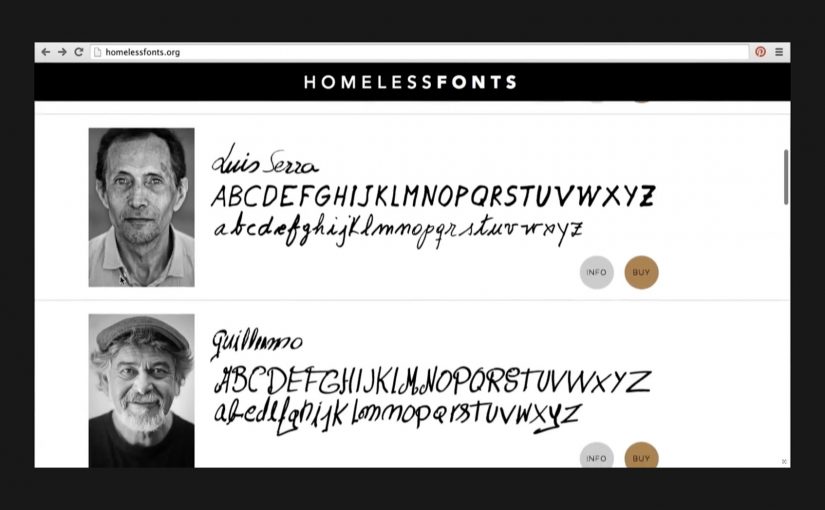
The Cyranos McCann teamed up with the Arrels Foundation in Barcelona to launch HomelessFonts.org. The site features fonts built from the real handwriting of local homeless people, available for purchase by marketers who want something more human than a default type library.

Here, a “font” is a downloadable typeface file that designers can license and use across ads, packaging, and digital interfaces, just like any other professional typeface.

In urban European cities, design-led micro-commerce can convert overlooked skills into dignified income streams.

Where the money goes

The money raised from the website is intended to support accommodation, food, social programs, and health care for people experiencing homelessness. For more information visit www.HomelessFonts.org.

Why this lands

It works because it asks brands to buy a useful asset instead of “donating to a cause.” You are not funding an abstract promise. You are paying for a tool that visibly changes the tone of your message, and the purchase itself carries a story your audience can recognize instantly.

Extractable takeaway: If you want purpose marketing to stick, attach the donation mechanic to a practical, reusable brand input (a font, a template, a dataset, a sound pack) so the act of funding also improves the work.

What it’s really trying to change

The real question is whether brands will pay for contribution instead of performative concern.

This is a stronger model than pure cause messaging because it gives people commercial value, not just visibility.

Beyond fundraising, the campaign reframes homeless people from passive recipients to contributors with identity and craft. The typefaces carry names and personality, and that shifts the conversation from pity to participation.

What to steal from Homeless Fonts

  • Sell a tool, not a feeling. Build the fundraising mechanic around something buyers genuinely need.
  • Make the proof visible. The output (handwriting) is instantly recognizable, which makes the story easy to retell.
  • Design for everyday reuse. The more places the asset can live (print, digital, packaging), the more sustainable the model becomes.
  • Keep the transaction simple. Clear product. Clear price. Clear destination for proceeds.

A few fast answers before you act

What is Homeless Fonts?

It’s a collection of purchasable fonts created from the handwriting of homeless people in Barcelona, sold via HomelessFonts.org.

Who created it?

The project was launched by the Arrels Foundation in partnership with Cyranos McCann.

How do brands actually use the fonts?

Like any licensed typeface. Designers can apply them in headlines, posters, packaging, social content, landing pages, and campaign visuals to add a distinctly human texture.

What does buying a font change versus asking for donations?

It turns support into a market exchange for a useful asset. That reduces “charity fatigue” and gives brands a concrete output that carries the story forward every time it’s used.

Where is the money intended to go?

The campaign describes proceeds being used for accommodation, food, social programs, and health care supporting people experiencing homelessness.