
The journey is now part of the product
This is not the first time a car brand has moved into adjacent safety or wellbeing territory.
What makes these two examples stronger is that they do not feel random. Škoda and Citroën are both dealing with small but consequential failures around the trip itself, not trying to invent a new category for the sake of it. That is a more credible stretch because the problem sits close to how the brand is already experienced.
What Škoda and Citroën are really addressing is mobility friction. Mobility friction is the small but consequential failure around a journey that changes safety, comfort, or control without changing the vehicle itself.
One brand is tackling external awareness around cyclists and pedestrians. The other is tackling in-car stress for pets. Different use cases, same underlying move. Both are extending the brand promise into the part of the journey where the consumer actually feels the problem.
Škoda and the new urban safety gap
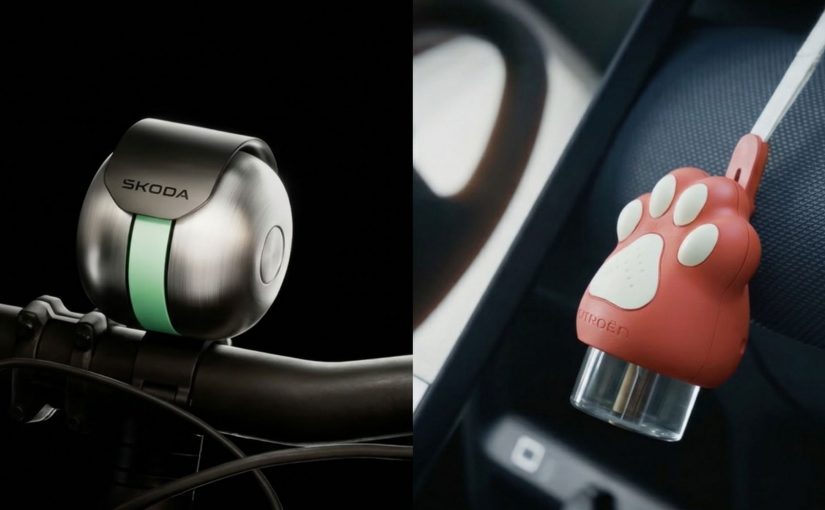
Škoda starts with a simple failure. Standard bike bells are easier to miss when pedestrians are wearing active noise-cancelling headphones, or ANC, so the company worked with the University of Salford to identify a narrow 750 to 780 Hz band that cuts through ANC more effectively and built DuoBell around that finding. Škoda says the product also uses a second resonator and an irregular strike pattern to make the alert harder for ANC systems to suppress.
That line of thinking fits a brand whose history began with bicycles and that still maintains a visible connection to cycling today.
This lands because the fix is practical, easy to explain, and directly tied to a real safety failure on the street.
Škoda also has the stronger proof layer here. The idea is backed by publicly available Salford research, and Škoda reports that testing showed pedestrians wearing ANC headphones gained up to 22 metres of additional reaction distance when DuoBell was activated.
This is the right kind of adjacent product move for an automotive brand.
Citroën and comfort beyond human passengers
Citroën starts from a different failure. For many pets, the car is not a neutral space. It is a stressful one. The Calm Diffuser is designed to release calming pheromones during the journey so the ride feels less anxious for dogs and cats. Citroën frames the device as an extension of its comfort promise to everyone on board, including pets.
That is why the idea works. Citroën is not leaving its lane here. It is widening a promise it already owns.
The brand logic matters more than the object itself. Citroën has long tried to make comfort a differentiator, and Calm Diffuser extends that positioning from human occupants to pet occupants. That is a small move on paper, but it reflects a larger shift in how consumers define who the journey is for.
What enterprise teams should notice
The real question is whether the brand is removing a journey failure consumers already feel, in a way that fits a promise it already owns.
That is not just a creative decision. It is an operating model decision. Teams need to know where friction shows up, which audience feels it most, which brand promise gives permission to act, and whether the answer belongs in product, service, content, partnership, or commerce. That is where consumer experience platforms and MarTech matter, because they help surface repeated friction, validate demand, segment relevance, and scale the explanation layer across touchpoints instead of treating each move as a one-off stunt.
The commercial upside is bigger than the product itself. The stronger capability is learning how to identify adjacent consumer problems early, prove that they matter, and translate brand promise into something operational and useful.
What mobility brands should take from this
The lesson is not that every automotive brand now needs a side product. The lesson is that adjacent innovation works when it removes a nearby failure in the journey, reinforces an existing promise, and can be supported across owned touchpoints, retail, CRM, and service.
The takeaway is clear. The brands that win these moves will not be the ones that look most inventive. They will be the ones that make the journey measurably safer, calmer, or easier in ways the business can actually support.
A few fast answers before you act
What is Škoda DuoBell?
Škoda DuoBell is a bicycle bell designed to be more detectable to pedestrians wearing ANC headphones. Škoda developed it with the University of Salford to respond to rising cyclist and pedestrian risk in dense urban settings.
What makes DuoBell different from a normal bike bell?
Škoda says DuoBell was tuned around a 750 to 780 Hz band that can cut through ANC more effectively than a conventional bell, with additional sound design choices to improve detectability.
What is Citroën Calm Diffuser?
Calm Diffuser is Citroën’s in-car device designed to release calming pheromones for pets during travel. Citroën presents it as a way to make journeys more comfortable for all passengers, including pets.
Why does Calm Diffuser fit Citroën so well?
It fits because Citroën has long treated comfort as a core brand promise. Calm Diffuser extends that promise from human occupants to pet occupants without feeling forced.
Why do these two launches matter beyond novelty?
They matter because they show a more disciplined way to extend a brand. Instead of chasing spectacle, both ideas target a specific friction point around the journey and connect the solution back to a promise the brand already owns.