
Škoda & Citroën: Fixing Mobility Friction

Škoda & Citroën: Fixing Mobility Friction

The journey is now part of the product

This is not the first time a car brand has moved into adjacent safety or wellbeing territory.

What makes these two examples stronger is that they do not feel random. Škoda and Citroën are both dealing with small but consequential failures around the trip itself, not trying to invent a new category for the sake of it. That is a more credible stretch because the problem sits close to how the brand is already experienced.

What Škoda and Citroën are really addressing is mobility friction. Mobility friction is the small but consequential failure around a journey that changes safety, comfort, or control without changing the vehicle itself.

One brand is tackling external awareness around cyclists and pedestrians. The other is tackling in-car stress for pets. Different use cases, same underlying move. Both are extending the brand promise into the part of the journey where the consumer actually feels the problem.

Škoda and the new urban safety gap

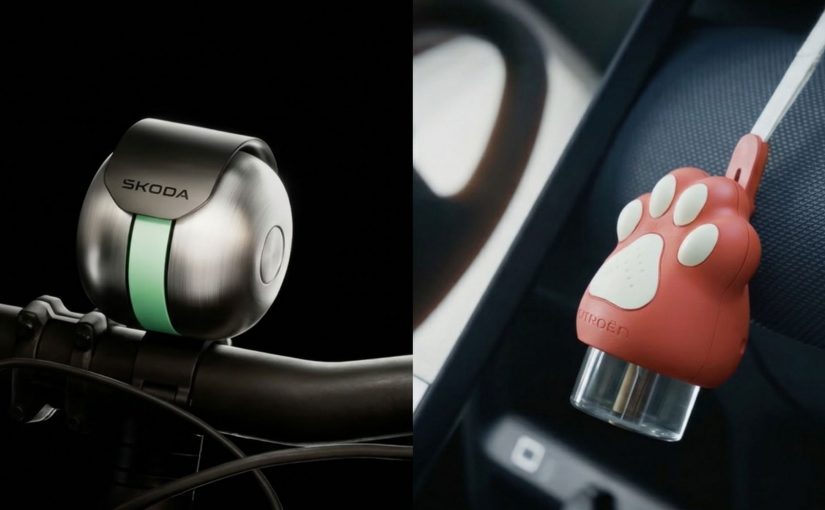
Škoda starts with a simple failure. Standard bike bells are easier to miss when pedestrians are wearing active noise-cancelling headphones, or ANC, so the company worked with the University of Salford to identify a narrow 750 to 780 Hz band that cuts through ANC more effectively and built DuoBell around that finding. Škoda says the product also uses a second resonator and an irregular strike pattern to make the alert harder for ANC systems to suppress.

That line of thinking fits a brand whose history began with bicycles and that still maintains a visible connection to cycling today.

This lands because the fix is practical, easy to explain, and directly tied to a real safety failure on the street.

Škoda also has the stronger proof layer here. The idea is backed by publicly available Salford research, and Škoda reports that testing showed pedestrians wearing ANC headphones gained up to 22 metres of additional reaction distance when DuoBell was activated.

This is the right kind of adjacent product move for an automotive brand.

Citroën and comfort beyond human passengers

Citroën starts from a different failure. For many pets, the car is not a neutral space. It is a stressful one. The Calm Diffuser is designed to release calming pheromones during the journey so the ride feels less anxious for dogs and cats. Citroën frames the device as an extension of its comfort promise to everyone on board, including pets.

That is why the idea works. Citroën is not leaving its lane here. It is widening a promise it already owns.

The brand logic matters more than the object itself. Citroën has long tried to make comfort a differentiator, and Calm Diffuser extends that positioning from human occupants to pet occupants. That is a small move on paper, but it reflects a larger shift in how consumers define who the journey is for.

What enterprise teams should notice

The real question is whether the brand is removing a journey failure consumers already feel, in a way that fits a promise it already owns.

That is not just a creative decision. It is an operating model decision. Teams need to know where friction shows up, which audience feels it most, which brand promise gives permission to act, and whether the answer belongs in product, service, content, partnership, or commerce. That is where consumer experience platforms and MarTech matter, because they help surface repeated friction, validate demand, segment relevance, and scale the explanation layer across touchpoints instead of treating each move as a one-off stunt.

The commercial upside is bigger than the product itself. The stronger capability is learning how to identify adjacent consumer problems early, prove that they matter, and translate brand promise into something operational and useful.

What mobility brands should take from this

The lesson is not that every automotive brand now needs a side product. The lesson is that adjacent innovation works when it removes a nearby failure in the journey, reinforces an existing promise, and can be supported across owned touchpoints, retail, CRM, and service.

The takeaway is clear. The brands that win these moves will not be the ones that look most inventive. They will be the ones that make the journey measurably safer, calmer, or easier in ways the business can actually support.


A few fast answers before you act

What is Škoda DuoBell?

Škoda DuoBell is a bicycle bell designed to be more detectable to pedestrians wearing ANC headphones. Škoda developed it with the University of Salford to respond to rising cyclist and pedestrian risk in dense urban settings.

What makes DuoBell different from a normal bike bell?

Škoda says DuoBell was tuned around a 750 to 780 Hz band that can cut through ANC more effectively than a conventional bell, with additional sound design choices to improve detectability.

What is Citroën Calm Diffuser?

Calm Diffuser is Citroën’s in-car device designed to release calming pheromones for pets during travel. Citroën presents it as a way to make journeys more comfortable for all passengers, including pets.

Why does Calm Diffuser fit Citroën so well?

It fits because Citroën has long treated comfort as a core brand promise. Calm Diffuser extends that promise from human occupants to pet occupants without feeling forced.

Why do these two launches matter beyond novelty?

They matter because they show a more disciplined way to extend a brand. Instead of chasing spectacle, both ideas target a specific friction point around the journey and connect the solution back to a promise the brand already owns.

Ford: Noise-Cancelling Kennel

Ford: Noise-Cancelling Kennel

A dog hears the first firework bang and starts to panic. The family tries the usual fixes. Closing curtains. Turning up the TV. Comforting words. But the noise still cuts through, and the stress spreads to everyone in the room.

Ford’s noise-cancelling kennel concept takes a different angle. It treats fireworks like an engineering problem. The prototype uses microphones to detect sudden loud sounds, then a built-in audio system plays opposing frequencies to reduce the noise inside the kennel. Sound-deadening materials, including high-density cork, add a physical layer of insulation on top of the active cancellation.

In consumer innovation storytelling, especially when the tech is hard to “see,” the fastest way to earn belief is to show it solving a small, relatable problem.

The real question is whether your R&D can earn belief by solving a tiny, emotional problem in the real world.

The idea is inspired by the Active Noise Control Ford introduced in the Edge SUV to make journeys quieter. Inside the Edge SUV cabin, microphones pick up unwanted noise and the audio system counteracts it with opposing sound waves. Here, the same principle is applied to a safe space for dogs during fireworks.

Why this lands with people who do not care about car tech

Because the benefit is immediate and emotional. Fireworks anxiety is common, and the problem shows up at home, not in a showroom. The kennel reframes Ford’s engineering as something that protects a family moment, not just something that improves a drive.

Extractable takeaway: When your technology is invisible, translate it into a felt reduction of a specific stressor. Reducing the sharp peaks of fireworks noise inside a safe space lowers the trigger that starts panic, so calm becomes observable in seconds.

What Ford is really building with “Interventions” thinking

This is a brand-positioning move disguised as a pet story. By “Interventions” thinking, Ford is repurposing a familiar experience into a purposeful disruption that makes the benefit felt immediately. It signals that automotive R&D can be repurposed into everyday life solutions, and it does it without a hard sell. The prototype is the proof-of-intent.

What to steal if you want to translate R&D into culture

  • Start with a problem people already feel. Fireworks fear is instantly understood without explanation.
  • Use a single, credible technology transfer. One tech. One benefit. No feature soup.
  • Make the benefit visible in seconds. Calm is the KPI here, not product specs.
  • Let the prototype be the story. A working concept creates more belief than a manifesto.

A few fast answers before you act

What is Ford’s noise-cancelling kennel concept?

It is a prototype dog kennel designed to reduce fireworks noise using active noise control and sound-insulating materials, giving anxious dogs a calmer space.

How does the noise cancellation work in simple terms?

Microphones detect the loud sound, then speakers play an opposing sound wave to reduce it. Physical insulation also helps block and absorb noise.

Is this a product you can buy?

It is presented as a concept/prototype rather than a retail product, used to demonstrate how existing Ford technology could be applied to everyday problems.

Why connect this to the Ford Edge SUV?

Because the kennel borrows the same Active Noise Control principle used to reduce unwanted noise in the vehicle cabin, then applies it to a different environment.

What is the main risk with “tech repurposed for good” ideas?

If the link between the original technology and the new use case feels flimsy, it reads as a gimmick. The transfer has to be technically believable and emotionally relevant.

The Ford Vending Machine

The Ford Vending Machine

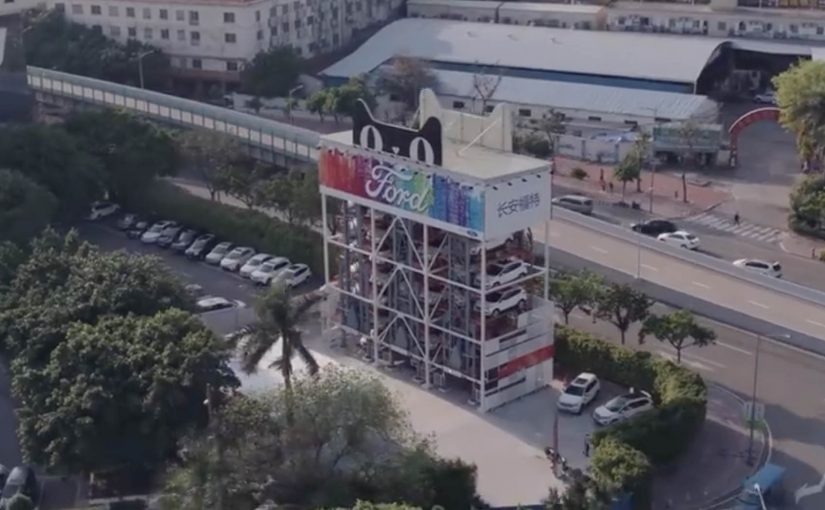
A glass “vending machine” in Guangzhou holds 42 cars. You choose a Ford model, pay a deposit in the Tmall app, schedule pickup, snap a selfie, and the machine recognises you when you arrive. Then it releases the car for a three-day test drive.

How the car vending machine flow works

Alibaba and Ford build this as a Super Test Drive Center. Think of it as a self-service test drive hub that compresses selection, deposit, scheduling, and pickup into one digital-to-physical flow. It turns the usual dealership steps into a clean sequence. Select the car model. Put down the deposit electronically via the Tmall app. Book a pickup slot. Use a selfie as identity confirmation at the moment of collection.

In high-density cities where e-commerce behaviours are habitual, self-serve pickup expectations spill into high-consideration products too.

The real question is how you remove dealership-shaped friction without removing trust.

Why this matters for test drives and conversion

The innovation is not the building. It is the removal of friction around intent. By compressing selection, deposit, scheduling, and identity confirmation into one predictable sequence, the concept reduces drop-off between “I want a test drive” and “I am in the car”. Here, “friction” is the waiting, paperwork back-and-forth, and sales pressure that makes people abandon the step entirely. This pattern is worth copying when your goal is more completed test drives, not more showroom theatre.

Extractable takeaway: If you can make “try before you buy” feel as immediate as e-commerce while keeping identity confirmation lightweight, you increase the odds that intent turns into action.

What the selfie step signals

The selfie is a simple trust layer. It connects the digital reservation to the physical handover. It also reinforces the theatre of the experience. You do not just pick up a car. You unlock it.

Stealable moves from this flow

  • Turn the test drive into checkout: Make selection, deposit, and scheduling a single, self-serve sequence.
  • Remove sales pressure by default: Let customers start with intent and time-on-product, not negotiation.
  • Use lightweight identity at pickup: Tie the digital reservation to the physical handover without adding paperwork loops.
  • Design for story, not just logistics: The unlock moment makes the handover feel earned and shareable.

A few fast answers before you act

What is a car vending machine?

It is a vertical, automated car storage and handover system that lets customers reserve and collect a vehicle via a digital flow, instead of a traditional showroom process.

How does the three-day test drive booking work in this concept?

You select a model, place a deposit electronically in the Tmall app, schedule a pickup time, and then collect the car for a three-day test drive at the vending machine site.

Why use a selfie for pickup?

It provides a lightweight identity confirmation step that ties the digital booking to the physical release, without adding visible friction for the customer.

What should brands measure if they copy this pattern?

Test-drive completion rate, conversion rate after the test period, time from reservation to pickup, repeat bookings, and the share of customers who choose this flow over a dealership visit.