
Misereor: The Power of a Coin

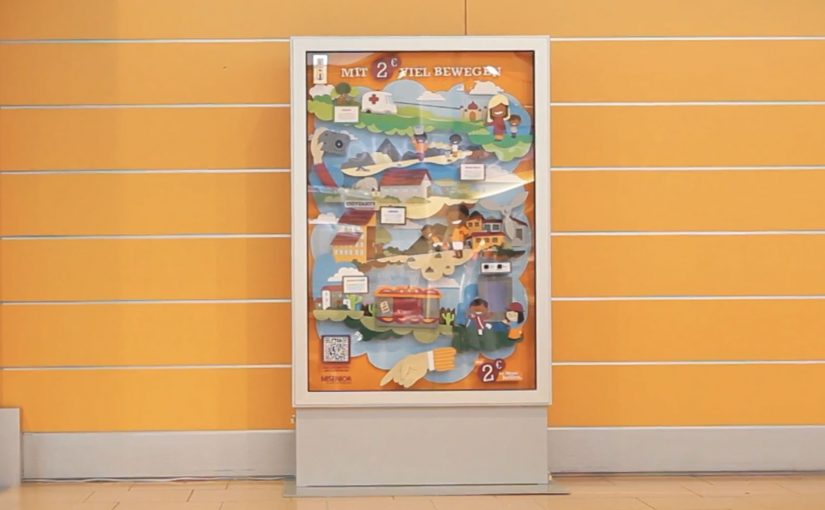
A billboard at Hamburg Airport does not just ask for money. It takes a 2-euro donation and immediately shows what that coin can do.

Misereor has been committed to fighting poverty in Africa, Asia and Latin America for over 50 years. To drive more donations, they install a billboard with a donation box built into it. When people put in 2 euros, the billboard brings to life how that coin can help across Misereor’s aid projects.

The billboard also links the offline act to an online conversation. It takes a photo of the donor and posts it to the campaign’s Facebook app. A QR code on the billboard lets donors share the promotion on their own Facebook page.

How the interaction is designed to convert

The mechanism is a tight, three-step loop. Physical donation triggers an immediate visual payoff. The payoff translates “impact” from an abstract promise into a concrete scene. The scene then becomes shareable proof through an automatic photo post and a QR-driven sharing prompt.

In high-traffic public spaces where attention is fragmented and dwell time is unpredictable, donation design wins when it minimizes steps and makes impact visible immediately.

Why it lands

This works because it replaces guilt with clarity. You do not just hear that your money helps. You see a specific outcome the moment you give, which makes the decision feel both meaningful and finished.

Extractable takeaway: If you want more donations, build a “give. see. share.” loop where the act of giving triggers instant, legible impact, and the sharing step is optional but effortless.

The real goal behind the 2-euro choice

The real question is whether a donation ask can feel immediate, visible, and worth doing before the traveler walks away. A 2-euro ask is small enough to feel impulse-safe, especially in an airport moment where people already make small purchases without overthinking. The campaign then uses the experience to recruit advocates, not just donors, by turning each donor into a visible participant online.

What this donation design gets right

  • Make the donation amount frictionless. Small, fixed amounts reduce decision paralysis.
  • Show impact instantly. The payoff must happen before the donor walks away.
  • Bridge offline to online. Capture a shareable artifact, but keep it consent-friendly.
  • Keep the interface obvious. A slot, a prompt, a clear result. No instructions required.

A few fast answers before you act

What is “The Power of a Coin”?

An interactive airport billboard for Misereor where a 2-euro donation triggers an animation that shows how the money helps, and then offers easy sharing via photo and Facebook.

What is the core mechanism?

Donate a fixed amount, get an immediate visual “impact reveal”, then optionally share via an automatically posted donor photo and a QR-enabled share prompt.

Why is the instant animation important?

It turns “trust us” into “watch this”. Immediate feedback reduces skepticism and increases the chance of giving in-the-moment.

What is the biggest risk with the social layer?

Consent and platform drift. If posting feels automatic in a way donors did not expect, or if platform permissions change, the sharing layer can backfire or break.

What is the transferable lesson for other causes?

Design the donation moment like a product demo. One action triggers a clear result, then the donor can share proof without extra effort.
Starbucks love project

At exactly 8:30 a.m. ET on Monday, December 7th, Starbucks joined forces with (RED) and creative agency BBDO to coordinate a global sing-along. Musicians worldwide performed The Beatles classic “All You Need Is Love” at the same moment, positioning the Love Project as a proof point for how connected the world is and how a small decision by one person can make a grand difference elsewhere.

The performance was broadcast live via the internet from far reaches such as Gabon and Fiji, with participation spanning over 100 countries. The initiative raised money and reinforced awareness for Africa’s fight against AIDS, while giving people a clear way to take part in the solution.

The campaign. A global moment that lives online

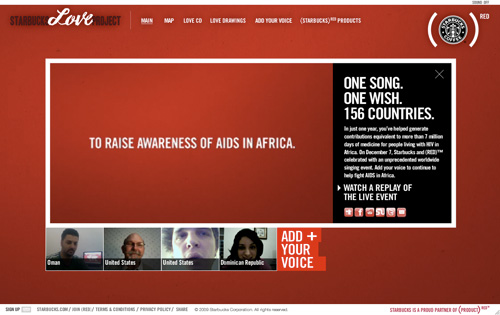
The performance was streamed live online at starbucksloveproject.com and acted as the anchor moment. Here, “anchor moment” means the single shared live event that gives the campaign a timestamp and a reason to gather.

Homepage of starbucksloveproject.com

After the live sing-along, people continued the campaign by going to the Starbucks website and uploading their own:

  • versions of “All You Need Is Love” videos
  • love drawing sketches

Each uploaded performance generated a donation from Starbucks to the cause, supporting (RED) and the Global Fund’s work.

In global consumer brands, the hardest part of cause marketing is turning a feel-good message into a repeatable participation mechanic.

The real question is how you design participation so it feels personal, public, and causally linked to impact.

Why it lands: participation that feels causal

This works because the mechanism makes the “how do I help?” step obvious and measurable. When contribution is triggered by a specific user action, scale stops being a vague aspiration and becomes a compounding loop that people can explain to each other.

Extractable takeaway: If you want a cause campaign to travel, make the participation act simple, visible, and directly tied to a concrete contribution.

The distribution layer. Partnering with Facebook

Starbucks partnered with Facebook to spread the message through the social network. The campaign was positioned as the largest global campaign ever for both Facebook and Starbucks.

The commercial layer. Turning participation into a product

The song was also commercially sold in stores on Starbucks’ Love CD, extending the fundraising and awareness beyond the live moment and the online uploads.

The scale signal. A record for global participation

A Guinness World Record was set for the “Most Nations in an Online Sing-Along,” reinforcing the Love Project as a massive organizational task that reaped the benefits of integrated marketing. Here, “integrated marketing” means the same idea expressed through a live anchor event, social distribution, and a product extension.

Steal this for your next global cause moment

  • Stage one timestamped anchor moment: Give the world a single time to show up, then let everything else ladder back to that moment.
  • Make participation generate impact: Tie a clear user action (uploads) to a concrete contribution (a donation) so people can explain the loop.
  • Design for sharing as distribution: Pick a network layer (Facebook here) that makes participation visible without extra effort.
  • Extend beyond the moment: Add a second way to participate (the Love CD) so the campaign does not end when the livestream ends.
  • Use proof signals carefully: If you claim scale (records, “largest ever”), ensure the mechanism and operations actually support it.

A few fast answers before you act

What is the Starbucks Love Project?

A global sing-along campaign with (RED), coordinated with BBDO, anchored by a simultaneous performance of “All You Need Is Love.”

How big is it?

The campaign described participation spanning over 100 countries, with performances broadcast live online from locations including Gabon and Fiji.

How does participation continue after the live event?

People upload their own “All You Need Is Love” videos and love drawing sketches on Starbucks’ campaign site.

How does it drive donation impact?

Each uploaded performance generates a donation from Starbucks to the cause, supporting (RED) and the Global Fund.

What role does Facebook play?

Facebook is presented as the distribution partner used to spread the message and participation through the social network.

What else extends the campaign beyond the moment?

The song is also sold commercially on Starbucks’ Love CD in stores.