ActionAid is an organisation committed to many projects, like fighting hunger and poverty. But in Italy it is known primarily for sponsoring children.
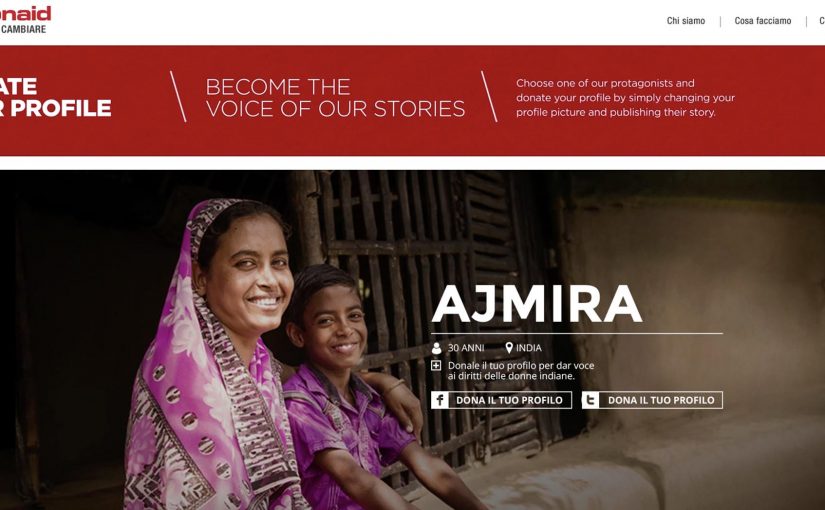
To communicate the broader work of ActionAid with a small media and production budget, DLV BBDO created “Donate Your Profile”. Participants donated their Facebook and Twitter profile pictures so that awareness could be generated for the stories of people ActionAid helped.
How “Donate Your Profile” worked
The mechanism is a simple identity swap. People hand over the most visible square in their social presence. Their profile photo. In return, they display a campaign image tied to a real person’s story, so every comment, like, and share carries that story into everyday social traffic.
Support from Radio 105, Radio Deejay, La Stampa, Marc Marquez and other Italian celebrities and brands helps normalise the behaviour. Once well-known accounts participate, the “donate your picture” action looks safe, easy, and socially endorsed.
In Italian cause marketing, borrowing social identity can outperform paid media when budgets are tight, because it turns personal networks into distribution.
The real question is how to turn a low-budget act of support into something people carry through their normal social behaviour.
Why the profile swap spreads
This works because it converts passive support into a visible, persistent signal. A profile picture is not a post that disappears in a feed. It is a durable badge that travels wherever you show up online, and it prompts questions that naturally lead to explanation and sharing.
Extractable takeaway: If you need earned reach without heavy spend, move the call to action from “share a post” to “change a default”. When people change a default surface, the campaign rides along with their normal behaviour.
The reported impact
The project was described as becoming the 5th most trending topic on Twitter and generating over 79 million media impressions, with more people joining in as the support network grew.
What to borrow from the profile-swap pattern
- Pick a high-frequency surface. Defaults like profile photos travel more than one-off posts.
- Make the action reversible. People participate faster when the commitment feels temporary.
- Seed with credible partners. Media brands and recognisable faces reduce hesitation.
- Turn participation into a conversation starter. The best mechanics invite questions, not just clicks.
A few fast answers before you act
What is “Donate Your Profile”?
It is a campaign where people replace their Facebook and Twitter profile pictures with a campaign image, so ActionAid stories gain awareness through everyday social interactions.
Why use profile pictures instead of posts?
A profile picture is persistent and high-visibility. It shows up repeatedly across comments and interactions, so the message travels without requiring constant re-posting.
How did the campaign scale beyond early participants?
Reportedly through support from media brands and celebrities, which makes the behaviour feel normal and increases follow-on participation.
What results were reported?
Reported results included reaching the 5th most trending topic on Twitter and generating over 79 million media impressions.
What is the main risk with this pattern?
Trust. If people are unclear about what is being changed, for how long, and what they are authorising, participation drops. The exchange must be transparent and easy to undo.