
Formula E: Leap of Faith

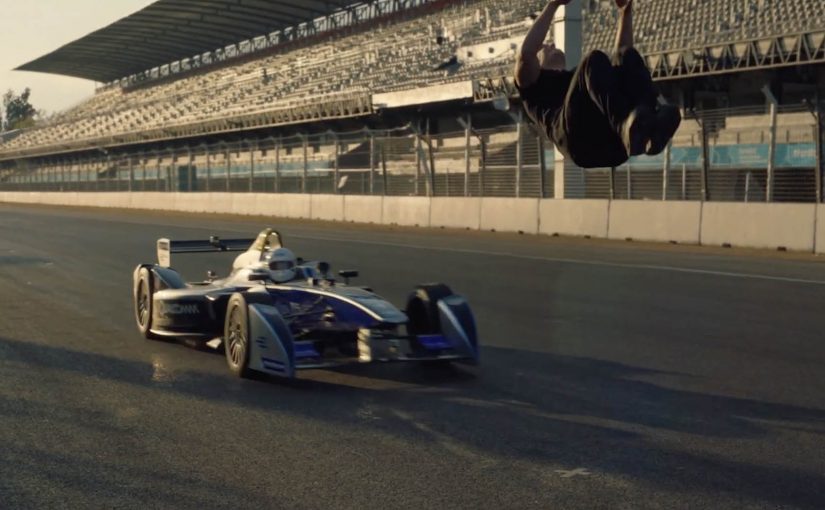
A race car comes up fast from behind. Damien Walters cannot see it. He commits anyway, throwing a backflip that clears the car at speed, landing as if it is routine.

Watch the perfectly synchronised leap below.

One trick, built on timing discipline

The mechanic is simple to describe and hard to execute. A blind backflip over a moving Formula E car. What makes it work is timing control. The driver holds a consistent approach speed, and the stunt is triggered off a repeatable timing reference so the flip happens at the exact moment the car reaches the take-off zone.

In sports branded content, the cleanest way to earn attention is to stage a single, unmissable proof where human skill and the sport’s technology meet in the same frame.

Why it lands

This is a spectacle with a clear question and a clear answer. Can he do it. Then, there it is. The real question is whether the stunt can make precision feel visible rather than merely claimed. The “blind” constraint adds tension because it removes the most obvious safety cue, and the viewer instinctively runs the risk calculation while watching. The payoff is the feeling of precision, not chaos. It reads less like danger for danger’s sake and more like controlled performance.

Extractable takeaway: If your story is “this is high-performance and precise,” build a moment where the viewer can see precision as a binary outcome, and keep the framing uncluttered enough that nobody misses the proof.

What Formula E gets out of it

The stunt borrows the language of elite motorsport. Speed, control, engineering, nerve. It also gives Formula E an easily shareable “you have to see this” asset that travels beyond core racing fans, while still feeling native to the category.

What to steal from the stunt

  • Make the promise visible. Translate “precision” into a single, legible pass or fail moment.
  • Add one constraint that increases tension. Blind, one-take, fixed distance, single attempt. Keep it understandable.
  • Keep the shot honest. The simpler the framing, the more the audience trusts what they are seeing.
  • Design for replay. If the moment is short and clean, people will rewatch and repost without needing context.

A few fast answers before you act

What is “Leap of Faith” in one sentence?

A branded stunt film where Damien Walters performs a blind backflip over a speeding Formula E car with tight timing synchronisation.

What makes the stunt feel different from a normal trick shot?

The car approaches from behind, so the timing has to be pre-controlled rather than visually adjusted, which raises tension and makes precision the headline.

Why does this format work for a sports brand?

It communicates the sport’s core attributes, speed and control, in a compact proof that is understandable even to non-fans.

What is the main creative risk?

If the production feels over-edited or overly cinematic, audiences question authenticity and the share impulse drops.

When should you use a “single proof moment” idea like this?

When your brand story is performance-based and you can express it as one unmistakable action that holds attention in the first three seconds.
Nokia Push: Connected Snowboarding in Beta

Even though Nokia has joined the Google and Apple smartphone party pretty late, they are clearly trying to innovate fast. With Nokia Push, they take a run at re-imagining snowboarding as a connected game you can play on any mountain in the world.

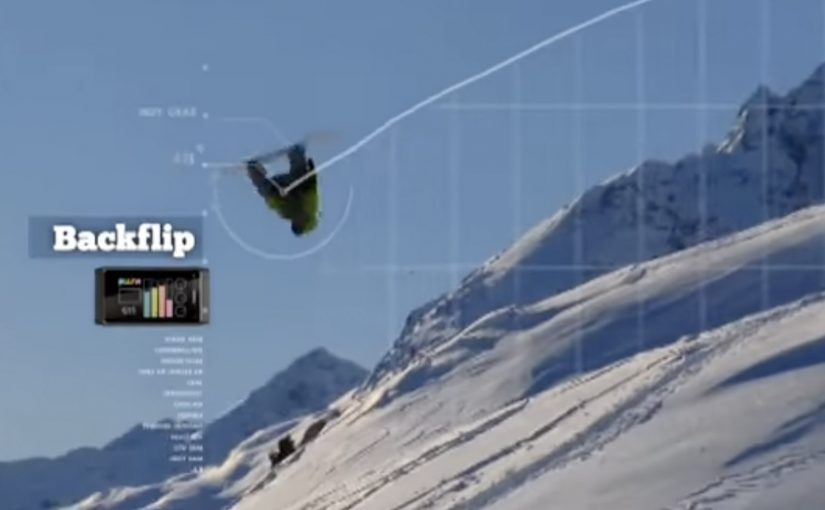
The idea is to mix gaming and reality using the data you generate while you ride. Bigger tricks, higher speed, crazier turns, more points. The experience is synced to your social life in real time, while also logging your full day on the mountain online.

Snowboarding, scored like a game

The core move is to treat a sport session as a live system of signals. Your board and your body generate performance data, and the platform translates that into a score and a story you can share. Because the system turns raw motion into immediate feedback and status, it gives riders a reason to repeat, improve, and share.

In global consumer tech marketing, sensor-driven “real-world games” help turn product capability into a shared, measurable experience.

Why Nokia frames it as “Push”

Nokia is not only showcasing hardware. It is showcasing a way of thinking. Open experimentation, community participation, and a product narrative that evolves in public instead of arriving fully finished. The real question is whether your “connected” feature creates a loop people want to compare and build on, not just data they can collect. That matters because the value is not just in the feature set. It is in the ecosystem effect, meaning the value that grows when other people can react to it, compare it, and build on it. Brands should treat beta as part of the product narrative, not a pre-launch excuse.

Extractable takeaway: If you can score the real world, ship the scoring and sharing loop early, so the community helps define what “good” looks like.

Where the story is heading next

By 2011, Nokia Push is set to collaborate with Burton Snowboards, described at the time as the world’s biggest snowboarding company, to create a new type of connected snowboarding. Work has already started, and the collaboration is positioned to run in the spirit of the Push project. Transparently, and openly in beta.

Regular progress videos are expected to detail what is being built and to count down to a beta moment at next year’s Burton Euro Open in January.

Steal this: connected sport as a game

  • Make the user the instrument. If the user’s movement creates the data, engagement becomes intrinsic, not forced.
  • Turn performance into a narrative. A score is useful. A replayable story is shareable.
  • Design for viewer control. Let people choose where, when, and how intensely they participate.
  • Ship in public. If the build is evolving, show the evolution so the community feels like a co-owner.

A few fast answers before you act

What is Nokia Push, in simple terms?

A concept that turns a real-world activity into a connected game by capturing performance data, scoring it, and sharing it socially.

What makes this different from a normal sports tracker?

The framing. It is built like a game with points and progression, not only like a dashboard for self-measurement.

Why does the “any mountain” promise matter?

It suggests the arena is the world, not a controlled venue. That universality is what makes it feel like a platform rather than a one-off stunt.

How does the beta, open approach help the campaign?

It creates an unfolding story. People can follow progress, anticipate milestones, and feel part of something that is being built, not just sold.

What is the biggest execution risk with this type of idea?

If setup is complex or sensor reliability is weak, the magic collapses. The experience has to feel effortless enough to use on a cold mountain with gloves on.