
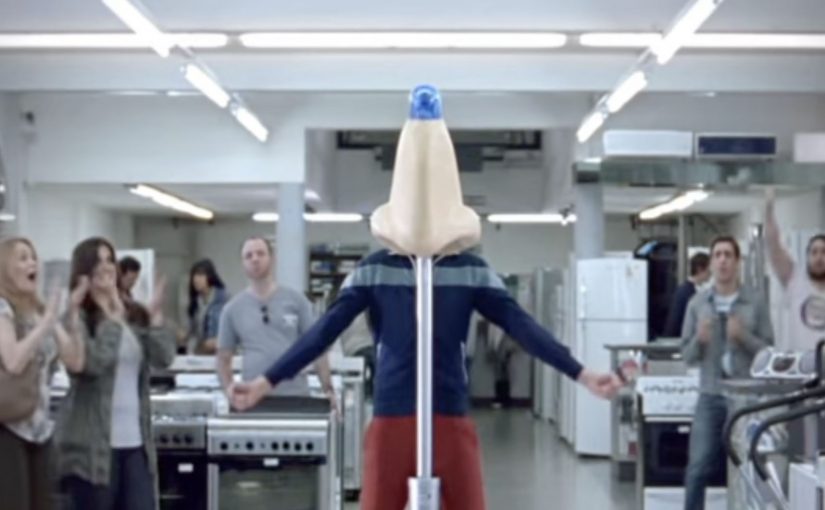
BGH Air Conditioners in Argentina wanted to promote their new line of silent air conditioners. So agency Del Campo Nazca Saatchi & Saatchi came up with a whacky integrated campaign called “Big Nose”.
Together they created the Nose-O-Meter, an in-store device capable of measuring noses. If your nose was big enough to touch the sensor, an alarm would go off and you could win a 25 percent discount.
How the Nose-O-Meter mechanic works
The mechanism is a simple, physical test that turns a product message into a game. Try your luck in-store. Hit the sensor with your nose. Trigger the alarm. Unlock the discount. Online, visitors could upload a profile picture to see if their nose might qualify, and the site pointed shoppers to the nearest Nose-O-Meter location.
That works because a visible pass-or-fail moment makes the product story easy to grasp, repeat, and film in seconds.
In Latin American appliance retail, in-store stunts that turn a functional claim into a public, repeatable challenge can generate attention without needing heavy media spend.
Why it lands
It uses an instantly readable visual proxy. A “silent” product is hard to demonstrate in a store, but a loud alarm creates a memorable contrast that people talk about. The absurdity lowers the barrier to participation, and the discount gives a clear reason to play rather than just watch.
Extractable takeaway: When your benefit is hard to demo, build a playful proxy people can physically perform. Then attach a real reward so the joke converts into action.
What the campaign is really trying to do
The real question is whether a silly retail mechanic can make a hard-to-demonstrate product benefit talkable enough to drive store traffic and sales.
This is awareness plus retail movement. The Nose-O-Meter creates footfall and talk value. The online upload tool extends reach, adds a low-friction entry point, and helps direct people into stores where the discount can close the sale.
Retail activation cues worth borrowing
- Turn the claim into a test. A measurable moment is easier to film, share, and repeat.
- Design for spectators as well as players. Public stunts work when watching is entertaining and playing is simple.
- Use a two-step funnel. Lightweight online interaction that drives to a physical conversion point.
- Make the reward meaningful. A real discount keeps the activation from feeling like a pure gimmick.
A few fast answers before you act
What is Big Nose in one sentence?
An integrated BGH campaign where a Nose-O-Meter measures your nose in-store, and if it hits the sensor you win a 25 percent discount.
Why include an online photo upload tool?
It lets people self-check and engage remotely, then nudges them toward the nearest in-store device where the discount is actually won.
How does this connect to “silent” air conditioners?
It avoids a technical demo and instead creates a talkable stunt that carries the brand name and offer into conversation, then relies on the discount to drive purchase consideration.
What makes this more than a pure gimmick?
The mechanic ties the joke to a concrete retail reward, so participation has a practical payoff rather than ending as a laugh with no next step.
What is the main risk with humor-led retail activations?
If the mechanic is unclear or the reward feels small, people will watch and laugh but not convert. Clarity and payoff have to be immediate.