
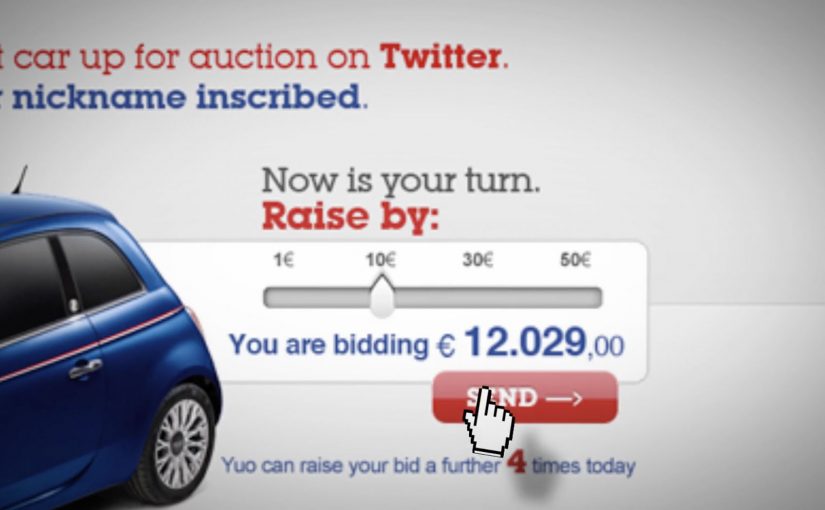
Fiat unveiled an exclusive limited edition run of 500 cars inspired by U.S. style at the Geneva Motor Show. Then, through a Twitter based auction, they made it possible to win the “number one” car (distinguished by a badge on the external pillar bearing the serial number 1/500 and the winner’s Twitter nickname) starting from a bid of €1.
To win the Fiat, participants were directed to follow @fiatontheweb on Twitter and then place a bid at www.500America.fiat500.com using their Twitter account. As a result, Fiat received 700 bids from 293 users, across 11 countries. A Twitter follower with a bid of €15,165 was declared the winner of the limited edition Fiat 500 America.
TwitBid turns a car launch into a public scoreboard
TwitBid is a Twitter-linked auction mechanic where each bid is tied to a visible handle. The smartest part is not the auction itself. It is the visibility layer. A bid is not a private transaction step. It becomes a social signal tied to an identity, which encourages escalation and turns the bidding ladder into content other people can watch unfold.
In brand launches with collector energy, mechanics that let fans compete in public create more momentum than mechanics that keep participation hidden.
What the mechanism is really doing
- Make entry frictionless. The opening bid starts at €1, which makes “having a go” feel low risk.
- Use identity as fuel. Bids are placed via Twitter, so the participant’s handle becomes part of the story.
- Turn the object into proof. The “number one” car carries a visible 1/500 marker and the winner’s nickname, which makes the win feel permanent and collectible.
In global consumer launches where scarcity is real, a public scoreboard can turn a product drop into shared entertainment.
Why it lands
The real question is whether your launch mechanic turns every participant move into something other people can see. Most automotive launches ask people to admire. This one asks people to compete. The auction format creates scarcity pressure, and the Twitter layer adds social proof. Even if you do not bid, you can still follow the narrative of who is winning and how high it goes.
Extractable takeaway: If you want real participation, attach identity to action and make progress public. People engage longer when their move is visible, comparable, and tied to status.
What Fiat is really buying with this
The obvious outcome is a high price for the first car. The deeper outcome is attention that behaves like earned media. Each bid acts like a micro-broadcast, and the “number one” badge ties the online moment back to a physical artifact. That is a clean bridge between social platforms and product storytelling.
Launch moves to copy from TwitBid
- Pick one scarce artifact. A single “first off the line” item is easier to explain than multiple prizes.
- Make the ladder visible. Competition needs a scoreboard, not a form.
- Build identity into the reward. A name, handle, or serialisation marker increases perceived ownership value.
- Engineer the minimum increment. Small step sizes keep the contest active and make it feel winnable.
A few fast answers before you act
What is TwitBid in plain terms?
It is a Twitter-linked online auction where people place bids using their Twitter account to compete for a specific limited-edition item.
Why tie bidding to Twitter instead of a normal auction site?
Because every bid is tied to an identity and can become visible in the social stream, which increases reach and reinforces the competition dynamic.
What makes the “number one” car feel more valuable than the other 499?
It is positioned as the first unit off the line and visibly marked with serial number 1/500 plus the winner’s nickname, which makes it a one-off collectible.
What is the biggest risk with social auctions?
Friction and trust. If sign-in, bidding, or confirmation steps are unclear, participation drops. If rules feel opaque, the brand takes reputational damage.
What should you measure if you run a similar mechanic?
Unique bidders, bids per bidder, bid velocity over time, conversion from followers to registrants, and how much incremental reach the bidding activity creates versus paid media.