
Pizza Hut: Pie Tops II

Pizza Hut: Pie Tops II

Pizza Hut is the official pizza of the NCAA, a men’s basketball tournament known informally as March Madness and played each spring in the United States.

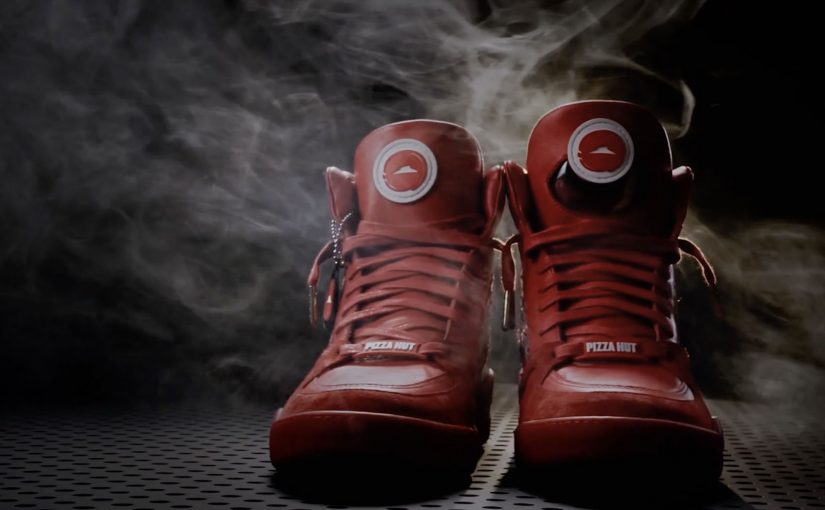
For last year’s tournament, Pizza Hut created what was billed as the world’s first shoe that ordered a pizza. Now, to celebrate their second year as the official pizza of the NCAA, Pizza Hut, Droga5 and the Shoe Surgeon launched Pie Tops II. It is a limited-edition high top shoe that not only uses your geolocation to order the current Pizza Hut deal at the press of a button, but also allows users to pause the game while they receive their delivery.

A TV ad has also been released to highlight the new pause feature of these newly relaunched Pie Top shoes.

A sneaker button that behaves like a remote

The mechanism is deliberately simple. Put a single button on the shoe. Tie it to an app. Map the press to two jobs: order, then pause. The shoe becomes a physical shortcut for a very specific March Madness moment, when people want food but do not want to miss play. That works because it removes friction at the exact moment attention is highest.

In second-screen sports viewing, the strongest interactions reduce interruption while keeping attention on the live game.

Why it lands on game day

Pie Tops II works because it converts a familiar tension into a prop. Hunger versus attention. Convenience versus FOMO. The “pause” feature turns a delivery problem into a punchline, and the shoe format makes the whole thing instantly tellable.

Extractable takeaway: If you can turn a high-frequency habit into a one-action ritual, you make the brand feel like part of the event, not just an ad around it.

The real intent behind the novelty

This is not really about footwear. The real question is how Pizza Hut earns a place inside the live ritual instead of advertising around it. It is about owning a behavior loop during March Madness. By behavior loop here, I mean a repeatable sequence of trigger, action, and reward that keeps the brand attached to the moment. Pizza ordering, deal recall, and a reason to talk about Pizza Hut in the same breath as the game. The smart move here is not the gadget but the way it turns brand utility into event behavior. Limited-edition scarcity does the rest, because it makes the product itself a piece of shareable culture.

What brands can steal from Pie Tops II

  • Pick one moment to own: design for a specific tension that happens repeatedly during an event, not for “sports fans” in general.
  • One control, two outcomes: a single action that triggers both utility and delight is more memorable than a complex feature list.
  • Make the object do the storytelling: the product should explain the campaign in one sentence, even without a logo.
  • Build viewer control into the idea: letting people keep the game in their hands makes the brand feel helpful, not interruptive.
  • Scarcity as distribution: limited runs can function like media spend when the object is inherently talkable.

A few fast answers before you act

What are Pie Tops II?

They are limited-edition Pizza Hut sneakers designed for March Madness that let you order pizza via a button press and, as described, pause the game while you wait for delivery.

What problem is this campaign solving?

It dramatizes a familiar game-day problem. People want food without missing play. The stunt turns that tension into a memorable product feature and a shareable story.

Why does the “pause” feature matter more than the pizza-ordering feature?

Ordering is convenient. Pausing is emotionally resonant because it speaks directly to FOMO during live sports. It is the twist that makes the idea travel.

Is this wearable tech or brand entertainment?

It is primarily brand entertainment packaged as a functional shortcut. The utility makes it credible. The novelty makes it worth talking about.

What is the reusable pattern for other brands?

Create a physical or tactile shortcut for a high-frequency moment. Keep the interaction to one obvious action. Then tie it to an event where people already have strong emotions and repeat behaviors.

The Kentucky Flying Object

The Kentucky Flying Object

KFC India turns a chicken box into a build-it-yourself tech toy. Select boxes for the newly announced Smoky Grilled Wings include the “Kentucky Flying Object,” also called “KFO,” a mini-drone you assemble yourself.

The limited-edition boxes are available in ten selected cities from January 25 to January 26.

If you receive one of the special boxes, you get your wings plus a fully functioning mini-drone, along with assembly instructions online at kfodrone.com.

The real question is whether your packaging can deliver a moment people want to prove, not just a message they can scan.

Why this is packaging-led “tech savvy” marketing

KFC is not adding a QR code or a one-off AR filter. It is putting the message inside the product experience. The packaging becomes the headline. The consumer gets something physical, surprising, and demonstrably “tech,” in the moment of consumption. Because the surprise is physical and immediate, it turns the claim into something people can demonstrate.

Extractable takeaway: “Tech savvy” marketing lands when the proof is inside the product experience, not bolted on as a scan, filter, or claim.

In quick-service restaurant marketing, packaging is often the only owned touchpoint guaranteed to be present at the moment of consumption.

This play is smart only if the object is safe, usable, and instantly explainable without a support ticket.

The behaviour it encourages

This is a meal that extends beyond eating.

  • Assemble.
  • Show someone.
  • Fly it.
  • Share the proof.

The drone is not just a giveaway. It is a social object that creates repeatable conversations, both offline and online. By “social object,” I mean a thing people naturally show, talk about, and pass around.

What to watch if you replicate this play

A high-novelty object inside a food pack raises immediate execution questions.

  • Safety and compliance. Especially around batteries, rotors, and usage guidance.
  • Availability clarity. Limited editions can frustrate if expectations are unclear.
  • Post-purchase support. Instructions, spare parts, and handling issues.

Make the pack the proof

  • Build the behaviour into the pack. If it cannot be assembled and shown in minutes, it will not travel.
  • Design for proof, not impressions. Give people something they can demonstrate, not just describe.
  • Pre-empt the three frictions. Safety guidance, availability clarity, and post-purchase support decide whether the stunt backfires.

A few fast answers before you act

What is the “Kentucky Flying Object”?

A limited-edition KFC India box concept where select Smoky Grilled Wings boxes include a DIY mini-drone.

When and where is it available?

In ten selected cities from January 25 to January 26.

What is the core marketing idea?

Turn packaging into the primary experience, then let the object create shareable proof that travels beyond the store.

Why is this stronger than adding a QR code or AR filter?

Because the “tech” proof is physical and immediate. It is experienced in-hand during consumption, then demonstrated, not just scanned or claimed.

What are the execution risks that decide whether it backfires?

Safety and compliance, availability clarity, and post-purchase support. If any of those fail, novelty turns into frustration.

Fiat 500 America: TwitBid Twitter Auction

Fiat 500 America: TwitBid Twitter Auction

Fiat unveiled an exclusive limited edition run of 500 cars inspired by U.S. style at the Geneva Motor Show. Then, through a Twitter based auction, they made it possible to win the “number one” car (distinguished by a badge on the external pillar bearing the serial number 1/500 and the winner’s Twitter nickname) starting from a bid of €1.

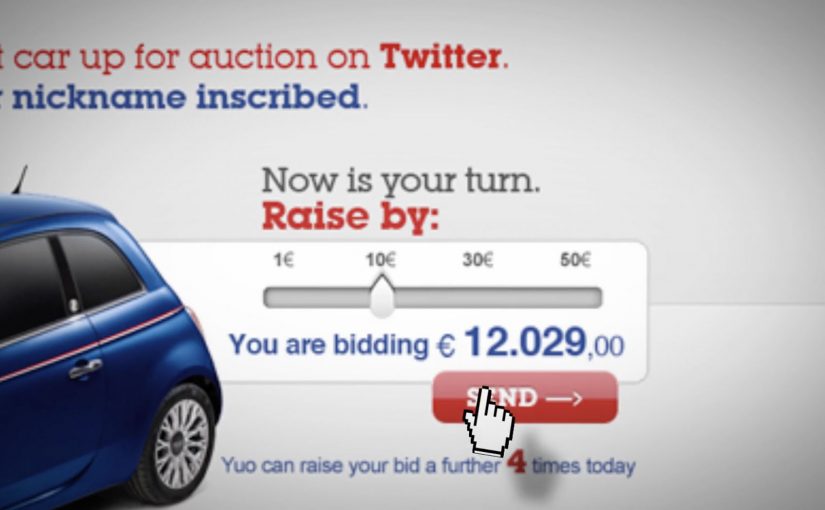
To win the Fiat, participants were directed to follow @fiatontheweb on Twitter and then place a bid at www.500America.fiat500.com using their Twitter account. As a result, Fiat received 700 bids from 293 users, across 11 countries. A Twitter follower with a bid of €15,165 was declared the winner of the limited edition Fiat 500 America.

TwitBid turns a car launch into a public scoreboard

TwitBid is a Twitter-linked auction mechanic where each bid is tied to a visible handle. The smartest part is not the auction itself. It is the visibility layer. A bid is not a private transaction step. It becomes a social signal tied to an identity, which encourages escalation and turns the bidding ladder into content other people can watch unfold.

In brand launches with collector energy, mechanics that let fans compete in public create more momentum than mechanics that keep participation hidden.

What the mechanism is really doing

  • Make entry frictionless. The opening bid starts at €1, which makes “having a go” feel low risk.
  • Use identity as fuel. Bids are placed via Twitter, so the participant’s handle becomes part of the story.
  • Turn the object into proof. The “number one” car carries a visible 1/500 marker and the winner’s nickname, which makes the win feel permanent and collectible.

In global consumer launches where scarcity is real, a public scoreboard can turn a product drop into shared entertainment.

Why it lands

The real question is whether your launch mechanic turns every participant move into something other people can see. Most automotive launches ask people to admire. This one asks people to compete. The auction format creates scarcity pressure, and the Twitter layer adds social proof. Even if you do not bid, you can still follow the narrative of who is winning and how high it goes.

Extractable takeaway: If you want real participation, attach identity to action and make progress public. People engage longer when their move is visible, comparable, and tied to status.

What Fiat is really buying with this

The obvious outcome is a high price for the first car. The deeper outcome is attention that behaves like earned media. Each bid acts like a micro-broadcast, and the “number one” badge ties the online moment back to a physical artifact. That is a clean bridge between social platforms and product storytelling.

Launch moves to copy from TwitBid

  • Pick one scarce artifact. A single “first off the line” item is easier to explain than multiple prizes.
  • Make the ladder visible. Competition needs a scoreboard, not a form.
  • Build identity into the reward. A name, handle, or serialisation marker increases perceived ownership value.
  • Engineer the minimum increment. Small step sizes keep the contest active and make it feel winnable.

A few fast answers before you act

What is TwitBid in plain terms?

It is a Twitter-linked online auction where people place bids using their Twitter account to compete for a specific limited-edition item.

Why tie bidding to Twitter instead of a normal auction site?

Because every bid is tied to an identity and can become visible in the social stream, which increases reach and reinforces the competition dynamic.

What makes the “number one” car feel more valuable than the other 499?

It is positioned as the first unit off the line and visibly marked with serial number 1/500 plus the winner’s nickname, which makes it a one-off collectible.

What is the biggest risk with social auctions?

Friction and trust. If sign-in, bidding, or confirmation steps are unclear, participation drops. If rules feel opaque, the brand takes reputational damage.

What should you measure if you run a similar mechanic?

Unique bidders, bids per bidder, bid velocity over time, conversion from followers to registrants, and how much incremental reach the bidding activity creates versus paid media.