
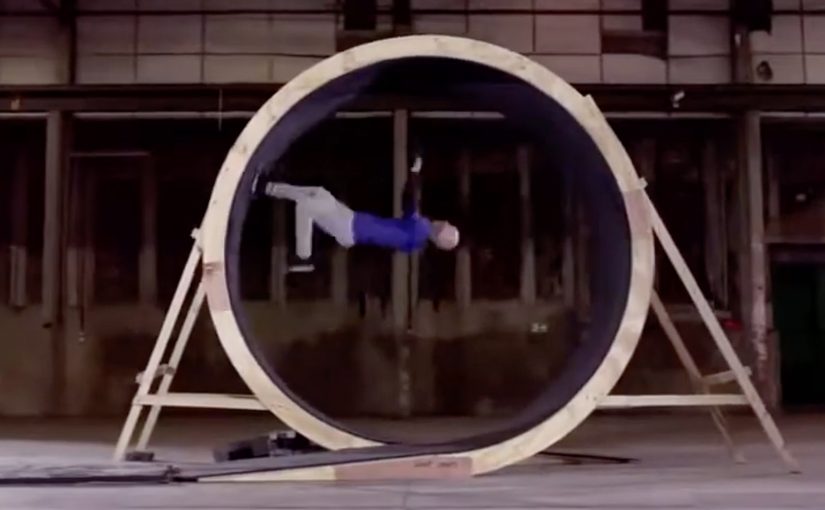
Last year, Pepsi Max for its ongoing #LiveForNow campaign created an unbelievable bus levitation stunt. Now continuing this “unbelievable feats and experiences” brand positioning, they challenged daredevil stuntman, Damien Walters to do another unbelievable stunt for them. Here, positioning means the single promise the brand wants people to remember and retell.
Pepsi Max provided Damien with a human-sized loop-the-loop in an abandoned warehouse and then got him to defy gravity for them…
In global FMCG marketing, stunts like this earn value when they reinforce an existing brand platform, not when they try to create one from scratch.
Why this stunt fits the brand
The mechanism is simple. A clearly defined physical challenge, executed by credible talent, makes the “unbelievable” promise feel real because the payoff is visible without narration.
Extractable takeaway: If your positioning is a claim, design one repeatable moment that functions as proof, then film it so the viewer can verify it without explanation.
- It commits to the promise. “Unbelievable” is not a line here. It is the product.
- It is instantly legible. You understand the challenge in one second, then you watch to see if it is possible.
- It is built for replay. Stunts invite rewatching, pausing, and sharing because people want to verify what they saw.
How to make the stunt behave like proof
The real question is whether your brand promise can be proven in one obvious moment on camera.
This kind of spectacle earns its keep only when it is a direct proof point for an ongoing platform, not a disconnected attempt at “random viral”.
If your positioning is about experiences, you need executions that behave like proof. This kind of spectacle works when the idea is simple, the talent is credible, and the payoff is visible without explanation.
- Make the promise behave like proof. If positioning is about experiences, the execution should demonstrate it, not describe it.
- Keep the idea simple and the payoff visible. The viewer should understand the challenge instantly and see the outcome without explanation.
- Use credible talent, then shoot for replay. Stunts invite rewatching, pausing, and sharing when people want to verify what they saw.
A few fast answers before you act
What is Pepsi Max “Human Loop”?
It is a Pepsi Max #LiveForNow stunt featuring Damien Walters attempting a human-sized loop-the-loop setup inside an abandoned warehouse.
Why does a loop-the-loop stunt perform so well in video?
The challenge is obvious, the risk feels real, and the outcome is visually conclusive, which makes it highly shareable.
What is the core pattern behind this kind of campaign?
Make the brand promise measurable in one moment, then capture it cleanly so the viewer does not need context to understand it.
How do you keep stunts from feeling like “random viral”?
Anchor them to an ongoing brand platform, use consistent talent and tone, and make each execution feel like a credible next chapter.
When should you avoid a stunt-led proof moment?
Avoid it when the idea cannot be understood instantly, the talent is not credible, or the execution does not ladder up to an ongoing brand platform.