
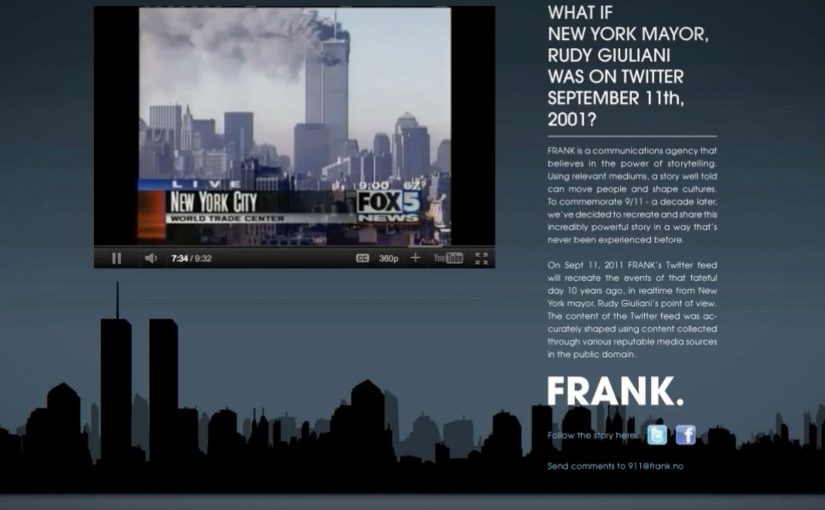
You follow a Twitter feed as if it is happening now. Updates arrive minute by minute, building confusion into urgency, then urgency into shock. The feed is written from New York mayor Rudy Giuliani’s point of view, and it recreates September 11, 2001 in real time.
FRANK is a communications agency from Oslo that wants to demonstrate the power of storytelling through the right medium. To commemorate 9/11 a decade later, they recreate and share the day as a live social stream experience.
On September 11, 2011, FRANK’s Twitter feed recreated the events of that day ten years earlier in real time from Giuliani’s point of view. The feed is described as being shaped using content collected from reputable public-domain media sources.
Real-time remembrance as a platform-native documentary
The mechanism is simple and specific. A single account publishes a paced sequence of posts that map to the original timeline, written in a constrained perspective, so the audience experiences the narrative in the same format they use for breaking news.
Here, platform-native means the story is built for the feed itself, not merely promoted through it.
In crisis and remembrance communications, real-time formats can make historical events feel immediate without changing the facts.
Why it lands
The power is in the temporal constraint. Real-time pacing prevents the viewer from jumping to the ending, which recreates uncertainty and heightens attention. The Giuliani viewpoint acts as a narrative spine, giving the stream a human decision-maker and a consistent voice, rather than a collage of headlines. It is a reminder that storytelling is not only what you tell, but also how you sequence it and where you let people experience it.
Extractable takeaway: If you want audiences to feel the weight of a known story, constrain the format. Pick one viewpoint, match the original timeline, and let pacing do what exposition cannot.
What the campaign is really doing
This is a proof of medium choice. The real question is whether the medium can carry remembrance with the same urgency as the original news cycle. Twitter is not used as a promotion channel. It is used as the container for the story. The campaign demonstrates that a platform-native structure can increase empathy and attention for complex events, while staying grounded in documented reporting.
What to steal from this real-time storytelling pattern
- Choose one perspective. A single viewpoint makes large events navigable and coherent.
- Use timing as a creative constraint. Real-time sequencing creates tension and attention without additional production.
- Build credibility into the sourcing. If you rely on archival material, describe your source discipline clearly.
- Match story to medium. The most persuasive channel is sometimes the format people already trust for “live” information.
A few fast answers before you act
What is FRANK Oslo’s “Giuliani 9/11” idea?
A real-time Twitter reconstruction of September 11, 2001 from Rudy Giuliani’s viewpoint, published ten years later to let audiences experience the timeline through a live-feed format.
Why use Twitter instead of a film or article?
Because the platform format is the point. A feed is how people experience unfolding events, so the campaign uses that native behavior to recreate pacing and uncertainty.
How does the single viewpoint help?
It creates narrative continuity. Viewers follow one decision-making perspective rather than switching between fragmented sources.
What is the main credibility requirement for this pattern?
Source discipline. If you claim accuracy, you need a clear method for selecting, verifying, and sequencing archival material.
When should you use real-time reconstruction?
When the goal is remembrance, education, or empathy, and when pacing and sequence are essential to understanding the human experience of the event.