
McDonald’s Reflective Billboard

You drive past a billboard during the day and see nothing. Then you pass it again at night, your headlights hit the surface, and a message appears. “Open all night.”

The idea. An ad you can only see at night

McDonald’s wanted to target people looking for a late night snack, so Cossette Vancouver created an ad that only showed itself when the audience was most likely to want it.

How reflective tape turns headlights into a reveal

Reflective tape was used to write “Open all night” on the billboard. The message was not visible during the day, but at night, with car headlights, it was revealed.

Why this works for late-night intent

This is behavioural targeting without data. The medium uses context. If you can see the message, you are already in motion at night. That makes the proposition feel timely, not intrusive.


A few fast answers before you act

What is the McDonald’s Reflective Billboard concept?

It is a billboard that stays visually “blank” in daylight, but reveals the line “Open all night” when car headlights hit reflective tape after dark.

Why is night-only visibility a smart creative constraint?

Because it aligns the message with the moment of need. People out late are more likely to want a snack, so the ad appears when intent is highest.

What is the key production technique here?

Using reflective tape to create a hidden message that only becomes legible under direct light sources like headlights.

What is the broader lesson for outdoor advertising?

Let context do the targeting. When the medium responds to time, light, or location, the message can feel personalised without collecting data.
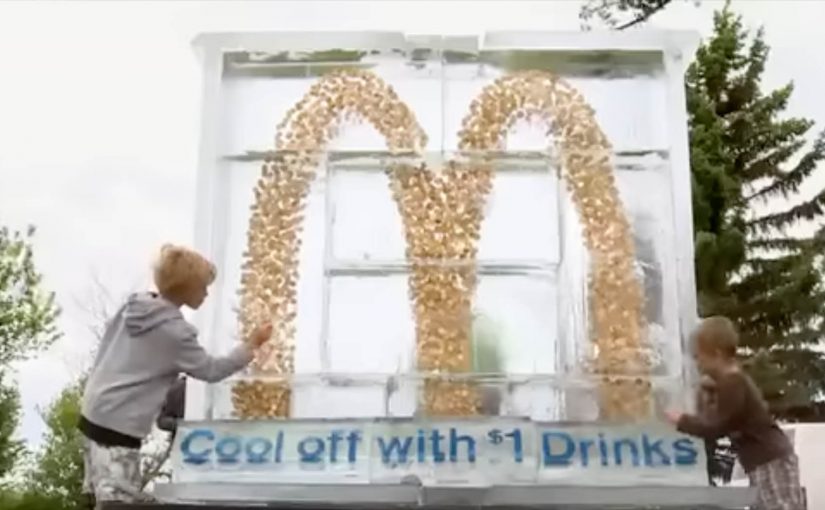
McDonald’s: Dollar Drink Days Ice Sculpture

McDonald’s Canada and Cossette Vancouver brought to life one of the first interactive ice sculptures this summer on behalf of McDonald’s Restaurants in Alberta. The objective was to drive consumer interest in the company’s Dollar Drink Days campaign.

Hosted in the town of Sylvan Lake, the stunt saw 8,000 pounds of ice moulded into a seven-foot tall installation containing over 4,000 sparkling loonies, shaped into McDonald’s famous Golden Arches. The ice melted on a summer Saturday, and consumers chipped away at the sculpture to collect their bounty.

To attract high levels of interaction, the sculpture was strategically placed near the Sylvan Lake Pier, an area frequented by young adults and families. The day also featured a DJ, street promotional teams, hula hooping, limbo contests and giveaways.

Why this activation pulls people in

  • A clear, physical payoff. The value is visible and tangible, and the “win” is earned through participation.
  • Built-in urgency. Melting ice creates a natural time limit, which pushes people to act now rather than “later”.
  • Placement does the heavy lifting. Putting it at a high-traffic summer spot turns curiosity into crowds.

What to take from it

This is a strong example of turning a price promotion into a real-world spectacle. Instead of telling people “Dollar Drink Days is on”, the brand created a moment people wanted to be part of, and then made participation the mechanism for reward.


A few fast answers before you act

What was the Dollar Drink Days ice sculpture?

It was a seven-foot interactive ice installation in Sylvan Lake, Alberta, shaped like the Golden Arches and packed with thousands of loonies for visitors to collect as it melted.

How did people interact with it?

As the sculpture melted during the day, people physically chipped away at the ice to reach the coins inside.

Why stage it near Sylvan Lake Pier?

The location is naturally busy with young adults and families in summer, which increases footfall and keeps participation high.

What is the core pattern worth reusing?

Give people one simple action that unlocks a tangible reward. Add a natural deadline, and stage it where the right crowd already gathers.