

Formula E: Leap of Faith

A race car comes up fast from behind. Damien Walters cannot see it. He commits anyway, throwing a backflip that clears the car at speed, landing as if it is routine.

Watch the perfectly synchronised leap below.

One trick, built on timing discipline

The mechanic is simple to describe and hard to execute. A blind backflip over a moving Formula E car. What makes it work is timing control. The driver holds a consistent approach speed, and the stunt is triggered off a repeatable timing reference so the flip happens at the exact moment the car reaches the take-off zone.

In sports branded content, the cleanest way to earn attention is to stage a single, unmissable proof where human skill and the sport’s technology meet in the same frame.

Why it lands

This is a spectacle with a clear question and a clear answer. Can he do it. Then, there it is. The real question is whether the stunt can make precision feel visible rather than merely claimed. The “blind” constraint adds tension because it removes the most obvious safety cue, and the viewer instinctively runs the risk calculation while watching. The payoff is the feeling of precision, not chaos. It reads less like danger for danger’s sake and more like controlled performance.

Extractable takeaway: If your story is “this is high-performance and precise,” build a moment where the viewer can see precision as a binary outcome, and keep the framing uncluttered enough that nobody misses the proof.

What Formula E gets out of it

The stunt borrows the language of elite motorsport. Speed, control, engineering, nerve. It also gives Formula E an easily shareable “you have to see this” asset that travels beyond core racing fans, while still feeling native to the category.

What to steal from the stunt

  • Make the promise visible. Translate “precision” into a single, legible pass or fail moment.
  • Add one constraint that increases tension. Blind, one-take, fixed distance, single attempt. Keep it understandable.
  • Keep the shot honest. The simpler the framing, the more the audience trusts what they are seeing.
  • Design for replay. If the moment is short and clean, people will rewatch and repost without needing context.

A few fast answers before you act

What is “Leap of Faith” in one sentence?

A branded stunt film where Damien Walters performs a blind backflip over a speeding Formula E car with tight timing synchronisation.

What makes the stunt feel different from a normal trick shot?

The car approaches from behind, so the timing has to be pre-controlled rather than visually adjusted, which raises tension and makes precision the headline.

Why does this format work for a sports brand?

It communicates the sport’s core attributes, speed and control, in a compact proof that is understandable even to non-fans.

What is the main creative risk?

If the production feels over-edited or overly cinematic, audiences question authenticity and the share impulse drops.

When should you use a “single proof moment” idea like this?

When your brand story is performance-based and you can express it as one unmistakable action that holds attention in the first three seconds.
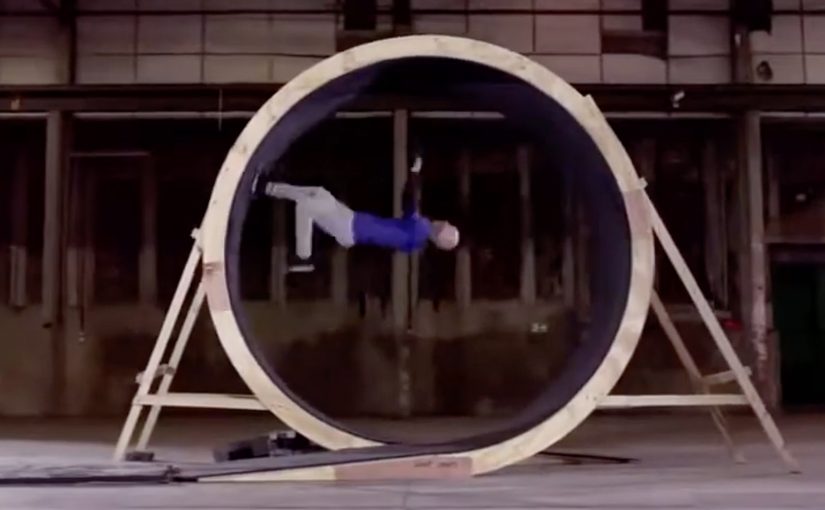
Pepsi Max: Human Loop

Last year, Pepsi Max for its ongoing #LiveForNow campaign created an unbelievable bus levitation stunt. Now continuing this “unbelievable feats and experiences” brand positioning, they challenged daredevil stuntman, Damien Walters to do another unbelievable stunt for them. Here, positioning means the single promise the brand wants people to remember and retell.

Pepsi Max provided Damien with a human-sized loop-the-loop in an abandoned warehouse and then got him to defy gravity for them…

In global FMCG marketing, stunts like this earn value when they reinforce an existing brand platform, not when they try to create one from scratch.

Why this stunt fits the brand

The mechanism is simple. A clearly defined physical challenge, executed by credible talent, makes the “unbelievable” promise feel real because the payoff is visible without narration.

Extractable takeaway: If your positioning is a claim, design one repeatable moment that functions as proof, then film it so the viewer can verify it without explanation.

  • It commits to the promise. “Unbelievable” is not a line here. It is the product.
  • It is instantly legible. You understand the challenge in one second, then you watch to see if it is possible.
  • It is built for replay. Stunts invite rewatching, pausing, and sharing because people want to verify what they saw.

How to make the stunt behave like proof

The real question is whether your brand promise can be proven in one obvious moment on camera.

This kind of spectacle earns its keep only when it is a direct proof point for an ongoing platform, not a disconnected attempt at “random viral”.

If your positioning is about experiences, you need executions that behave like proof. This kind of spectacle works when the idea is simple, the talent is credible, and the payoff is visible without explanation.

  • Make the promise behave like proof. If positioning is about experiences, the execution should demonstrate it, not describe it.
  • Keep the idea simple and the payoff visible. The viewer should understand the challenge instantly and see the outcome without explanation.
  • Use credible talent, then shoot for replay. Stunts invite rewatching, pausing, and sharing when people want to verify what they saw.

A few fast answers before you act

What is Pepsi Max “Human Loop”?

It is a Pepsi Max #LiveForNow stunt featuring Damien Walters attempting a human-sized loop-the-loop setup inside an abandoned warehouse.

Why does a loop-the-loop stunt perform so well in video?

The challenge is obvious, the risk feels real, and the outcome is visually conclusive, which makes it highly shareable.

What is the core pattern behind this kind of campaign?

Make the brand promise measurable in one moment, then capture it cleanly so the viewer does not need context to understand it.

How do you keep stunts from feeling like “random viral”?

Anchor them to an ongoing brand platform, use consistent talent and tone, and make each execution feel like a credible next chapter.

When should you avoid a stunt-led proof moment?

Avoid it when the idea cannot be understood instantly, the talent is not credible, or the execution does not ladder up to an ongoing brand platform.