
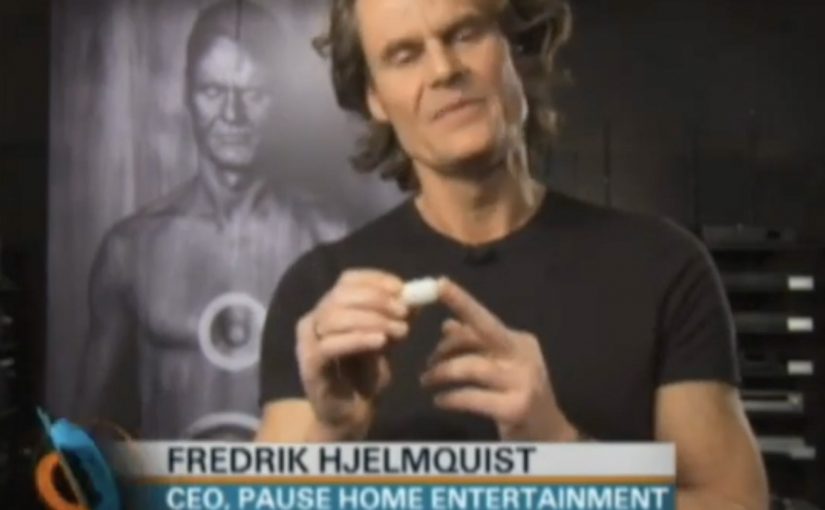
On 26 November 2010, Fredrik Hjelmquist, CEO of Pause Home Entertainment, is described as swallowing a specially made wireless sound system to transform himself into a Human Jukebox, a person whose body becomes the live playback point for the stunt.
The device is then controlled wirelessly. Anyone can trigger music “inside him” by visiting the company website and selecting a track. The stunt exists to make one claim feel literal. When it comes to custom sound systems by Pause, anything is possible.
How the Human Jukebox mechanism is staged
The mechanic is built around an extreme demo. Put the product promise into a body. Add a remote interface. Make the public the operator. The point is not technical detail. The point is a story so concrete that people can repeat it in one sentence. That works because a concrete, repeatable image is easier to remember and retell than a broad capability claim.
In consumer electronics and specialist retail, physical proof beats specification sheets when the goal is to signal “custom” and “no-limits” in a way people actually remember.
Why it lands
It makes the brand promise impossible to ignore. The act is absurd, slightly uncomfortable, and therefore sticky. It also turns a passive viewer into a participant, because the audience is invited to choose the track and trigger the result.
Extractable takeaway: If you sell “anything is possible”, show a single, outrageous proof point that compresses the promise into an unforgettable image, then give the audience a simple way to control the outcome.
What Pause is really buying
This is not about reach first. It is about credibility and talk value. The real question is whether the brand can turn “custom” from a vague service claim into a story people repeat. A custom sound systems retailer needs to feel like a destination for people who care about uniqueness, and a stunt like this functions as a shortcut to that perception.
What to steal for your own product story
- Demo the promise, not the product. Show the meaning of the benefit in one memorable scene.
- Make the audience the trigger. When people can activate the outcome, they feel ownership and retell it more.
- Keep the rules simple. One action. One result. No explanation required.
- Build a proof artifact. A single film that captures the idea cleanly is the distribution unit.
A few fast answers before you act
What is the core idea of Human Jukebox?
A stunt that turns a person into a playable sound system, controlled by the public through a simple track-selection interface.
Why does this communicate “custom sound systems” effectively?
Because it demonstrates extreme customization as a story. The audience infers capability from the proof, without needing specs.
What makes the mechanic shareable?
It is summarizable, visual, and slightly shocking. Those traits make it easy to retell and hard to forget.
Why does audience control matter here?
Because letting people choose the track makes the proof participatory, not just watchable. That increases involvement and makes the stunt easier to remember and repeat.
What is the main risk in copying this approach?
If the stunt feels unsafe or irresponsible, the brand pays for attention with trust. The proof must still feel controlled and credible.