
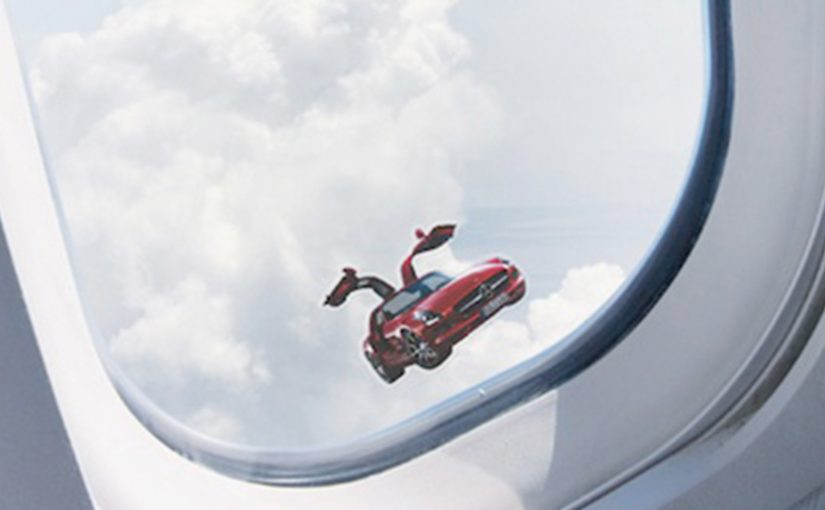
Mercedes-Benz, with the help of Ponto de Criacao from Brazil, executed a highly segmented vertical action to increase visibility for the brand among top executives and business people. Here, “vertical action” means a narrowly targeted activation placed in a single corridor that concentrates the exact audience you want.
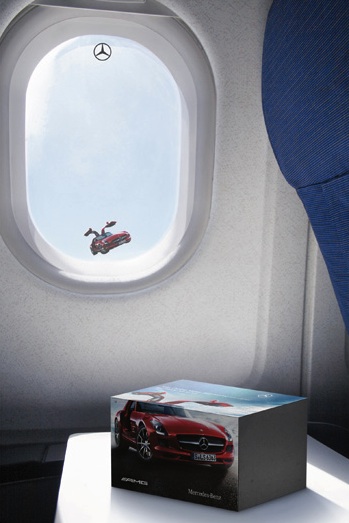
As a courtesy, passengers also received a miniature car.
In one month, 100% of the target audience was reached, nearly 400 executives.
In premium automotive marketing aimed at senior business travelers, attention is scarce and context is often the only reliable way to earn it.
When the audience is this narrow and valuable, precision distribution can outperform broad reach because the placement becomes the idea.
Why this placement is so effective
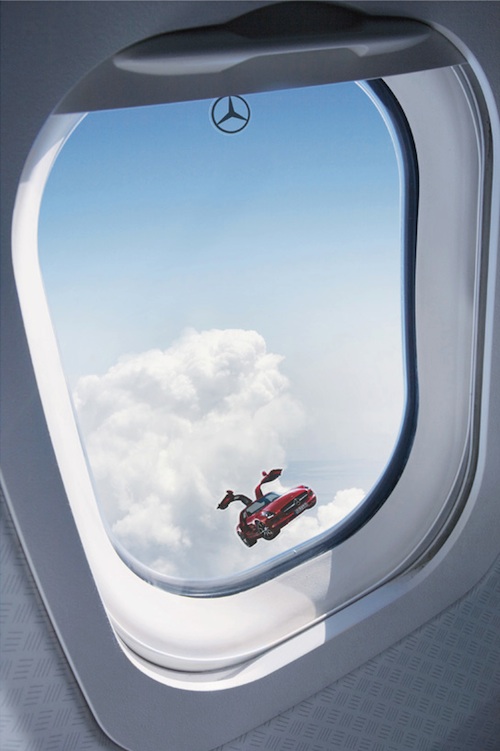
The mechanism is simple and the payoff is immediate. By turning the aircraft window into the “media unit,” the mind completes the illusion, which makes the moment feel native, surprising, and worth retelling.
Extractable takeaway: When your audience is concentrated in a repeatable corridor, design a message that only works in that context so the situation does the persuasion for you.
- Context does the work. The illusion only makes sense in-flight, which turns a standard window view into a brand moment.
- Precision beats scale. Shuttle flights concentrate the exact audience Mercedes-Benz wanted, without wasting impressions.
- Low friction, high memorability. A simple sticker creates an instant “did you see that?” effect, then the miniature car extends the memory.
What to take from it
The real question is which high-value corridor your audience repeats, where attention is naturally high, and where your message can feel native instead of intrusive.
When the audience is narrow and valuable, distribution can be the idea. This activation did not rely on complex tech. It relied on selecting the right corridor, placing the message where attention is naturally high, and creating a visual that feels native to the moment.
- Start with the corridor. Identify the repeatable moment where your audience is already together and already looking.
- Make the context do the explaining. Build the visual so it only makes sense there, so the placement becomes the punchline.
- Extend the memory. Add a small, simple takeaway that keeps the moment alive after the corridor ends.
A few fast answers before you act
What was “Flying Car” by Mercedes-Benz?
It was a targeted activation that placed SLS AMG window stickers on shuttle flights, creating the illusion of the car “flying” outside the aircraft window for executive travelers.
Why use shuttle flights for this?
Because those routes clustered top executives and business travelers, delivering near-perfect audience fit with minimal wasted reach.
What role did the miniature car play?
It extended the experience beyond the flight as a physical takeaway, reinforcing recall after the moment passed.
What is the transferable pattern?
Pick a narrow, high-value corridor, design a context-native visual that only works there, then add a small extension to carry the memory forward.
How do you apply this pattern without access to flights?
Find any repeatable corridor that concentrates your audience, then design a context-native cue that only works in that moment and can be carried forward with a simple takeaway.