
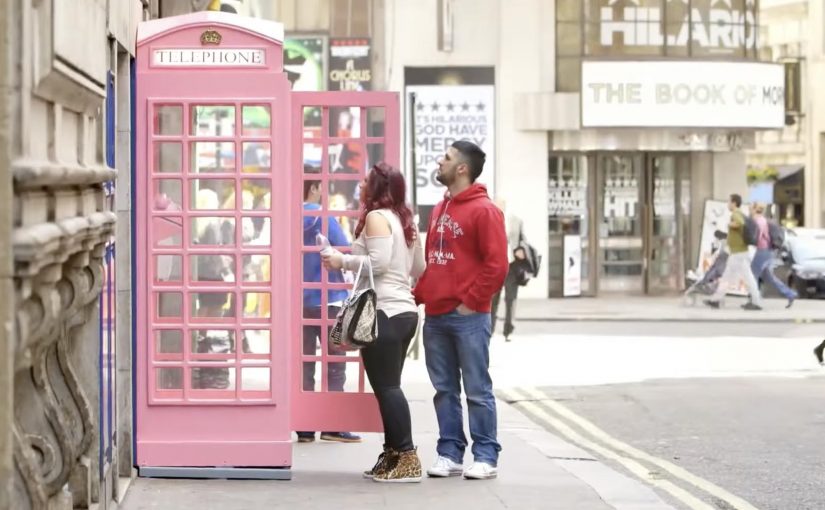
Benefit Cosmetics: Temptation Telephone

‘Ring ring…’ A pink telephone starts ringing in the middle of London. The question is simple. Do you pick it up.

Benefit Cosmetics places a pink phone booth on a busy street for a day and turns the call into a dare. If you answer, you are pulled into a pop-up “celebrity moment”. A quick makeover, then a trip to Café de Paris where you are pushed onto the stage to sing Whitney Houston’s “I Wanna Dance With Somebody” with a live band in front of a packed room.

The temptation mechanic

The mechanism is built around a single micro-decision, meaning one small public choice with immediate consequences. Answering a ringing phone in public. The payoff is immediate escalation. You are not given a flyer or a discount. You are given a story you will retell. The booth, the ring, the dare, the stage. The whole thing is designed to transform a passerby into the headline.

In beauty retail and experiential marketing, the fastest way to earn attention is to convert curiosity into a socially shareable moment that makes the participant feel chosen.

Why it lands

This works because it exploits a universal impulse. Most people want to know what happens if they answer. The booth creates theatre, the ringing creates urgency, and the venue creates legitimacy. That sequence works because the first action feels harmless, while the public payoff turns a passing impulse into a memorable story. The participant does not feel like they “took part in advertising”. They feel like they got a once-only experience, which is exactly what makes the footage feel authentic and replayable.

Extractable takeaway: When you can own a clear “dare”, design it around a tiny public action with a big, fast reward, then stage the reward somewhere iconic so the story carries your brand without further explanation.

What Benefit Cosmetics is really selling

The real question is whether Benefit can make confidence feel like something you step into, not something you buy. Benefit is not really selling makeup here. It is selling permission to be bold. The makeover is a prop. The real product is the feeling of stepping into the spotlight for ten minutes.

What to steal from Benefit’s temptation loop

  • Engineer a single, obvious trigger. One action. One choice. Answer or walk past.
  • Pay off immediately. Curiosity dies fast. Reward it fast.
  • Borrow an iconic container. A recognizable venue turns a stunt into “a real event”.
  • Make the participant the content. Their nerves and laughter do more than scripted copy ever will.

A few fast answers before you act

What is Benefit’s “Temptation Telephone”?

A one-day street activation where a ringing pink phone booth lures passersby into answering, then escalates into a makeover and a live on-stage performance at Café de Paris.

Why does the ringing phone work as a trigger?

Because it creates an unavoidable question. Who is calling. What happens if I answer. That curiosity produces voluntary engagement.

What role does Café de Paris play in the idea?

It supplies instant credibility and spectacle. The venue makes the payoff feel like a “real night out”, not a brand demo.

What makes this feel shareable rather than staged?

The participant’s reaction arc. Hesitation, commitment, then performance. Viewers watch to see whether the person goes through with it.

When is this pattern a good fit?

When your brand can credibly promise confidence, fun, or transformation, and you can deliver a fast, memorable payoff tied to a single public decision.
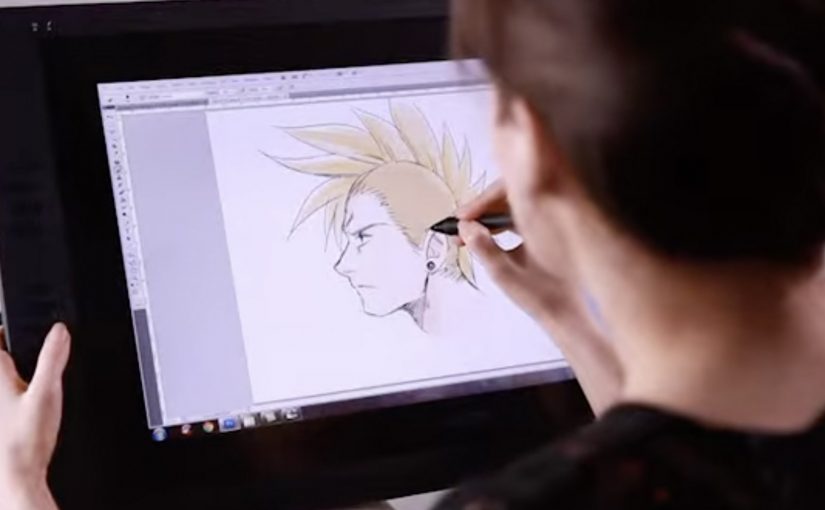
Wacom Inkling: paper sketches, digitized

Wacom is launching a cool new digital sketch pen for artists called the Inkling. This unique pen allows artists to draw or sketch on a standard piece of paper and then automatically have a digital version created.

The trick is that Inkling pairs a real ink pen with a small receiver that clips to your paper and records your strokes as you draw, so you can plug it into a computer later and bring the sketch into your digital workflow.

What Inkling changes in a familiar habit

Most artists already start with pen and paper because it is fast, portable, and forgiving. Inkling keeps that behaviour intact, but removes the “scan it later” step by capturing the drawing while it happens.

How the capture works in practice

  • Draw normally. You sketch with an actual ballpoint pen on regular paper.
  • Record quietly. The clipped receiver tracks each stroke and stores the sketch.
  • Transfer when ready. You connect the receiver to your computer and import the captured file for editing.
  • Refine digitally. The value shows up when you want to iterate, clean up, or reuse elements without redrawing from scratch.

In creative and design workflows, bridging paper-first sketching to digital editing keeps momentum for artists who think with their hands.

The real question is whether you can keep paper-first speed while still landing in edit-ready digital files.

Why it lands: it removes one of the most annoying handoffs

The friction is never “making the sketch”. The friction is getting that sketch into the tools where it becomes a layout, a storyboard, an illustration draft, or a presentation asset. Inkling makes the handoff feel like part of the act of drawing, not a separate job you do later.

Extractable takeaway: If you remove one ugly handoff between a familiar analog habit and a digital toolchain, you get adoption without asking creators to change how they start.

What Wacom is really selling here

This is not just a new pen. It is a bridge product that expands Wacom’s relevance beyond tablets and into the earliest moment of creation, when ideas are still raw and fast. A bridge product connects a trusted old workflow to a newer one, so users can cross without friction. Wacom is right to focus on the handoff, not on adding more pen features. If the first capture happens with Wacom, the next steps in the workflow are more likely to happen with Wacom-friendly tools too.

Takeaways for marketing creator tools

  • Respect existing habits. Do not force a new behaviour when the old one already works.
  • Remove a single painful step. “No scanning” is a clearer benefit than a long list of features.
  • Sell the workflow, not the gadget. The story is speed from idea to editable file.
  • Show the before and after. Demos work best when viewers can see the exact handoff being eliminated.

A few fast answers before you act

What is Wacom Inkling?

It is a digital sketch pen system that lets you draw on regular paper with real ink while capturing a digital version of the sketch for later transfer to a computer.

Do you need special paper to use Inkling?

No. The idea is that you sketch on standard paper while a clipped receiver records your strokes.

How do you get the sketch onto your computer?

You connect the receiver to your computer and import the stored sketch so it can be edited digitally.

What is the main benefit compared to scanning?

You skip the “capture later” step. The sketch is already recorded as you draw, which makes it faster to move from rough idea to editable file.

Who is this best suited for?

It fits artists and designers who start on paper for speed, then want to refine, iterate, or reuse parts of the sketch digitally without redrawing everything.