An SOS written by a living swarm
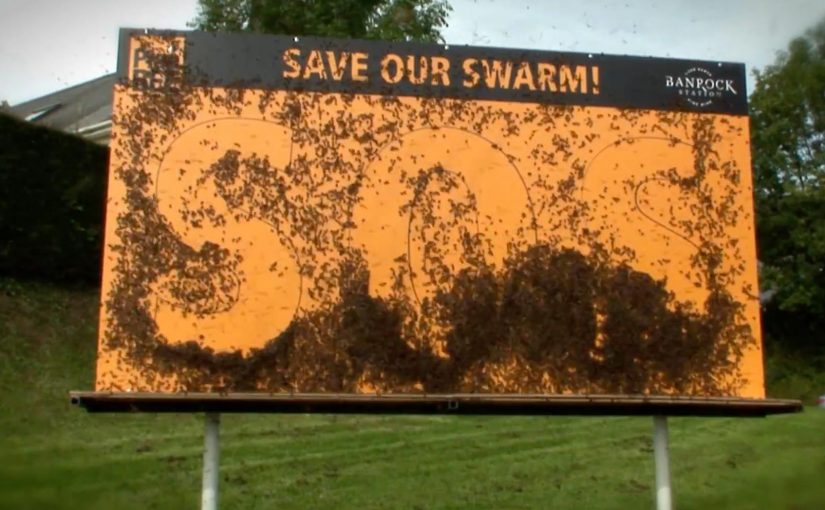
Honey-bee populations are mysteriously dwindling worldwide. In England, the Banrock Station winery created what it described as the world’s first ad with live bees to call attention to the problem.
Using queen-bee pheromones, the team attracted a giant swarm of bees, as many as 100,000, from a nearby honey farm to spell out an “SOS” message on a billboard.
Queen-bee pheromones are chemical signals that draw worker bees toward what they perceive as the queen’s location, making it possible to guide where a swarm clusters.
How it works: make the message unavoidable
The mechanism is blunt and brilliant. Use the medium itself as proof. A billboard about bees becomes a billboard made of bees, so the problem is not explained. It is witnessed.
In UK cause marketing, a conservation message that becomes a public spectacle can travel faster because it creates a stoppable moment people feel compelled to verify and share.
Why it lands: it turns concern into a physical reaction
This works because it compresses a complex topic into one immediate sensation. Surprise first, meaning second. You see the swarm, you read “SOS”, and only then do you connect it to the decline story.
Mechanism to why sentence: because the billboard is literally formed by the subject of the campaign, the message feels less like persuasion and more like evidence, which increases attention and recall.
The business intent: build salience and fund the cause
The film earns awareness, but it also links the stunt to action. Banrock Station also donates 5p to the honey-bee cause for every bottle sold, turning attention into a measurable contribution.
What to steal if you want cause marketing to feel real
- Make the medium the proof. If you can embody the issue in the execution, you do not need long explanation.
- Design for a “verify it” reaction. People share what they feel they need to show others to be believed.
- Connect attention to a concrete contribution. Pair the story with a simple, trackable give-back mechanic.
- Keep the message legible at a glance. “SOS” works because it is instantly readable even before context arrives.
Extractable takeaway: The most effective cause marketing often turns an abstract problem into a physical moment, then ties that moment to a simple action that funds or advances the cause.
A few fast answers before you act
What is Banrock Station’s “live bees billboard” in one sentence?
An out-of-home awareness piece that uses a real, visible “live bees” element to make the environmental message feel tangible rather than symbolic.
What is the core mechanism?
The medium becomes the proof. The execution embodies the issue in a way passers-by can immediately see, which makes the story inherently shareable.
Why does this kind of cause marketing earn attention?
Because it triggers a “verify it” reaction. People are more likely to share something they feel others need to see to believe.
What business intent does it serve beyond awareness?
It links brand meaning to a concrete, memorable moment, and can be paired with a trackable give-back or action mechanic to convert attention into contribution.
What is the most transferable takeaway?
If you can turn a cause into a physical, legible proof-point, you reduce explanation and increase both recall and retellability.