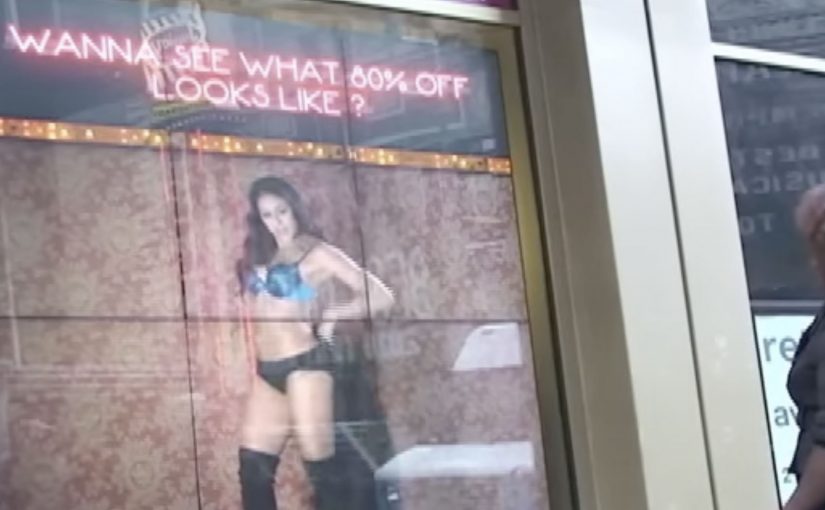
You are walking past a Daffy’s store window in Manhattan and it looks like a fashion show has moved onto the street. Models are inside the display. A crowd is outside. And the public is controlling what happens by text message.
Daffy’s is a fashion retailer from NYC. For their fall fashion launch, they created a street-level event that blended window shopping, a fashion show, and an interactive peep show, meaning passers-by could text outfit requests to models inside while the exchange played out publicly on the glass, to create live interaction from hundreds of passers-by for an entire day and night.
The idea was simple. Put great-looking models in the window with items from the new range. Ask the public at street level to text a special number for each model, requesting specific items to try on and then change out of. Each message was projected onto the store window, letting the crowd follow the conversation, while the models used phones to interact with people on the street.
That shift from window to stage is what turns a shopfront into a live media channel when footfall competes with endless distractions.
Why the mechanism pulls a crowd
The mechanism is a tight loop. You text. Your message appears publicly. The model responds with an immediate, visible action. That creates instant feedback, plus social proof, because everyone can see that participation changes the experience.
Extractable takeaway: When participation is public and the response is immediate, bystanders become an audience because they can see cause and effect in real time.
It also turns fashion into a game with a scoreboard you can read. The projected message stream makes the crowd feel like a single audience, not scattered individuals passing by.
In high-traffic retail corridors, the format works best when the interaction loop is visible to everyone, not just the person who texts.
What Daffy’s is really buying
This is not just “engagement” for its own sake. It is earned attention at street level, then a shareable story that travels beyond the location. The activation is designed to make people stop, watch, talk, and tell others to come over.
The real question is whether you are designing for fast, visible participation that creates social proof, or just staging a spectacle.
This pattern is worth copying only when you can keep the loop tight and keep people safe once the crowd forms.
According to Daffy’s communications, more than 1,500 text messages were received between 6:00 p.m. and 9:30 p.m., and the event was suspended twice by NYC police due to crowd overflow impacting pedestrian and vehicle traffic.
Practical takeaways for interactive storefronts
- Make the audience the controller. Participation should change something real, not just “send a message”.
- Project the input publicly. Visibility creates social proof and gives bystanders a reason to join.
- Design for fast feedback. The shorter the gap between action and response, the bigger the crowd gets.
- Let the store be the medium. If the window is already the brand’s stage, use it as one.
A few fast answers before you act
What was Daffy’s “Undressing Room”?
A storefront window event where passers-by texted requests to models inside the window, and the messages were displayed publicly so the crowd could follow along in real time.
Why does projecting messages onto the window matter?
It turns private participation into a public feed. People see that the experience is live, and that others are actively shaping it, which increases curiosity and crowd growth.
What’s the core interaction design pattern here?
Public input plus immediate physical response. The text is the trigger. The window action is the payoff.
What makes this more effective than a normal fashion show?
Viewer control. People do not just watch. They influence what happens, and that makes them more likely to stay, share, and bring others.
What’s the biggest operational risk with this kind of activation?
Crowd control. If the moment works, it attracts more people than a normal storefront can safely handle, so permits and on-site management matter.