
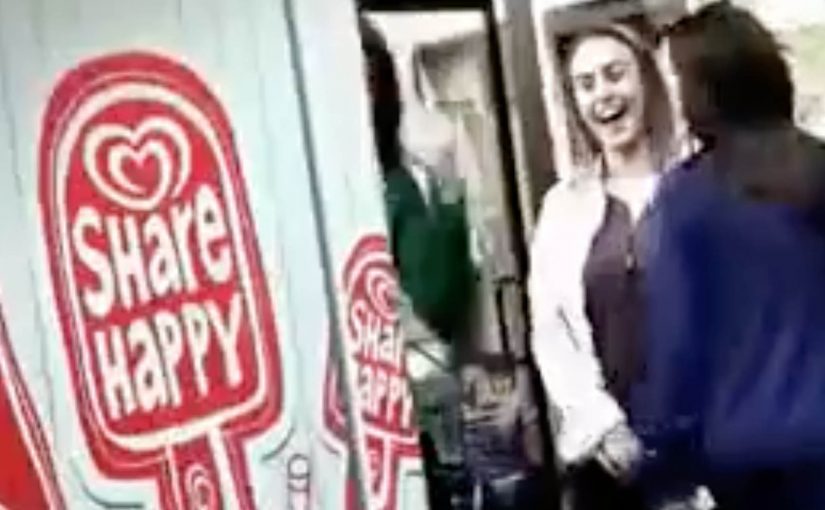
Share Happy Ice Cream Machine

You approach an ice cream machine that refuses to work for a solo person. It only dispenses when two people participate together. The reward is simple. Free ice cream. The behaviour it creates is even simpler. Ask someone nearby to join you.

The idea. Turn a freebie into a shared ritual

Most giveaway machines are built for speed. Press, receive, leave. Share flips the script. The machine makes cooperation the trigger, so the brand message is performed in public rather than stated on a poster.

Why this mechanic works

It removes awkwardness. People have a reason to talk to strangers, and the machine becomes the icebreaker. The shared reward also creates a shared story, which is why these activations often travel well on social. Here, the mechanic is simply the rule people must follow to unlock the reward.

Extractable takeaway: When the reward depends on two people, the brand turns participation itself into proof of the idea.

Buy interaction, not just sampling

In crowded retail and event environments, the hard part is not handing out samples, but giving strangers a reason to interact in public.

The real question is not whether a free ice cream can attract attention. It is whether the brand can turn that attention into a memorable social behaviour.

Share gets that right, because the interaction is the media, not just the reward.

Steal this from the teamwork mechanic

  • Make the rule obvious before people arrive. People should understand from a distance that this only works together.
  • Keep the action physical and quick. The longer the interaction takes, the more the social energy drops.
  • Make the reward immediate. Fast payoff is what turns a small interaction into a satisfying public moment.
  • Judge success by interactions, not just giveaways. The stronger metric is how many micro-connections the brand creates between people.

A few fast answers before you act

What is the Happy Ice Cream Machine?

It is a vending-machine-style activation that dispenses free ice cream only when people participate together, so the reward is tied to cooperation.

Why require two people?

Because it forces a social moment. The brand message becomes a behaviour. Sharing is not a slogan. It is the unlock mechanism.

What makes this kind of activation spread?

It is easy to understand on video. Two strangers team up, the machine responds, and the payoff is instant. That simplicity travels.

Where does this work best?

It works best in places with natural foot traffic and a low barrier to joining in, such as retail zones, festivals, campuses, and public events.

What should you measure?

Participation pairs per hour, average dwell time, repeat attempts, and the share rate of user-generated clips during the activation window.
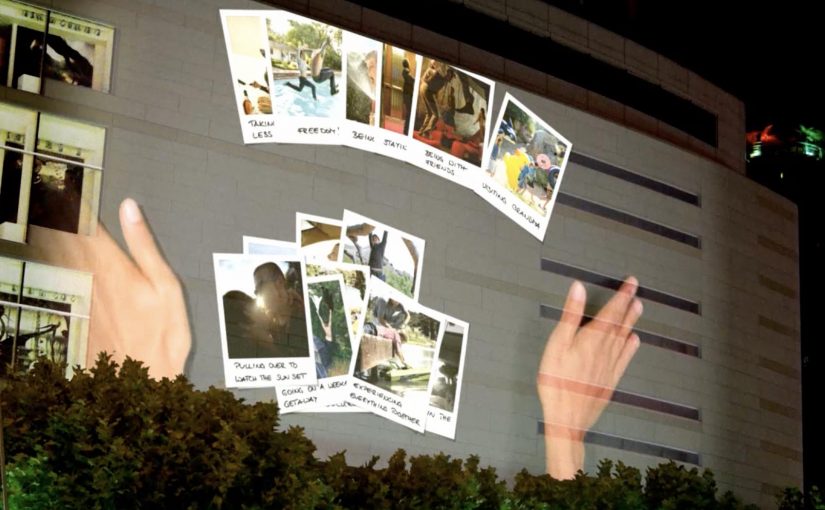
Volvo: There’s More to Life, in 3D

Volvo is pushing past the “cold Swedish marque” perception and leaning into an emotion-led brand campaign built around a disarming line: “There’s more to life than a Volvo.”

The campaign print ad sets up a string of human moments, then lands the message back on the car with a safety punchline. “There’s not running into the car ahead of you, in your XC60. That’s why you drive one.”

Germany gets a very different kind of treatment. A 3D projection in Frankfurt turns the thought into a public spectacle, produced by NuFormer in cooperation with Saatchi & Saatchi.

When the brand line needs public proof

Projection mapping, sometimes called 3D video mapping, is the practice of aligning animated light to the exact geometry of a building facade so the architecture appears to move, fold, or transform. Here, it becomes a storytelling canvas for an emotion-led repositioning. By public proof, I mean a shared, observable moment that demonstrates the brand promise in the real world.

Across European automotive brand building, public-space spectacle is often used to make an abstract shift in perception feel immediate and shared.

Why this execution fits the line

“There’s more to life than a Volvo” only works if it feels like an invitation, not a lecture. The projection format helps because it is experiential rather than declarative. It lets the audience feel the campaign instead of being told about it.

Extractable takeaway: If a repositioning line asks for emotion, design the experience so the audience lives the feeling first, then let the product proof arrive as the payoff.

It also reframes safety. Safety is still the payoff, but it arrives after life. The story says: live fully. Then rely on the car to take care of you when the unpredictable happens.

The real craft move

The real question is whether your repositioning can be experienced, not just stated.

This is branded content without pretending to be entertainment content. The execution does not hide the brand. It earns attention through novelty in public space, then uses that attention to make the line stick as a memory.

Turn a repositioning line into proof

  • Pick a line that can carry a scene, not just a tagline. If you can imagine it as an experience, you can build with it.
  • Translate the message into a physical moment, so “brand shift” becomes something people witness together.
  • Keep the emotional arc intact. Life first, product proof second. That order is the strategy.
  • Use one technical definition inside the story, so audiences and answer engines can repeat what the format is and why it matters.

A few fast answers before you act

What is projection mapping, in plain terms?

It is a technique where projectors are calibrated to a building’s shape so animated visuals appear to interact with the architecture, creating a 3D illusion.

Why use a 3D projection for a brand line?

Because it makes an intangible message tangible. A public moment gives a repositioning scale, memorability, and social proof.

How does this support Volvo’s safety story without leading with safety?

It frames safety as enabling life, not replacing it. The campaign invites emotion and spontaneity, then lands on protection as the reason the promise is credible.

What is the key risk with spectacle-led brand work?

If the spectacle is not anchored to a single, repeatable line, people remember the show and forget the meaning. The message must be retellable in one sentence.

What should be measured to judge effectiveness?

Unaided recall of the line, brand attribute shift toward “modern” and “engaging,” plus amplification signals like organic shares and press pickup tied to the execution.