
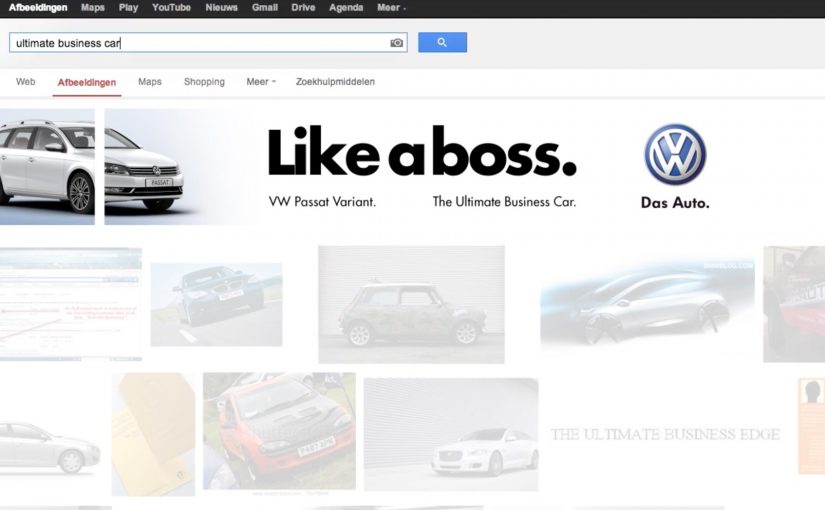
When the “ad” is the search results page
Everyday millions of people are searching for products and brands on Google. So in this latest example of search optimisation, SEA Team from UK created a search engine advertising campaign for Volkswagen which positioned the car in a unique “organic ad” created by optimising the first five individual URLs of a Google Image Search.
By “organic ad” here, I mean unpaid image results arranged to read like a single designed creative.
The campaign does feel realistic but when I searched for “ultimate business car”, I got only images from people posting about the campaign.
The hack: assemble a creative out of ranked tiles
The idea is essentially compositional SEO. By compositional SEO, I mean deliberately ranking separate assets so the grid reads as one coherent “ad.” You do not buy a placement. You engineer multiple image results so the interface itself becomes the creative. The medium is the interface people already trust.
In consumer brands and automotive marketing, this only holds when the search behavior is stable enough to be predictable.
Why it is both clever and fragile
It feels native because it lives inside an everyday behavior. Searching. But the moment the campaign becomes the story, the query gets polluted. That contamination is when coverage and commentary replace the normal mix of competing results.
Extractable takeaway: If your “creative” depends on organic authenticity, assume the interface will amplify attention first and destroy repeatability second.
What this is really trying to achieve
The real question is whether you can borrow organic credibility without turning the query into a PR artifact.
Borrow the credibility of organic results while delivering the impact of a designed creative. A brand moment that lives exactly where intent lives. It is clever, but I would not treat it as a repeatable acquisition lever.
Steal the container, not the banner
- Use interface-level creativity. Sometimes the container is the canvas.
- Plan for contamination. Once the stunt spreads, organic authenticity degrades fast.
- Choose mechanics that survive attention. Pick queries where the effect can outlive press and copycats.
A few fast answers before you act
What was the Volkswagen “organic ad” concept?
A campaign that optimized the first five source URLs in a Google Image Search so the image grid formed a single Volkswagen creative.
Was this paid search?
No. The idea is to engineer multiple image results so the grid becomes the creative, rather than buying a placement.
Who created it?
The post credits SEA Team from the UK.
Why does it feel realistic at first?
Because it appears inside an organic search behavior and uses the familiar image-results interface as the placement.
What problem did the post observe when trying it later?
Searching for “ultimate business car” returned mostly images of people posting about the campaign, rather than a clean, normal-looking result set.