
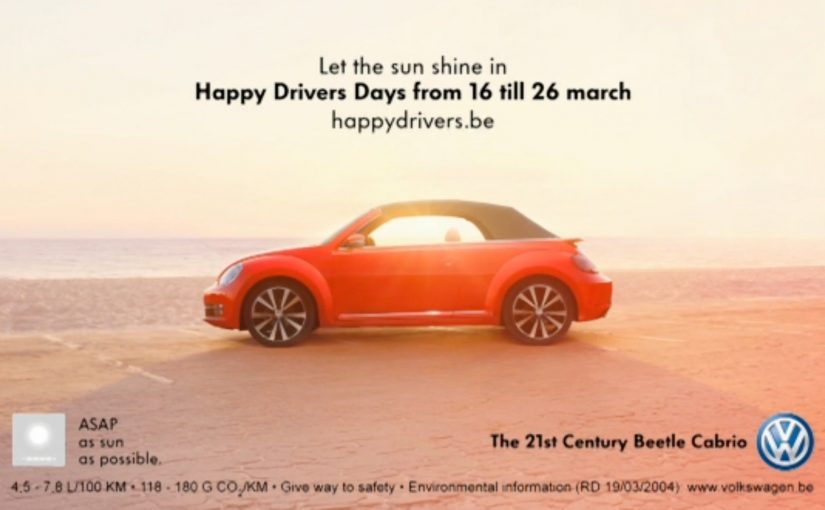
Volkswagen Beetle: Slowmercial

A lot of people fast-forward TV commercials when watching time-shifted shows. So Volkswagen took the opposite approach and made a deliberately slow, almost static “slowmercial”. In this context, a slowmercial is a TV ad engineered to stay legible when it is played back at high speed.

The idea is simple. When the spot is fast-forwarded on a TV recorder, it collapses into something that feels like a print ad. A single, readable message. A clear product reveal. No complicated storyline to miss.

A tv spot designed for 8x speed

This is not “slow motion” for cinematic drama. It is time engineered as a media format. The frames are composed to hold meaning when they blur together, and the copy and visuals are built to survive the exact behavior viewers use to avoid ads. Because the frames stay stable and the typography stays readable, fast-forward still delivers a complete message instead of noise.

In DVR-heavy TV markets, the remote control is the real media buyer.

Why it lands

It respects the viewer’s habit without pretending it will change. Instead of trying to stop skipping, it designs for skipping. That creates a rare feeling of cleverness, because the ad meets you where you are, and still gives you a complete message. The deeper lesson is that “attention” is not binary. The real question is whether your creative is engineered for how people actually watch, not how you wish they watched.

Extractable takeaway: Treat attention as a spectrum and design one primary message that stays readable under partial attention.

Business intent: keep the message intact

Brands should design for skipping instead of trying to shame or trick viewers into watching. The intent is straightforward. Protect the core benefit and the product impression in a world where traditional 30-second storytelling gets shredded by fast-forward. The slowmercial approach makes sure the Beetle remains visible and understandable, even when the viewer refuses to watch properly.

Steal this for skip-proof creative

  • Design for the behavior, not the ideal. If people skip, build a format that works while skipping.
  • Make one message unmissable. One benefit. One visual proof. One clean takeaway.
  • Borrow from print discipline. Composition, hierarchy, and legibility beat complexity.
  • Assume partial attention as default. Build creative that degrades gracefully instead of collapsing.

A few fast answers before you act

What is a slowmercial?

A slowmercial is a TV ad designed to work even when viewers fast-forward. It uses ultra-slow pacing and print-like composition so the message remains readable at high playback speeds.

Why does fast-forward turn this into a print ad experience?

Because fast-forward compresses time and removes nuance. If the creative is built around stable frames, clear typography, and a single message, the compressed playback still delivers a coherent visual and idea.

When should a brand use this approach?

When you know a meaningful portion of viewing happens time-shifted, and when the ad’s job is to deliver one clean message rather than tell a complex story.

What is the biggest creative mistake with “anti-skipping” ideas?

Over-engineering. If the concept requires explanation, it fails. The viewer must understand the message instantly, even in partial attention.

What metrics matter for this kind of creative?

Ad recall under time-shifted viewing, brand linkage, and message takeout. If you can test it, compare recall for normal-speed versus fast-forward exposure.
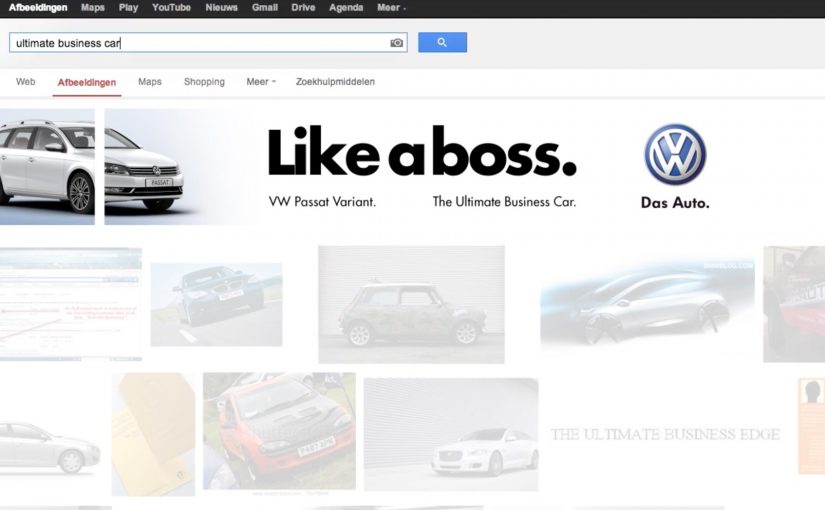
Volkswagen: Image Search SEO as an “Organic Ad”

When the “ad” is the search results page

Everyday millions of people are searching for products and brands on Google. So in this latest example of search optimisation, SEA Team from UK created a search engine advertising campaign for Volkswagen which positioned the car in a unique “organic ad” created by optimising the first five individual URLs of a Google Image Search.

By “organic ad” here, I mean unpaid image results arranged to read like a single designed creative.

The campaign does feel realistic but when I searched for “ultimate business car”, I got only images from people posting about the campaign.

The hack: assemble a creative out of ranked tiles

The idea is essentially compositional SEO. By compositional SEO, I mean deliberately ranking separate assets so the grid reads as one coherent “ad.” You do not buy a placement. You engineer multiple image results so the interface itself becomes the creative. The medium is the interface people already trust.

In consumer brands and automotive marketing, this only holds when the search behavior is stable enough to be predictable.

Why it is both clever and fragile

It feels native because it lives inside an everyday behavior. Searching. But the moment the campaign becomes the story, the query gets polluted. That contamination is when coverage and commentary replace the normal mix of competing results.

Extractable takeaway: If your “creative” depends on organic authenticity, assume the interface will amplify attention first and destroy repeatability second.

What this is really trying to achieve

The real question is whether you can borrow organic credibility without turning the query into a PR artifact.

Borrow the credibility of organic results while delivering the impact of a designed creative. A brand moment that lives exactly where intent lives. It is clever, but I would not treat it as a repeatable acquisition lever.

Steal the container, not the banner

  • Use interface-level creativity. Sometimes the container is the canvas.
  • Plan for contamination. Once the stunt spreads, organic authenticity degrades fast.
  • Choose mechanics that survive attention. Pick queries where the effect can outlive press and copycats.

A few fast answers before you act

What was the Volkswagen “organic ad” concept?

A campaign that optimized the first five source URLs in a Google Image Search so the image grid formed a single Volkswagen creative.

Was this paid search?

No. The idea is to engineer multiple image results so the grid becomes the creative, rather than buying a placement.

Who created it?

The post credits SEA Team from the UK.

Why does it feel realistic at first?

Because it appears inside an organic search behavior and uses the familiar image-results interface as the placement.

What problem did the post observe when trying it later?

Searching for “ultimate business car” returned mostly images of people posting about the campaign, rather than a clean, normal-looking result set.

Volkswagen Canada: The Great Art Heist

They say that beauty is in the eye of the beholder. But if Volkswagen Canada has their say, beauty will be in the hands of the person who’s stealing it. That is the idea behind this ambient-meets-social campaign for the Volkswagen Jetta GLI.

Since the beginning of October, agency Red Urban has created a series of pop-up art galleries across major cities in Canada that feature “light paintings” made by the movement of the Volkswagen Jetta. These light paintings are long-exposure photographs that turn headlight and taillight trails into abstract artwork.

While the frames in the exhibits have been hung for all to admire, they have not been hung that securely, allowing more daring admirers to claim the artwork for themselves. The “thieves” are then asked to share their stolen items via Tweets and Facebook posts. Volkswagen Canada’s Facebook page starts receiving photos from fans decorating homes and offices with the imagery.

When out-of-home becomes a participation prompt

The mechanism is a deliberate temptation loop. By that, I mean the setup places something desirable in public and makes acting on that impulse part of the idea. Place desirable objects in public. Make them easy to take. Then turn the taking into the call to action, with social sharing as the proof layer. The “gallery” is the stage. The heist is the interaction. The reposted photos are the distribution.

In automotive launch marketing, giving people something physical to claim and display can turn attention into advocacy faster than conventional ads.

The real question is how to turn a static display into an action people want to repeat and publicize.

Why it lands

This works because it flips the normal rules of outdoor advertising. Instead of “look at this and move on”, the frame invites a decision and a story. The act of taking the artwork creates instant ownership, and ownership makes people far more likely to post, discuss, and keep the brand in the room. The strongest move here is not the gallery format but the permission to take the media home.

Extractable takeaway: If you can transform a passive medium into a “take it, show it” mechanic, you convert exposure into participation. Participation creates proof, and proof drives organic reach.

What to steal from this activation

  • Make the object desirable on its own: if the item is genuinely display-worthy, people will do the promotion for you.
  • Use a single rule: “take it and share it” is easy to understand and easy to repeat.
  • Build for accumulation: the more stolen pieces show up online, the more the campaign feels real and alive.
  • Let the audience finish the media buy: the repost is the real multiplier, not the initial placement.
  • Manage the ethics upfront: the line between playful permission and real theft must be unambiguous in execution.

A few fast answers before you act

What is the “Great Art Heist” idea?

It is a pop-up street gallery of framed “light painting” photos tied to the Volkswagen Jetta GLI, where passersby are implicitly encouraged to take a frame and share it socially.

What are “light paintings” in this campaign?

They are long-exposure photographs capturing the car’s headlight and taillight trails, producing abstract, art-like images.

Why does encouraging people to take the artwork work?

Because it creates ownership and a personal story. Once someone has the piece, sharing becomes natural and the brand becomes part of their environment.

Is this more out-of-home or more social?

Both. Out-of-home provides the physical trigger and scarcity. Social sharing provides proof and scale.

What is the biggest risk with a “steal it” mechanic?

Misinterpretation. If permission is not clear, the idea can feel irresponsible. The execution must make the intended rules obvious to avoid negative backlash.