
Aldo: Ring My Bell

Aldo: Ring My Bell

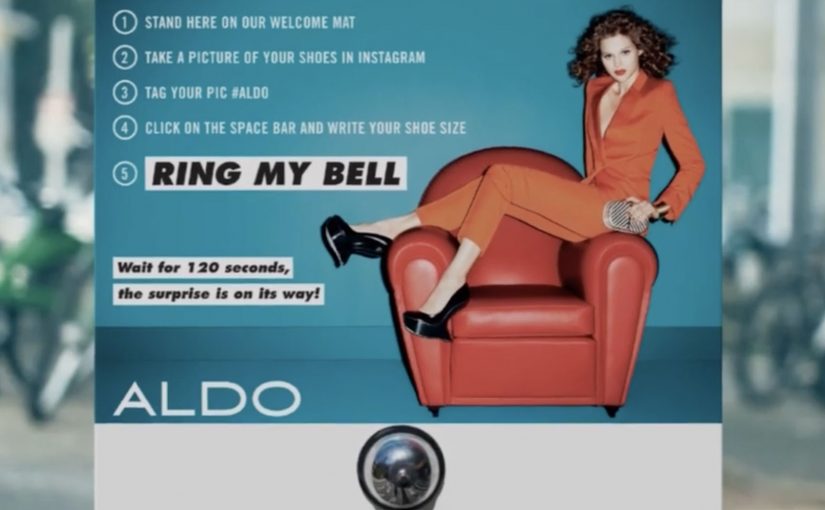
You stand on a welcome mat in the middle of the street, photograph your shoes, post to Instagram with #ALDO, add your shoe size, then ring a bell and wait 120 seconds. If you complete the steps, you get a surprise gift.

How the stunt turns a hashtag into a real-world trigger

The mechanism is a five-step participation script, a fixed sequence of actions that any passer-by can copy, that converts street curiosity into a trackable social action. The welcome mat marks the “stage”. The Instagram post captures proof and size data. The bell is the commitment moment. The 120-second wait creates tension. Then the brand pays off with a physical surprise delivered to the participant.

In high-footfall urban shopping streets where social posting is second nature, the fastest activations are the ones that turn a simple post into an immediate, tangible reward.

Why it lands

This works because it is friction-light and outcome-heavy. The instructions are short enough to follow at a glance, and the payoff happens quickly enough that the crowd stays to watch. The bell and countdown also make the moment public, which naturally pulls in the next participant.

Extractable takeaway: If you want social behaviour in the wild, write the participation flow like a street recipe. One clear prompt, one proof action, one suspense beat, one fast reward.

What the brand is really buying

The real question is not whether a hashtag can spread, but whether it can trigger a public action that proves the reward is real. This is less about reach in the abstract and more about engineered proof. By engineered proof, the brand makes the promised reward visible in real time so the next person believes it will work for them too. People do not just see a poster. They see someone trigger a reward in real time, which makes the campaign feel trustworthy and repeatable.

What to steal from a street-triggered reward loop

  • Make the call-to-action executable in under a minute. Anything slower loses passers-by.
  • Use a public commitment moment. A bell, button, or scan turns observers into a queue.
  • Time-box the suspense. The 120 seconds creates attention and crowd energy.
  • Design the payoff for spectators too. The best street rewards recruit the next person automatically.

A few fast answers before you act

What is “Ring My Bell”?

A street activation where pedestrians post a shoe photo to Instagram with #ALDO and their size, ring a bell, wait 120 seconds, then receive a surprise gift.

What is the core mechanism?

A simple participation script that links a social post to a physical reward, with a short countdown to keep attention on-site.

Why collect shoe size in the post?

So the reward can be prepared or matched quickly, and so the brand can fulfill immediately without follow-up friction.

What makes this work as OOH?

It turns signage into an interaction, and it makes the result visible to everyone nearby, which creates instant social proof on the street.

What is the safest reusable lesson?

Build an offline-to-online loop where the social action is the trigger, and the reward is fast enough to be witnessed in the moment.
ERAN: When Facing Distress, Dial 1201

ERAN: When Facing Distress, Dial 1201

Here is a campaign from ERAN, the National Crisis Intervention Hotline in Israel.

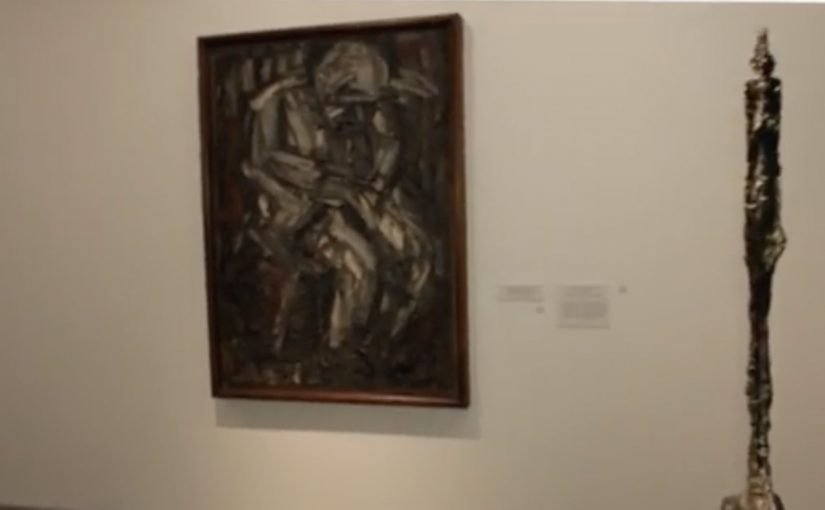
To make people aware of the 1201 hotline, McCann Erickson worked with the Israel Museum in Jerusalem. They identified paintings that express distress, then changed each artwork’s audio guide number to 1201. Dialing that number on the guide gives visitors a customized message that mirrors the emotion of what they are looking at, while quietly pointing to the same number outside the museum.

A hotline reminder that hides in plain sight

The trick is that nothing feels like advertising at first. You are already in “audio guide mode”. You are already entering numbers. The campaign simply reroutes a familiar behavior into a moment of recognition, then uses the artwork’s emotional weight to make the number stick.

How the mechanism earns attention without shouting

This is ambient marketing built from context rather than volume. The museum provides the emotional frame. The audio guide provides the interface. The number provides the bridge between cultural experience and real-world help. It is a one-step interaction, and the message arrives when the viewer is already primed to feel.

Because the visitor is already using the guide as intended, the intervention feels credible rather than intrusive, which makes the number easier to absorb and remember.

In public service communication, the most effective prompts often appear inside routines people already trust, so the call-to-action feels like guidance rather than persuasion.

Why it lands

It lands because it changes the meaning of a number. “1201” stops being a hotline you may never need, and becomes a small, memorable experience tied to a specific feeling and a specific place. The museum setting also lowers defensiveness. People expect reflection, not selling, so they are more open to receiving a supportive message.

Extractable takeaway: If you can place a helpline inside an existing, legitimate interface, and align it with an emotionally resonant context, you turn awareness into recall without relying on fear or shock.

What ERAN is really doing here

This is recall engineering. That means designing a vivid cue so a critical number is easier to remember when it matters.

The real question is how to make a crisis number memorable before someone actually needs it.

ERAN is right to optimize for respectful recall over louder awareness. The value is not the interaction itself. The value is that a visitor leaves with a number that now has emotional meaning.

What to borrow from this hotline recall design

  • Borrow an interface people already use. Audio guides, ticketing kiosks, vending machines, any trusted routine.
  • Let context do the targeting. The environment pre-qualifies the emotional state and attention level.
  • Keep the action to one step. The smaller the action, the higher the completion.
  • Design for respectful tone. Supportive beats sensational when the topic is distress.
  • Make the recall object simple. A short number, a clear phrase, one job.

A few fast answers before you act

What is the core idea of “When Facing Distress, Dial 1201”?

Turn museum audio guide numbers into a hotline reminder by assigning “1201” to distress-themed artworks and delivering supportive messages through the guide.

Why use a museum as the medium?

Because visitors expect emotion and reflection. That context makes the message feel natural, and it helps the number attach to a real feeling rather than a generic PSA.

What makes this more memorable than a poster?

The viewer performs an action. They dial the number. That small act creates muscle memory and meaning, which improves recall later.

What is the biggest execution risk?

If the experience feels like it interrupts the museum visit or trivializes the artworks, it can trigger backlash. The tone has to stay respectful and restrained.

How can other causes apply this approach?

Find a trusted public interface, align the message with the environment’s emotional purpose, and make the action so simple it can happen without instruction.

LG: My Wife Smashed My TV

LG: My Wife Smashed My TV

A husband walks in the door, does what he always does, and reaches for the TV. This time, his wife beats him to it, smashing the set in front of him.

LG takes that familiar “couch potato” tension and turns it into a candid-camera series. Five households are set up with hidden cameras while the men are away at work. When they return, the TV gets destroyed, and the immediate reactions are captured on film. The footage becomes five viral videos that were reported to reach over 200,000 views on Flix, described as a leading video host in Israel.

The stunt mechanic

The mechanic is a controlled, in-home prank with a single, irreversible trigger. The TV is smashed in real time, the reaction is the content, and the series format multiplies the shareable moments across multiple “types” of husband responses.

In consumer electronics marketing, tapping into a real household ritual can make a product story travel further than feature claims because it feels like lived culture, not advertising.

Why it lands

The idea works because it is instantly legible. Everyone understands the setup in one second, and the shock produces unscripted emotion. The campaign also benefits from a simple moral frame. The TV is the symbol of the habit, so breaking it reads like breaking the routine. That makes each clip feel like a punchline people can retell without context.

Extractable takeaway: If your category is part of a daily habit, build the story around the habit itself, and let genuine reactions do the persuasion work that scripted messaging usually struggles to earn.

What LG is really buying

The real question is whether surprise can turn a familiar domestic ritual into a brand story people want to retell. LG is buying talkability here, not just views. It inserts LG into a domestic conversation about screen time and routines, then uses surprise and authenticity to earn distribution on platforms where polished product films are easy to ignore.

Takeaways from LG’s reaction-led stunt

  • Use a single clear trigger. One decisive moment creates an easy hook and a clean thumbnail narrative.
  • Design for repeatability. A series lets you capture variation, not just one lucky reaction.
  • Keep the framing simple. The fewer moving parts, the more credible the reactions feel.
  • Plan the ethical boundaries early. Surprise can work, but only if consent, safety, and aftercare are treated as part of the production, not an afterthought.

A few fast answers before you act

What is “My Wife Smashed My TV”?

A candid-camera series where wives smash their husbands’ TVs when they come home, capturing authentic reactions and packaging them as viral clips.

Why does the idea spread so easily?

Because the setup is universal and the payoff is immediate. The audience understands the relationship dynamic instantly, then watches the unscripted reaction.

What did the campaign claim as a result?

The legacy write-up reports over 200,000 views on Flix for the set of videos.

What is the main risk with prank-based advertising?

If it feels cruel, unsafe, or non-consensual, the attention flips into backlash and the brand becomes the villain of the story.

When is a reaction-led format a good fit?

When your message can be carried by a recognizable everyday situation, and the emotional response communicates the point better than exposition.